Introduction
The story of the Birth of Geography cannot be told without mentioning Eratosthenes, one of the greatest scholars of the ancient Greek world. Living during the 3rd century BCE, Eratosthenes made groundbreaking contributions to geography, mathematics, astronomy, and literature. His work transformed geography from simple descriptions of lands and travelers’ stories into a scientific discipline based on measurement, observation, and logical reasoning.
Today, many historians call Eratosthenes the father of geography because he was among the first scholars to study the Earth systematically. His famous calculation of the Earth’s Circumference demonstrated how mathematics could be used to understand the planet’s size and shape. Along with his innovative thinking, discoveries such as the Sieve of Eratosthenes highlight his broad intellectual curiosity and deep Mathematics Contributions.
Working as the chief librarian of the Library of Alexandria, one of the greatest centers of knowledge in the ancient world, Eratosthenes had access to countless texts and scientific observations. Using this information, he developed ideas that were centuries Ahead of His Time, laying the foundation for modern geography.
Who Was Eratosthenes?
Eratosthenes was born around 276 BCE in Cyrene, a Greek city in present-day Libya. He studied in Athens, where he learned philosophy, mathematics, poetry, and astronomy. His wide range of interests earned him a reputation as a polymath—a person skilled in many different fields.
Later, he was invited to Egypt by the ruler Ptolemy III to become the chief librarian at the Library of Alexandria. This position placed him at the center of intellectual life in the Hellenistic world.
While working there, he conducted research that would influence many fields, including geography. His most famous achievement—calculating the Earth’s Circumference—demonstrated how mathematical thinking could solve large scientific questions.
At the same time, his creation of the Sieve of Eratosthenes showed his ability to develop clever mathematical techniques, further adding to his long list of Mathematics Contributions.
Geography Before Eratosthenes
Before the time of Eratosthenes, geography was largely based on travel stories, myths, and rough descriptions of distant lands. Ancient writers such as Homer and Herodotus described different regions of the world, but their works were not scientific maps or measurements.
Maps were often inaccurate, and distances between places were rarely calculated with precision. Most people believed the Earth was spherical, but few attempted to measure it.
This situation began to change with the work of Eratosthenes, who applied mathematical reasoning to geographical problems. By combining observation with geometry, he transformed geography into a scientific discipline.
This transformation marks the true Birth of Geography as a field of study.
Measuring the Earth
One of the most famous achievements of Eratosthenes was his calculation of the Earth’s Circumference. His method demonstrated how geography and mathematics could work together.
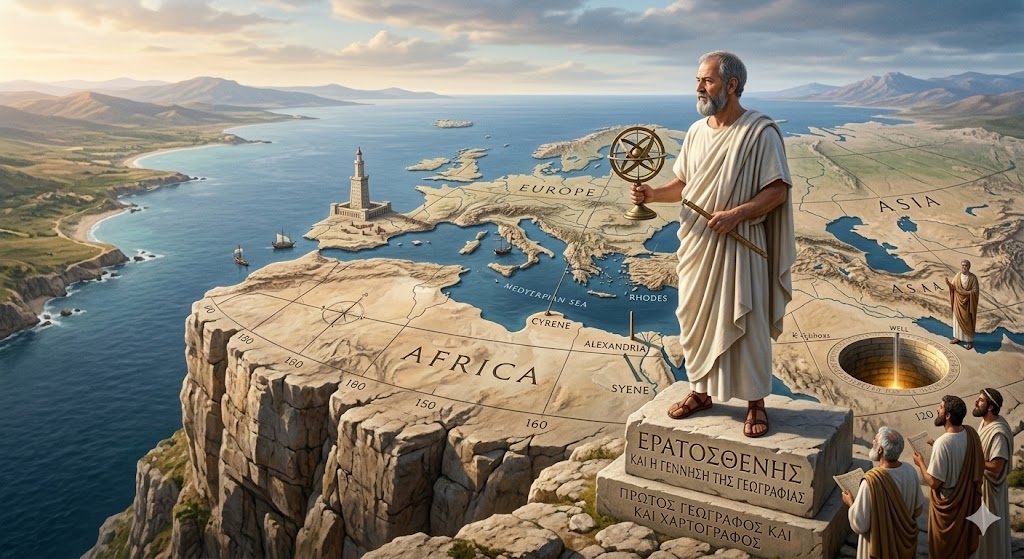
He observed that in the Egyptian city of Syene (modern Aswan), the sun was directly overhead at noon on the summer solstice, meaning objects cast no shadow. However, in Alexandria at the same time, objects did cast a shadow.
By measuring the angle of the shadow in Alexandria and knowing the distance between the two cities, he used geometry to estimate the size of the Earth.
His result was astonishingly accurate—within a few percent of modern measurements.
This discovery became one of the greatest examples of early scientific reasoning and played a crucial role in the Birth of Geography as a scientific discipline.
Creating One of the First World Maps
Another major achievement of Eratosthenes was his attempt to create one of the earliest scientifically based maps of the world.
Using reports from travelers, sailors, and explorers, he mapped known regions of Europe, Asia, and Africa. He introduced a system of grid lines similar to modern latitude and longitude, allowing locations to be described more precisely.
This approach was revolutionary because it combined geographic information with mathematical measurement. His mapping techniques influenced later geographers such as Ptolemy and eventually shaped modern cartography.
These innovations demonstrate how his Mathematics Contributions extended far beyond numbers and calculations.
Geography and Mathematics
The work of Eratosthenes clearly shows the strong relationship between geography and mathematics.
By using geometric reasoning to calculate the Earth’s Circumference, he proved that mathematical principles could explain large-scale features of the planet.
His intellectual curiosity also led him to develop the Sieve of Eratosthenes, a mathematical method for identifying prime numbers. Although this discovery belongs to number theory, it reflects the same analytical thinking he used in geography.
These achievements highlight the depth of his Mathematics Contributions, showing how different fields of knowledge can be connected through logical reasoning.
The Role of the Library of Alexandria
The Library of Alexandria played a crucial role in the work of Eratosthenes. As the chief librarian, he had access to thousands of scrolls containing knowledge from across the ancient world.
The library gathered texts from Greece, Egypt, Persia, India, and other regions. Scholars working there exchanged ideas, studied scientific observations, and collaborated on research.
This intellectual environment helped Eratosthenes collect geographic information from travelers and explorers. Using this data, he could build more accurate maps and develop theories about the Earth’s size and structure.
Without the vast resources of the Library of Alexandria, many of his discoveries might never have been possible.
Why Eratosthenes Was Ahead of His Time
Many historians describe Eratosthenes as a thinker Ahead of His Time because his methods resembled modern scientific practices.
Instead of relying on myths or guesses, he used observation, measurement, and logical reasoning to understand the world. His work showed that scientific questions could be answered through careful analysis and mathematical thinking.
His calculation of the Earth’s Circumference proved that even large natural phenomena could be measured using geometry. Similarly, the Sieve of Eratosthenes demonstrated how simple logical processes could reveal patterns within numbers.
These achievements illustrate the remarkable intellectual vision that made him one of the most influential scholars of the ancient world.
Influence on Modern Geography
The work of Eratosthenes had a lasting influence on geography and science. His ideas inspired later scholars who continued to improve maps, explore the Earth, and study its physical features.
Modern geography now includes fields such as cartography, climate science, environmental studies, and geographic information systems. Although these fields rely on advanced technology, their foundations trace back to the early ideas introduced during the Birth of Geography.
The concept of measuring the Earth, mapping locations, and studying the planet scientifically all began with pioneers like Eratosthenes.
Frequently Asked Questions (FAQs)
Who was Eratosthenes?
Eratosthenes was a Greek mathematician, geographer, and astronomer who lived during the 3rd century BCE and made major contributions to geography and mathematics.
Why is Eratosthenes called the father of geography?
He is called the father of geography because he transformed geographic study into a scientific discipline by measuring the Earth’s Circumference and creating systematic maps.
What was Eratosthenes’ greatest geographic achievement?
His greatest achievement was calculating the Earth’s Circumference using geometry and observations of sunlight in different locations.
What is the Sieve of Eratosthenes?
The Sieve of Eratosthenes is a mathematical algorithm used to find prime numbers by eliminating multiples of numbers from a list.
Where did Eratosthenes work?
He served as the chief librarian at the famous Library of Alexandria, which was one of the largest centers of knowledge in the ancient world.
Why is Eratosthenes considered ahead of his time?
He is considered Ahead of His Time because he used scientific observation, mathematical reasoning, and logical analysis to study the Earth long before modern scientific methods were developed.