Introduction
The Library of Alexandria was one of the greatest centers of knowledge in the ancient world, and its most famous librarian, Eratosthenes, played a central role in its intellectual achievements. Living in the 3rd century BCE, Eratosthenes was a mathematician, geographer, and astronomer whose work spanned multiple disciplines.
At the Library, he had access to countless scrolls from across the ancient Mediterranean and beyond. This access allowed him to study earlier scientific texts, refine mathematical concepts, and develop groundbreaking discoveries. His studies not only advanced understanding of the Earth’s Circumference but also supported the Birth of Geography as a scientific discipline.
Additionally, he created the Sieve of Eratosthenes, a brilliant method to identify prime numbers, and made numerous Mathematics Contributions that influenced generations of scholars. His innovative thinking placed him firmly Ahead of His Time, combining observation, logic, and computation in ways that foreshadowed modern scientific methods.
Who Was Eratosthenes?
Eratosthenes was born around 276 BCE in Cyrene, in modern-day Libya. He studied in Athens, learning philosophy, mathematics, and astronomy, before moving to Alexandria, Egypt. There, he became the chief librarian at the Library of Alexandria, giving him access to the largest collection of books and scrolls in the ancient world.
This position allowed him to study works from multiple cultures, including Greek, Egyptian, Babylonian, and Indian texts. Eratosthenes’ ability to synthesize knowledge from these sources enabled him to develop new theories and make groundbreaking discoveries in mathematics, geography, and astronomy.
The Library of Alexandria: A Center of Knowledge
The Library of Alexandria was established under the reign of Ptolemy II and aimed to gather all knowledge from around the known world. Scholars from various regions came to study, translate, and expand human understanding.
As chief librarian, Eratosthenes supervised the collection, organized research projects, and facilitated scholarly exchange. The library provided him with the resources to calculate the Earth’s Circumference using geometric principles and observational data, a feat that was centuries ahead of its time.
Earth’s Circumference: Mathematics Meets Geography
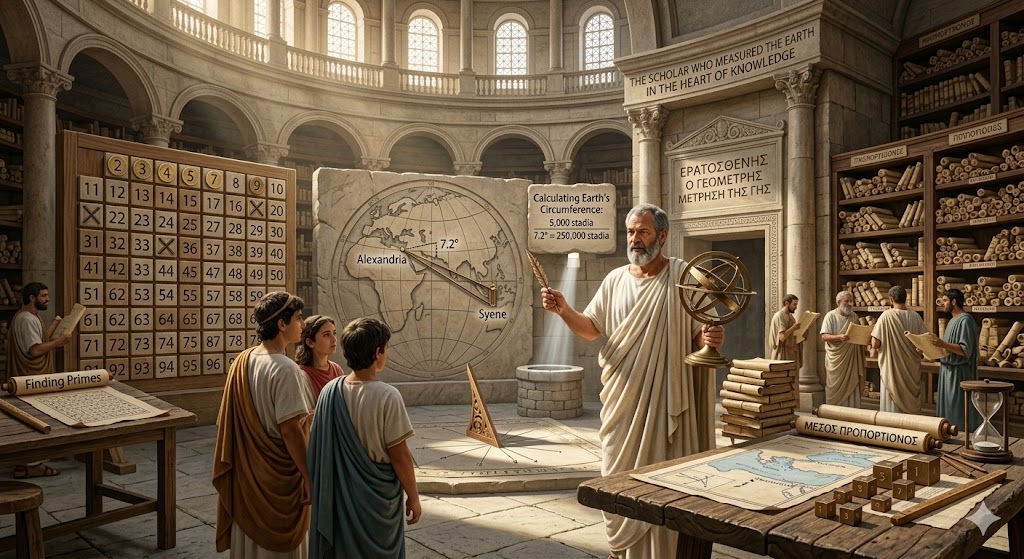
One of Eratosthenes’ most famous achievements was calculating the Earth’s Circumference. By observing the angle of sunlight in Syene (modern Aswan) and Alexandria during the summer solstice, he used geometry to determine the size of the Earth with remarkable accuracy.
This accomplishment was possible thanks to access to maps, travelers’ reports, and astronomical records available at the Library of Alexandria. It demonstrated the power of combining mathematical reasoning with real-world observations, laying the foundation for the Birth of Geography as a scientific discipline.
The Sieve of Eratosthenes
In addition to his geographic studies, Eratosthenes developed the Sieve of Eratosthenes, a method for identifying prime numbers. This algorithm systematically eliminates multiples of numbers to reveal primes, illustrating his deep understanding of numerical patterns and Mathematics Contributions.
The creation of the sieve was likely inspired by access to prior mathematical texts in the library, showing how the Library of Alexandria fostered innovation by providing resources and intellectual collaboration.
Birth of Geography and Mapping the World
The Library of Alexandria gave Eratosthenes the ability to collect information about distant lands, seas, and cities. Using this data, he mapped known regions of Europe, Africa, and Asia with mathematical precision.
His approach introduced systematic measurement, grid systems resembling latitude and longitude, and the use of observation to create accurate representations of the Earth. This work marked the true Birth of Geography, turning it into a science rather than a collection of myths and traveler’s tales.
Mathematics Contributions in the Library
Eratosthenes’ position at the library allowed him to explore multiple mathematical fields. His Mathematics Contributions extended to geometry, number theory, and applied mathematics, helping him calculate distances and angles for mapping and astronomical observation.
By studying texts from previous civilizations, he synthesized knowledge to create new theories and methods, influencing later scholars in both mathematics and geography.
Why Eratosthenes Was Ahead of His Time
The work of Eratosthenes demonstrates why historians describe him as Ahead of His Time. He combined observation, logic, and mathematics in a methodical way that resembled modern scientific practices.
- Calculating the Earth’s Circumference using geometry.
- Developing the Sieve of Eratosthenes for prime numbers.
- Mapping the world systematically and contributing to the Birth of Geography.
- Synthesizing knowledge from the vast Library of Alexandria collections.
His approach emphasized critical thinking and measurement over myth and speculation, influencing science for centuries.
Legacy of Eratosthenes and the Library
The intellectual achievements of Eratosthenes at the Library of Alexandria had lasting effects on mathematics, geography, and science. His work inspired later scholars like Claudius Ptolemy and laid foundations for the development of modern geography and mathematical methods.
The library itself, though eventually destroyed, remained a symbol of human curiosity and the importance of preserving knowledge. Through Eratosthenes’ contributions, we see the power of combining access to information with critical thinking and innovation.
Frequently Asked Questions (FAQs)
Who was Eratosthenes?
Eratosthenes was a Greek mathematician, geographer, and astronomer who worked as the chief librarian at the Library of Alexandria.
What is the Library of Alexandria?
It was the largest center of learning in the ancient world, containing thousands of scrolls and texts from across the known world.
How did Eratosthenes calculate the Earth’s Circumference?
By measuring the sun’s angle at Syene and Alexandria during the solstice and applying geometry, he estimated the Earth’s Circumference accurately.
What is the Sieve of Eratosthenes?
It is a mathematical method to identify prime numbers by systematically eliminating multiples.
Why is Eratosthenes considered ahead of his time?
He applied observation, mathematics, and logic systematically to scientific problems centuries before modern methods existed.
How did the Library of Alexandria support his discoveries?
The library provided access to maps, texts, and astronomical records, allowing him to combine knowledge from different disciplines effectively.