Introduction
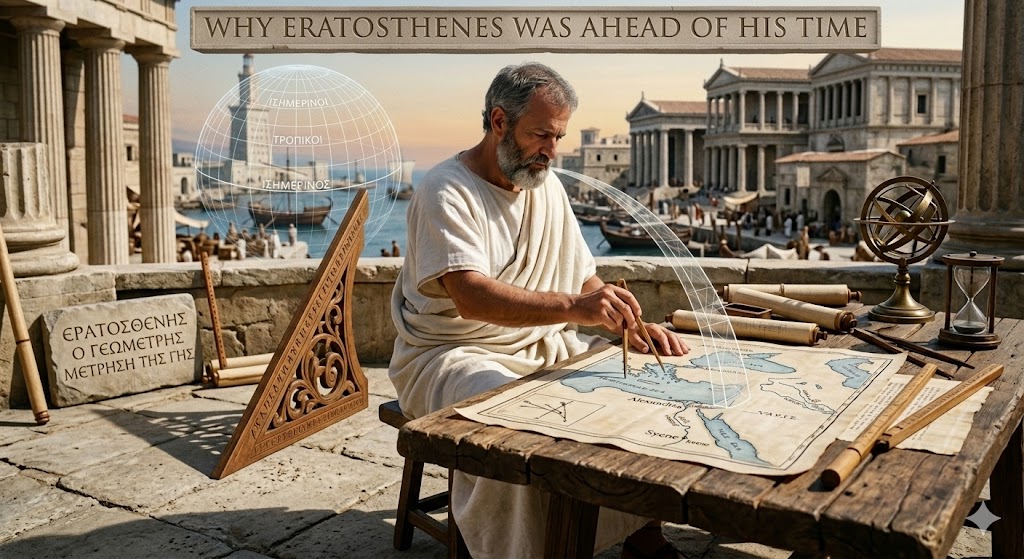
In the ancient world, few scholars demonstrated as much intellectual breadth as Eratosthenes. Born in 276 BCE in Cyrene, he excelled in mathematics, astronomy, geography, and philosophy. His innovations laid the foundations for multiple disciplines, earning him a reputation as a thinker Ahead of His Time.
Working at the legendary Library of Alexandria, Eratosthenes had access to a vast collection of texts and scrolls, which allowed him to explore mathematics, science, and geography in unprecedented ways. He developed techniques and ideas that were centuries ahead of their era, including methods to calculate the Earth’s Circumference, the Sieve of Eratosthenes for identifying prime numbers, and approaches that advanced the Birth of Geography.
This article explores the ways in which Eratosthenes was a visionary, highlighting his Mathematics Contributions, his observational methods, and his ability to integrate knowledge across disciplines.
Early Life and Education
Eratosthenes was born in Cyrene, a Greek city in present-day Libya, and later studied in Athens under prominent philosophers and mathematicians. His education emphasized logic, mathematics, and astronomy, which equipped him with the tools to pursue groundbreaking researchEventually, he was appointed chief librarian at the Library of Alexandria, one of the largest repositories of knowledge in the ancient world. Here, he gained access to texts from across the Mediterranean, including works on astronomy, mathematics, geography, and philosophy. This rich intellectual environment enabled him to synthesize information and make discoveries that were far ahead of his contemporaries.
Calculating the Earth’s Circumference
One of Eratosthenes’ most famous achievements was his calculation of the Earth’s Circumference. Using observations of the sun at Syene (modern Aswan) and Alexandria during the summer solstice, he applied geometry to estimate the Earth’s size with remarkable accuracy.
This feat demonstrated the power of mathematical reasoning combined with careful observation. By measuring the angle of the sun’s shadow and knowing the distance between the two cities, Eratosthenes was able to make one of the earliest accurate measurements of the Earth’s dimensions.
His success in this endeavor illustrates why he is considered Ahead of His Time, as he applied systematic analysis centuries before modern scientific tools were available.
The Sieve of Eratosthenes
Another example of his visionary thinking is the Sieve of Eratosthenes, a method for identifying prime numbers. This simple yet powerful algorithm involves systematically eliminating multiples of numbers to find all primes within a range.
The Sieve of Eratosthenes remains a foundational technique in number theory and computer science today. It reflects Eratosthenes’ Mathematics Contributions, showing his ability to devise logical systems that were both practical and elegant.
Contributions to Geography
Eratosthenes also played a pivotal role in the Birth of Geography. He compiled data about various regions, developed early maps, and applied mathematical methods to measure distances between cities. His approach transformed geography into a quantitative and scientific discipline rather than relying solely on anecdotal reports or myths.
By integrating geometry, measurement, and observation, Eratosthenes created a systematic framework for understanding the Earth’s surface. His geographic innovations were directly linked to his other studies, such as the calculation of the Earth’s Circumference and the analysis of astronomical phenomena.
Mathematics Contributions Beyond Geography
The Mathematics Contributions of Eratosthenes extend beyond prime numbers and geographic calculations. He worked on geometry, applied mathematical reasoning to astronomy, and used quantitative analysis to solve practical problems.
For example, his methods influenced navigation, engineering, and scientific observation. By combining abstract mathematics with real-world applications, Eratosthenes demonstrated an integrated approach to knowledge that was rare in his era.
Role of the Library of Alexandria
The Library of Alexandria provided Eratosthenes with the resources to achieve these remarkable feats. Access to diverse texts allowed him to compare theories, test hypotheses, and synthesize information across multiple disciplines.
This environment fostered intellectual creativity and collaboration, enabling Eratosthenes to remain Ahead of His Time. The library was not just a repository of books but a center where ideas could be developed, refined, and connected in ways that shaped the future of science.
Why He Was Ahead of His Time
Several factors illustrate why Eratosthenes is considered a visionary:
- Integration of Knowledge: He combined mathematics, geography, astronomy, and observation to create comprehensive scientific methods.
- Quantitative Reasoning: His work on the Earth’s Circumference and the Sieve of Eratosthenes demonstrated systematic measurement and logical analysis.
- Scientific Approach: He relied on observation and calculation instead of myths or speculation.
- Influence Across Disciplines: His methods influenced future mathematicians, geographers, and scientists, demonstrating lasting impact.
These achievements reveal a scholar whose insights predated many modern scientific practices by centuries.
Legacy
The legacy of Eratosthenes remains evident in mathematics, geography, and science. His methodologies—using observation, mathematics, and logical reasoning—continue to inspire scholars today.
By applying numerical analysis to map the Earth, identify primes, and solve practical problems, Eratosthenes exemplified an approach that bridged multiple disciplines. His work at the Library of Alexandria ensured that knowledge could be preserved, studied, and built upon by future generations.
Frequently Asked Questions (FAQs)
Who was Eratosthenes?
Eratosthenes was a Greek mathematician, geographer, and astronomer known for his groundbreaking scientific and mathematical contributions.
What is the Sieve of Eratosthenes?
It is a method for finding all prime numbers in a given range by systematically eliminating multiples of numbers.
How did Eratosthenes measure the Earth’s circumference?
By observing the sun’s angle in Syene and Alexandria and applying geometry, he calculated the Earth’s Circumference accurately.
What role did the Library of Alexandria play in his discoveries?
The library provided access to a vast collection of texts and knowledge that allowed Eratosthenes to study, compare, and innovate across multiple disciplines.
Why is Eratosthenes considered ahead of his time?
He applied observation, mathematics, and systematic analysis centuries before similar methods became standard in modern science.
How did Eratosthenes contribute to the birth of geography?
By using measurements, maps, and mathematical reasoning, he transformed geography into a scientific discipline.