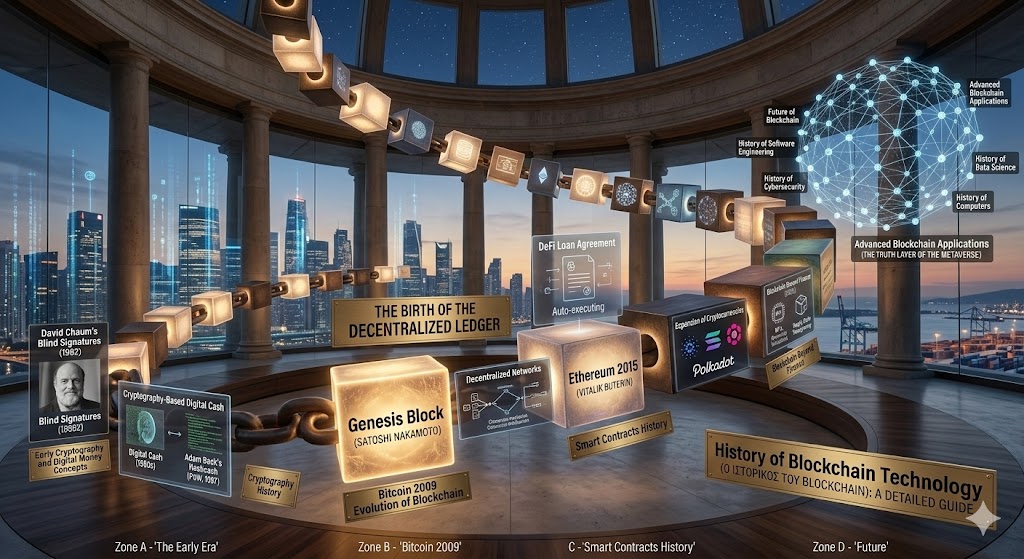
In the modern digital era, trust is the ultimate currency. For decades, we relied on central authorities—banks, governments, and massive corporations—to verify our identities and transactions. However, the History of Blockchain Technology represents a radical departure from this centralized model. It is a story of how mathematics and code replaced the middleman. This evolution didn’t happen in a vacuum; it was built upon the foundations found in the History of Computers and decades of research into secure communication. Today, blockchain is more than just the engine behind Bitcoin; it is a fundamental shift in how we store and share value across the globe.
Early Cryptography and Digital Money Concepts – 1980s
The seeds of blockchain were sown long before the first block was ever mined. In the 1980s, the world was beginning to grapple with the privacy implications of a computerized society. This led to a surge in cryptography history research. In 1982, computer scientist David Chaum proposed “blind signatures,” a mathematical method that allowed for a digital currency that could not be traced by the issuing authority.
This period was a turning point in the History of Cybersecurity, as researchers realized that encryption could be used not just to hide messages, but to create “digital tokens” with real-world value. However, these early concepts still required a central server to prevent “double-spending”—the act of using the same digital token twice. Solving this problem without a central authority would become the “Holy Grail” of decentralized networks.
Cryptography-Based Digital Cash – 1990s
The 1990s saw the rise of the “Cypherpunks,” a group of activists and programmers dedicated to using cryptography to protect individual liberty. During this decade, several influential attempts at digital cash emerged. In 1997, Adam Back invented Hashcash, a system designed to limit email spam by requiring a “proof-of-work” (PoW) from the sender.
Shortly after, Wei Dai published a proposal for “b-money,” an anonymous, distributed electronic cash system, and Nick Szabo designed “Bit Gold.” While Bit Gold was never implemented, it featured many elements of the eventual Bitcoin 2009 launch, including a chain of hashes that linked data together. This era relied heavily on the History of the Internet, as the growing web provided the playground for these early cryptographic experiments. However, the lack of a robust consensus mechanism meant that these early projects remained largely theoretical.
Bitcoin and the First Blockchain – 2009
The global financial crisis of 2008 served as the catalyst for the most significant event in the blockchain timeline. On October 31, 2008, a person or group using the pseudonym Satoshi Nakamoto published the Bitcoin Whitepaper. It solved the double-spending problem by using a peer-to-peer network and a distributed ledger.
In January 2009, the first block—the Genesis Block—was mined, marking the official start of Bitcoin 2009. This was the first time that the History of Software Engineering had produced a system that was truly decentralized, immutable, and transparent. Every transaction was grouped into a “block” and “chained” to the previous one using cryptographic hashes, creating an unbreakable record. This wasn’t just a new currency; it was a new way to organize data without a central point of failure.
The Rise of Ethereum and Smart Contracts – 2015
While Bitcoin proved that blockchain worked for money, a young programmer named Vitalik Buterin realized it could do much more. In 2013, he proposed Ethereum, which launched in 2015. Ethereum introduced the concept of “Smart Contracts”—self-executing contracts with the terms of the agreement directly written into code.
Ethereum 2015 transformed the History of Blockchain Technology from a simple payment system into a “World Computer.” This allowed developers to build decentralized applications (dApps) on top of the blockchain. The smart contracts history is vital because it moved blockchain into the realm of programmable logic. This decade also saw the History of Data Science intersect with blockchain, as analysts began using the transparent ledger to track global economic trends with unprecedented accuracy.
Expansion of Cryptocurrencies and Blockchain Networks – 2010s
Following the success of Bitcoin and Ethereum, the 2010s saw a massive expansion of the ecosystem. This was the era of the Initial Coin Offering (ICO) and the birth of thousands of “altcoins.” Developers began experimenting with different consensus mechanisms, such as Proof of Stake (PoS), to reduce the energy consumption associated with Bitcoin’s Proof of Work.
Decentralized networks began to tackle issues of scalability and interoperability. Projects like Cardano, Solana, and Polkadot emerged to handle thousands of transactions per second. This growth was supported by the History of Software Engineering, as new programming languages and frameworks were developed specifically for blockchain security. The industry began to move beyond “niche” status and into the mainstream financial consciousness.
Blockchain Beyond Finance – 2020s
As we navigate the 2020s, the evolution of blockchain has moved far beyond simple currency. We are now seeing blockchain applications in supply chain management, healthcare, and digital identity. Non-Fungible Tokens (NFTs) have revolutionized the art world, proving that blockchain can verify the “uniqueness” of digital assets.
The rise of Decentralized Finance (DeFi) is currently challenging the traditional banking system by offering lending, borrowing, and trading services without a bank. Furthermore, the History of Cybersecurity is being rewritten as blockchain provides a more resilient defense against data breaches and identity theft. We are also seeing the History of Data Science utilize “zero-knowledge proofs”—a way to prove something is true without revealing the underlying data—to enhance privacy in an increasingly tracked world.
The Convergence of Blockchain and the Metaverse
One of the most exciting aspects of the future of blockchain is its role in the Metaverse. For a digital world to have a functioning economy, it needs a way to prove ownership of digital land, clothes, and tools. Blockchain provides the “truth layer” for these virtual worlds. This convergence relies on the History of Computers reaching a point where we have the processing power to render these worlds while simultaneously maintaining a secure, decentralized ledger in the background.
Frequently Asked Questions (FAQs)
Who is Satoshi Nakamoto?
Satoshi Nakamoto is the pseudonym of the creator of Bitcoin. To this day, the true identity of the person or group remains a mystery.
What is a “block” in a blockchain?
A block is a digital container for data. In the context of Bitcoin, it contains a list of transactions. Each block contains a unique code (a hash) that links it to the block that came before it.
What is the difference between Bitcoin and Ethereum?
Bitcoin is primarily a digital currency and a “store of value.” Ethereum is a programmable blockchain that allows for the creation of smart contracts and decentralized applications.
Can a blockchain be hacked?
While an individual’s “wallet” can be hacked if they lose their password, the underlying blockchain network is extremely difficult to hack because it would require controlling more than 50% of the network’s computing power simultaneously.
Why is blockchain considered “immutable”?
Once a block is added to the chain, changing it would require changing every subsequent block in the chain across the entire network, which is mathematically and computationally nearly impossible.
Conclusion
The History of Blockchain Technology is a testament to the power of decentralized thinking. What began as a niche interest for cryptographers and hobbyists in the 1980s has evolved into a global movement that is redefining the History of Software Engineering and the History of the Internet. From the launch of Bitcoin 2009 to the complex smart contracts of today, blockchain has proved that transparency and security can exist without a central authority. As we look toward the future of blockchain, it is clear that we are moving toward a more open, fair, and decentralized world. The ledger is open, and the next chapter is already being written.