The history of data centers reflects the dramatic transformation of computing infrastructure over the past eight decades. From early glass-walled computer rooms housing massive machines to today’s hyperscale facilities powering cloud services and artificial intelligence, data centers have become the backbone of the digital world.
In the earliest decades of computing, organizations relied on centralized machines that required highly controlled environments. Over time, the rapid expansion of the internet, virtualization technologies, and cloud platforms transformed these facilities into large-scale computing hubs capable of processing enormous volumes of data.
Modern data centers support everything from enterprise applications to modern artificial intelligence applications, enabling organizations to run complex systems, manage global services, and analyze large datasets.
The evolution of these facilities is closely related to developments in history of computers, history of computer hardware, and history of cloud storage, all of which contributed to the growth of modern computing infrastructure.
Understanding the history of data centers provides valuable insight into how modern IT infrastructure trends emerged and how future technologies will shape digital infrastructure.
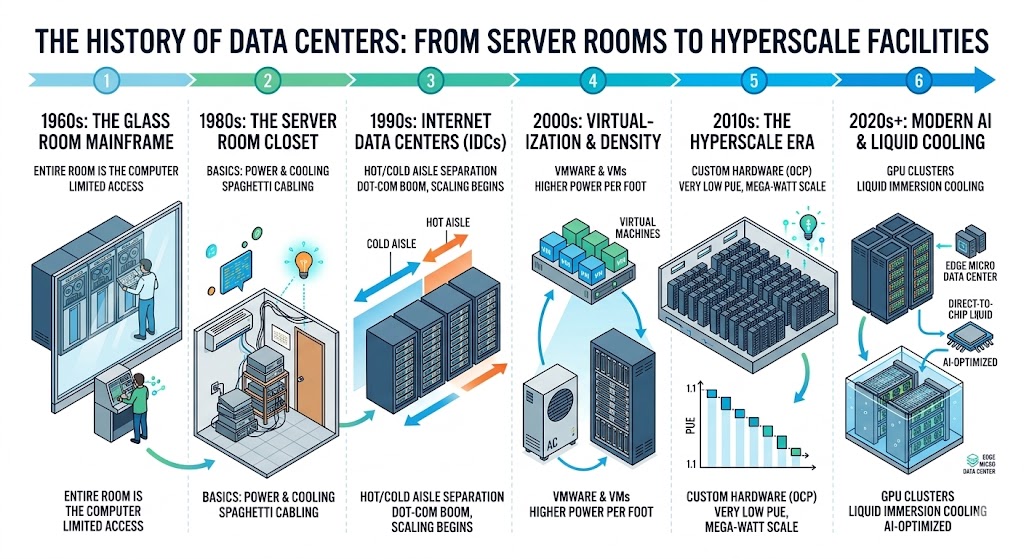
A. The Era of the Glass Room – 1940–1960
The earliest stage in the history of data centers began during the 1940s and 1950s, when organizations used large mainframe computers to process data.
These machines were extremely expensive and required specialized environments. Companies placed them inside controlled rooms often surrounded by glass walls—commonly referred to as “glass rooms.” These spaces allowed technicians to monitor equipment while maintaining strict environmental conditions.
Cooling systems, dedicated electrical systems, and early uninterruptible power supply (ups) solutions were necessary to keep these machines running.
During this era, computing systems were large and centralized, reflecting the early evolution of server architecture. Most organizations processed all workloads on a single mainframe computer.
B. The Rise of the Server Room – 1970–1980
The 1970s and 1980s marked an important shift in the history of data centers as smaller computers and servers began replacing massive mainframes.
Businesses started creating dedicated server rooms within their offices. These rooms housed multiple servers arranged in racks measured in rack units (u).
To maintain efficiency, data centers introduced airflow management systems such as hot aisle / cold aisle containment, which improved data center cooling technology.
The development of operating systems and networking technologies—explored in history of operating systems and history of computer networking—allowed servers to communicate and share workloads more efficiently.
This period also introduced the first structured infrastructure standards that eventually influenced modern tia-942 standards for data center design.
C. The Internet Explosion and the History of Data Centers – 1990–2000
The 1990s brought a dramatic transformation in the history of data centers due to the rapid expansion of the internet.
Businesses suddenly needed large-scale computing infrastructure capable of hosting websites, email services, and online platforms.
The explosive growth of online traffic dramatically increased demands for reliable data center facilities.
The Dot-Com Boom
During the late 1990s, the dot-com boom led to massive investments in internet infrastructure.
Companies built larger facilities with improved latency and connectivity to support online services.
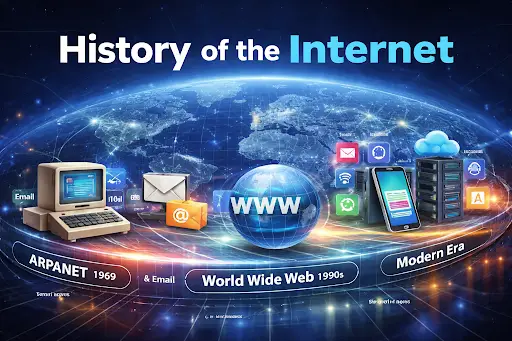
The internet revolution described in history of internet played a critical role in accelerating the demand for modern data centers.
The Rise of Colocation
The increasing cost of building infrastructure led to the development of colocation vs. enterprise data centers.
Colocation providers allowed multiple businesses to rent space within a shared facility, reducing infrastructure costs while improving scalability.
This model helped shape the future of the history of data centers and became a core part of the global hosting industry.
D. The Virtualization Revolution – 2001–2009
The early 2000s introduced one of the most important breakthroughs in the history of data centers: virtualization technology.
Instead of running one operating system per physical machine, virtualization allowed multiple virtual machines (vms) to run on a single server.
VMware and Virtualization
Companies like VMware pioneered virtualization platforms that allowed businesses to maximize server efficiency.
Virtualization eventually led to the concept of the software-defined data center (sddc), where computing resources such as storage, networking, and processing could be managed through software.
This transformation dramatically reduced hardware costs and improved infrastructure scalability.
It also contributed to the rapid development of cloud computing platforms discussed in history of cloud storage.
E. The Hyperscale Era and the History of Data Centers – 2010–2018
The 2010s marked the beginning of hyperscale data centers operated by major technology companies.
These massive facilities contained thousands of servers and supported global cloud platforms, social networks, and streaming services.
Custom Hardware and PUE
To optimize efficiency, hyperscale companies developed custom hardware through initiatives like the open compute project (ocp).
Another key metric introduced during this era was power usage effectiveness (pue), which measures how efficiently a data center uses energy.
Improving PUE became a major focus as companies sought to reduce operational costs and environmental impact.
The growth of hyperscale infrastructure also supported the rapid expansion of analytics platforms discussed in history of big data.
F. The Modern AI and Liquid Cooling Era – 2019–2026
In recent years, the history of data centers has entered a new phase driven by artificial intelligence workloads and advanced computing demands.
AI systems require enormous processing power, pushing data centers to adopt new cooling and infrastructure technologies.
The Return of Liquid Cooling
Modern facilities increasingly use liquid immersion cooling to manage heat generated by high-performance computing systems.
This advanced cooling approach is far more efficient than traditional air cooling systems.
These innovations reflect the ongoing development of data center cooling technology.
Edge Data Centers
Another emerging trend is the growth of edge data centers, which place computing resources closer to users and devices.
This trend connects directly with the development of distributed systems explored in history of edge computing.
Edge facilities reduce latency and enable faster data processing for applications such as autonomous vehicles and smart cities.
G. The Sustainable Future – 2026 and Beyond
Looking ahead, the history of data centers will continue evolving as organizations focus on sustainability and efficiency.
Future facilities are expected to prioritize:
- renewable energy integration
- improved cooling technologies
- decentralized infrastructure
- advanced automation systems
Data centers will also support new technologies such as artificial intelligence, spatial computing, and large-scale analytics.
These facilities will remain a critical part of global digital infrastructure.
Frequently Asked Questions (FAQs)
What is a data center?
A data center is a facility that houses computing systems, servers, networking equipment, and storage infrastructure used to process and store digital data.
Why are data centers important?
Data centers power websites, cloud platforms, enterprise applications, and digital services used by billions of people worldwide.
What is a hyperscale data center?
A hyperscale data center is a massive facility designed to support large-scale cloud computing operations and handle enormous workloads.
What is PUE in data centers?
power usage effectiveness (pue) measures how efficiently a data center uses energy. Lower PUE values indicate higher energy efficiency.
Conclusion
The history of data centers illustrates how computing infrastructure evolved from small server rooms into massive hyperscale facilities powering the digital world. Over decades, innovations such as virtualization, hyperscale architectures, and liquid cooling technologies transformed how organizations manage computing resources.
As modern technologies like artificial intelligence, cloud computing, and edge infrastructure continue to grow, data centers will remain essential to global digital ecosystems. The next generation of sustainable and energy-efficient facilities will play a critical role in shaping the future of modern IT infrastructure.