Introduction
The question who invented the first operating system is one of the most fascinating topics in the world of computing history. Today every computer, smartphone, and server relies on an operating system to function. Without operating systems modern computing would not exist because the operating system acts as the central software that controls hardware and manages resources.
Understanding who invented the first operating system requires exploring the early days of computing when machines were extremely large and complex. In the early era computers did not have user friendly software. Instead programmers had to interact directly with machine instructions and hardware controls.
The development of operating systems changed everything. An operating system introduced a structured way to control computing resources, manage files, and allow multiple programs to run efficiently. It created a bridge between hardware and software so that developers could build applications more easily.
Early computer innovations were also influenced by advancements in the evolution of transistors, which allowed machines to become smaller and more powerful. As computers improved engineers realized that a software layer was needed to control resources such as memory, storage, and processors.
Another major factor in operating system development was the rise of storage technology, which allowed systems to manage large collections of data using structured file systems.
The story of who invented the first operating system reveals how software infrastructure evolved to become the foundation of modern computing.
Who Invented It
The answer to who invented the first operating system often leads to the work of General Motors Research Laboratories. In the early era of computing engineers at General Motors developed the first real operating system designed to automate computing tasks.
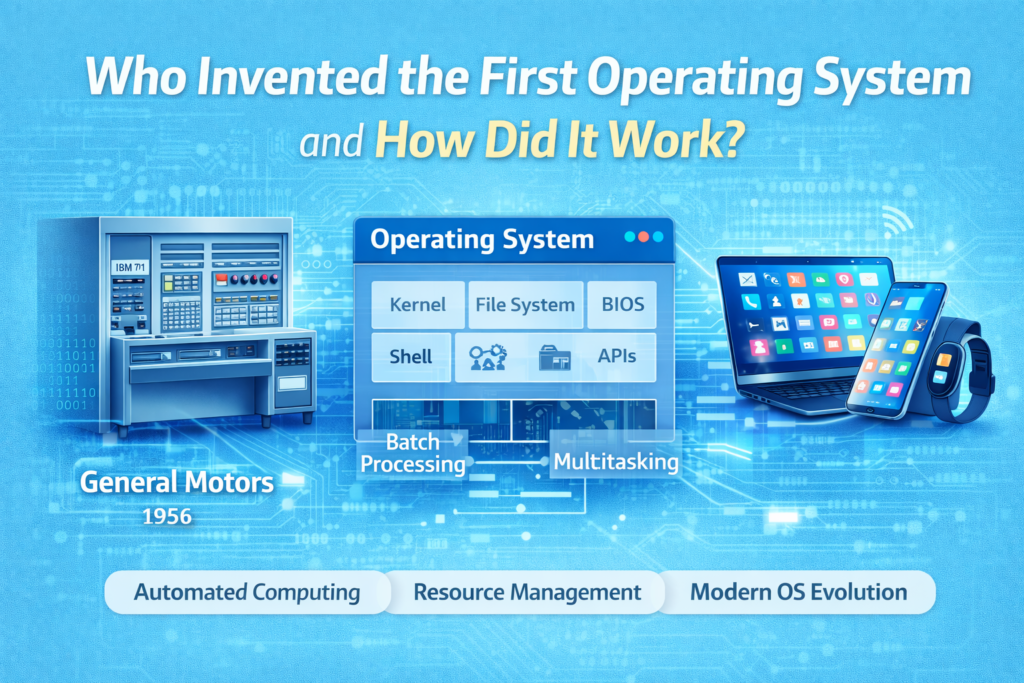
The system was created for the IBM 701 computer and became known as the GM OS. The project was led by pioneering engineers who wanted to simplify the process of running programs on large mainframe machines.
Before this invention computer operators had to manually load programs into the machine. Each task required human intervention and the computer remained idle between jobs. This process was inefficient and extremely time consuming.
The engineers at General Motors Research Laboratories created a system that automatically loaded programs and managed computing tasks. This invention marked a major milestone in the history of operating systems and answered the historic question of who invented the first operating system.
Later operating system research involved other famous developers such as Ken Thompson and Dennis Ritchie who created Unix. Their work laid the foundation for many modern operating systems including Linux and macOS.
The development of operating systems also relied heavily on advancements in hardware design which are documented in the history of computer hardware.
Through these innovations the concept of a software controlled computing environment became possible.
When It Was Invented
The first operating system was created in 1956 when General Motors Research Laboratories developed the GM OS for the IBM 701 computer.
This invention marked the beginning of structured computer resource management. The system allowed computers to execute multiple jobs automatically through a process known as batch processing.
The year 1956 became a turning point in the story of who invented the first operating system because it demonstrated that software could control the operation of complex machines.
During the late nineteen fifties and early nineteen sixties more advanced systems appeared. These systems introduced features such as memory management and improved input output handling.
As computers became more powerful new operating system architectures emerged. Engineers began experimenting with multitasking systems that could run several programs simultaneously.
The rapid improvement of processors driven by the evolution of transistors made it possible to design more sophisticated operating systems.
During this period researchers also developed the first file system concepts which allowed computers to organize and retrieve stored data efficiently.
These innovations played a crucial role in answering the historical question who invented the first operating system and shaped the future of software development.
How It Worked
To understand who invented the first operating system, it is important to understand how early operating systems functioned.
The first operating systems were primarily batch processing systems. Instead of interacting directly with the computer users submitted jobs that were executed sequentially.
The operating system handled several important tasks including resource management, program execution, and file handling.
At the core of every operating system is the kernel. The kernel manages communication between hardware and software components. It controls memory allocation, processor scheduling, and device drivers.
Users interacted with early systems through a Command Line Interface which allowed them to issue instructions using text commands.
The operating system also introduced important components such as the shell, file systems, and APIs that allowed software applications to interact with the system.
Modern operating systems expanded these concepts by adding graphical user interfaces which made computers accessible to everyday users.
The development of distributed systems and network computing also influenced operating system design and is closely related to the history of computer networking.
Storage devices became more advanced through the rise of storage technology, enabling operating systems to manage larger databases and complex applications.
These innovations illustrate how the invention explained in who invented the first operating system created the foundation for all modern computing environments.
Why It Was Important
The invention of the operating system revolutionized computing in several powerful ways.
Before operating systems existed computers were extremely difficult to use. Only trained engineers could operate them and every program had to be loaded manually.
The development described in who invented the first operating system changed this completely. Operating systems automated the process of running programs and managing system resources.
This innovation made computers more efficient and accessible to researchers, businesses, and universities.
Operating systems also introduced resource management systems that allowed multiple users and programs to share the same computer.
Another critical impact was the development of application programming interfaces which allowed software developers to build programs without directly interacting with hardware.
Operating systems also played a central role in the growth of personal computing. Systems such as Microsoft Windows and Apple macOS introduced graphical user interfaces that made computers easy for everyday users.
These developments represent an important part of the history of computers and helped transform computing into a mainstream technology.
The importance of operating systems also extends to cloud computing, mobile devices, and artificial intelligence platforms that rely on advanced kernel architectures.
How It Evolved Today
The operating systems used today are far more advanced than the early systems created in the nineteen fifties.
Modern operating systems include complex kernel architectures that manage memory, processors, and storage systems efficiently.
Windows, macOS, and Linux are examples of modern operating systems that evolved from earlier concepts.
Linux kernel development played a significant role in modern operating system evolution. Linux powers servers, cloud platforms, and many embedded systems.
Operating systems today also support advanced technologies such as virtualization and distributed computing.
Mobile devices rely on operating systems such as Android and iOS which manage applications, sensors, and network connectivity.
These modern systems rely on hardware improvements driven by the evolution of transistors and increasingly powerful processors.
Advanced file systems and storage management techniques enabled by the rise of storage technology allow modern operating systems to handle enormous volumes of data.
The journey that began with the answer to who invented the first operating system continues to shape the future of computing technology.
Frequently Asked Questions (FAQs)
Who invented the first operating system?
The first operating system was developed by General Motors Research Laboratories in 1956 for the IBM 701 computer.
Why were operating systems invented?
Operating systems were created to automate computer operations and manage resources such as memory, processors, and storage.
What is the kernel in an operating system?
The kernel is the core component that manages communication between hardware and software.
What is the difference between batch processing and multitasking?
Batch processing executes jobs sequentially while multitasking allows multiple programs to run simultaneously.
What operating systems are popular today?
Modern operating systems include Windows, macOS, Linux, Android, and iOS.
The Operating System Revolution and Modern Software Infrastructure (1956 to Present)
The story behind who invented the first operating system represents one of the most important breakthroughs in computing history.
From the first batch processing systems to modern distributed platforms operating systems have evolved into sophisticated software infrastructures that power nearly every digital device.
Operating systems enable communication between hardware and software, manage system resources, and provide user friendly environments for applications.
The innovations introduced by General Motors Research Laboratories in 1956 created the foundation for decades of technological progress.
Today operating systems continue to evolve with new features such as virtualization, cloud integration, and advanced security systems.
The answer to who invented the first operating system reminds us that even the most complex digital technologies begin with simple ideas and visionary engineers who strive to make computing more powerful and accessible for the world.