Introduction
The question who invented databases is one of the most important topics in the evolution of modern computing. Databases are the backbone of digital systems because they store, organize, and manage data efficiently. From banking systems to social media platforms, databases power nearly every application we use today.
Understanding who invented databases requires exploring the early days of computing when data was stored in simple flat files. These files lacked structure and made it difficult to retrieve and manage information efficiently.
As computing systems became more complex, the need for structured data management became clear. Engineers began developing database management systems that could organize data into structured formats such as tables and records.
The development of databases is closely connected with the history of databases, which explains how data management evolved from simple storage systems to advanced relational databases.
The journey of who invented databases reveals how visionary researchers created powerful systems that transformed data storage and retrieval.
Who Invented It
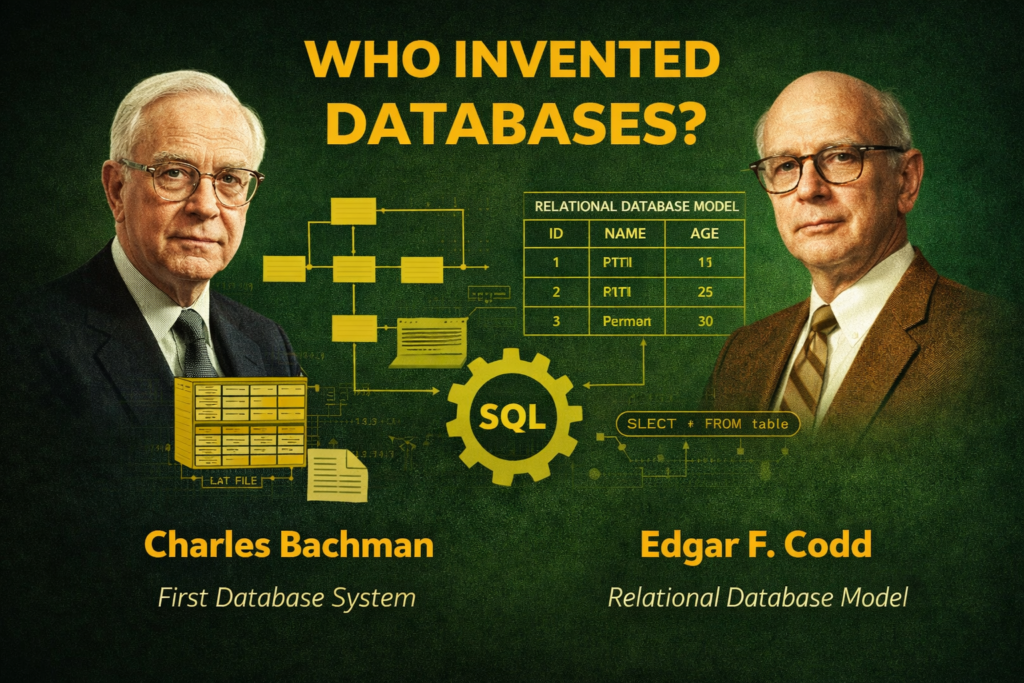
When discussing who invented databases, one of the earliest pioneers is Charles Bachman. He developed one of the first database management systems known as the Integrated Data Store in the nineteen sixties.
Charles Bachman introduced the concept of organizing data into structured formats that could be accessed efficiently. His work laid the foundation for modern database systems.
Another major contributor to who invented databases is Edgar F Codd, who introduced the relational database model in 1970. This model organized data into tables with rows and columns, making it easier to manage and query data.
Edgar Codd also introduced key concepts such as normalization, primary key, and foreign key relationships. These concepts are fundamental to modern database design.
The contributions of these pioneers are also part of the history of computers, which shows how computing systems evolved alongside data management technologies.
These innovations provide a clear answer to the question who invented databases and highlight the development of modern database systems.
When It Was Invented
The first database systems were developed in the 1960s when Charles Bachman created the Integrated Data Store.
The relational database model was introduced in 1970 by Edgar F Codd. This milestone is critical in understanding who invented databases because it defined how modern databases are structured.
During this period organizations needed efficient ways to manage large volumes of data. Early systems such as IBM Information Management System used hierarchical structures to store data.
These systems organized data in tree like structures where each record had a parent and child relationship.
The introduction of relational databases allowed data to be organized into tables and linked using keys. This made it easier to retrieve and manage information.
The year 1970 therefore represents a turning point in the history of who invented databases.
How It Worked
To understand who invented databases, it is important to understand how early database systems worked.
Early databases stored data in structured formats using records and fields. Data was organized into tables where each row represented a record and each column represented an attribute.
Database systems used schemas to define the structure of data. A schema describes how data is organized and how different elements relate to each other.
Queries were used to retrieve data from databases. Query language allowed users to search for specific information.
The development of SQL made it possible to interact with relational databases using simple commands.
Databases also introduced concepts such as data integrity and ACID properties to ensure reliability.
Indexing techniques improved performance by allowing faster data retrieval.
These innovations demonstrate how the ideas behind who invented databases created efficient systems for managing large amounts of information.
Why It Was Important
Databases revolutionized how data is stored and managed.
Before databases existed organizations relied on manual record keeping or simple flat files. These methods were inefficient and prone to errors.
Understanding who invented databases highlights how structured data management improved efficiency and accuracy.
Databases allow organizations to store large volumes of data and retrieve information quickly.
They also support complex applications such as financial systems, healthcare records, and online services.
The importance of databases extends to modern technologies such as cloud computing and big data analytics.
The development of databases is closely related to the history of data science, which uses data for analysis and decision making.
Databases also play a key role in software development and are closely connected with the who created the sdlc process.
Without databases modern digital systems would not be able to function efficiently.
How It Evolved Today
Database technology has evolved significantly since its early beginnings.
Modern databases include relational systems such as MySQL and Oracle as well as NoSQL databases designed for large scale data processing.
Cloud based databases allow organizations to store and access data globally.
The growth of big data and distributed systems has led to the development of advanced database architectures.
Modern databases support high performance applications and real time data processing.
The development of these systems is closely related to the history of cloud storage, which explains how data management evolved in modern computing.
Advancements in computing hardware supported by the Evolution of GPUs have enabled faster data processing and analytics.
In the final stage of evolution improvements in hardware driven by the evolution of transistors and advancements in data handling through the rise of storage technology have made modern databases more powerful and scalable.
The journey of who invented databases continues to influence modern data driven technologies.
Frequently Asked Questions (FAQs)
Who invented databases?
Charles Bachman developed one of the first database systems while Edgar F Codd introduced the relational model.
What is a database?
A database is a system that stores and organizes data for easy access and management.
What is SQL?
SQL is a query language used to interact with relational databases.
Why are databases important?
Databases enable efficient storage, retrieval, and management of data.
How have databases evolved?
Databases evolved from flat files to relational systems and modern cloud based architectures.
The Database Revolution and Modern Data Systems 1960s to Present
The story behind who invented databases represents a powerful transformation in computing history. From the early work of Charles Bachman to the relational model introduced by Edgar Codd databases have become essential to modern technology.
Databases enable efficient data management and support applications across industries.
The contributions of pioneers such as Charles Bachman and Edgar F Codd created a foundation for decades of innovation.
Modern databases continue to evolve with advancements in hardware and software technologies.
The legacy of who invented databases reminds us that structured data management is essential for building the future of digital systems.