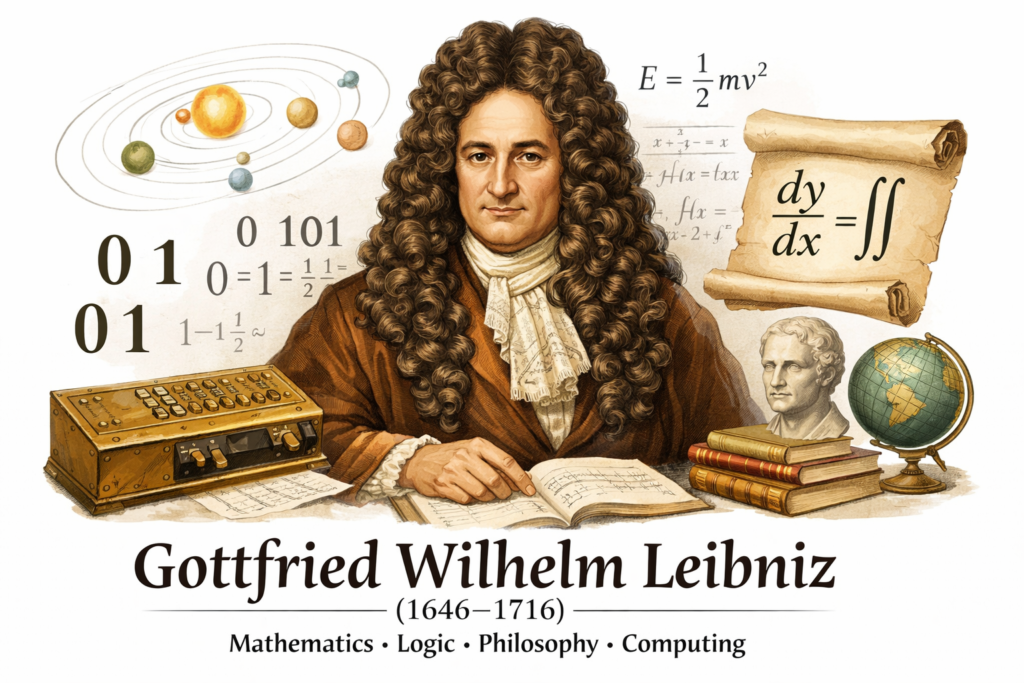
The story of gottfried wilhelm leibniz discoveries is one of the most powerful intellectual journeys in the history of science. Gottfried Wilhelm Leibniz was not just a mathematician but a universal thinker whose contributions shaped mathematics logic computing and philosophy.
During the scientific revolution the world witnessed groundbreaking transformations in knowledge. While Newton explained motion and gravity Leibniz introduced new mathematical tools and logical frameworks that changed how humans understand the universe.
The importance of gottfried wilhelm leibniz discoveries lies in their depth and diversity. His work connects mathematics physics computer science and philosophy into one unified vision. This makes Leibniz one of the most influential thinkers in human history.
Early Life and Education of Leibniz
Gottfried Wilhelm Leibniz was born in 1646 in Leipzig Germany into an academic family. His father was a professor which gave Leibniz access to scholarly books from a young age.
By the age of six he began learning Latin independently and soon developed a strong interest in logic and reasoning. His early exposure to knowledge shaped the foundation of gottfried wilhelm leibniz discoveries.
Leibniz studied philosophy law and mathematics at the University of Leipzig. His legal training helped him develop structured thinking while his interest in mathematics guided him toward scientific innovation.
His education was not limited to formal study. Leibniz constantly explored ideas beyond traditional subjects which later allowed him to create revolutionary concepts across disciplines.
Leibniz as a Universal Thinker
One of the most remarkable aspects of gottfried wilhelm leibniz discoveries is his ability to connect different fields of knowledge.
He worked as a mathematician philosopher diplomat engineer and historian. This multidisciplinary approach allowed him to see patterns and relationships that others could not.
Leibniz believed that all knowledge could be expressed through logic and mathematics. This vision later influenced modern computing and symbolic reasoning systems.
His dream of creating a universal system of knowledge became a defining feature of his intellectual legacy.
Leibniz and the Invention of Calculus
One of the most important contributions within gottfried wilhelm leibniz discoveries is the development of calculus.
Leibniz independently created a mathematical system that describes change motion and accumulation. This system became essential in physics engineering and astronomy.
For examplerepresents the rate of change of a variable.represents accumulation or area under a curve.
These tools allow scientists to analyze motion growth and forces in a precise mathematical way.
The full story behind this achievement is explored in Leibniz Calculus Discovery, where the development of calculus is explained in depth.
Leibniz Calculus Notation That Shaped Modern Mathematics
A key strength of gottfried wilhelm leibniz discoveries lies in his elegant and practical notation.
Leibniz introduced symbols that made calculus easier to understand and apply. His notation clearly shows relationships between variables which made it widely accepted across Europe.
Today modern mathematics still uses his system because of its clarity and flexibility.
This powerful symbolic system is explained further in Leibniz Calculus Notation, where you will see how these symbols became universal in mathematics.
The Calculus Conflict with Newton
The development of calculus led to one of the most dramatic rivalries in scientific history.
Both Newton and Leibniz developed calculus independently but disagreements over priority created tension. This conflict divided the scientific community into opposing sides.
Despite this rivalry historians now agree that both thinkers made independent contributions.
This episode remains a central part of gottfried wilhelm leibniz discoveries and highlights the competitive nature of the scientific revolution.
Leibniz Binary System The Foundation of Digital Technology
Among the most revolutionary gottfried wilhelm leibniz discoveries is the binary number system.
Leibniz demonstrated that all numbers can be expressed using only two digits
0 and 1.
For example
Decimal 5 becomes binary 101.
This simple system became the foundation of modern computers digital electronics and programming.
Every digital device today operates using binary logic.
The importance of this concept is explained further in Leibniz Binary System, where its role in modern computing is explored.
Leibniz Mechanical Calculator The Step Reckoner
Leibniz also made major contributions to engineering through his invention of a mechanical calculator.
This machine known as the Step Reckoner could perform addition subtraction multiplication and division automatically.
It used gears and mechanical components to process numbers which made it one of the earliest computing devices.
This invention showed how machines could assist human calculation and reasoning.
You can learn more about this innovation in Leibniz Step Reckoner, where the design and impact of the machine are explained.
Leibniz Vision of Universal Logic
Leibniz believed that reasoning itself could be transformed into a mathematical system.
He proposed a universal symbolic language where all knowledge could be expressed logically and calculated systematically.
This idea became one of the earliest foundations of modern logic computer science and artificial intelligence.
Leibniz imagined a world where disputes could be solved through calculation instead of debate.
This visionary concept is explored in Leibniz Universal Logic, where his philosophical ideas are examined in detail.
Leibniz Contributions to Physics and Energy
Although primarily known for mathematics Leibniz also contributed to physics.
He introduced the concept of vis viva which relates to modern kinetic energy.This concept helped scientists understand energy conservation and motion.
His work complemented discoveries such as newton laws of motion and gravitational theory.
These contributions show how gottfried wilhelm leibniz discoveries extended beyond mathematics into physical science.
Leibniz Role in the Scientific Revolution
The scientific revolution was shaped by thinkers like Copernicus Galileo Newton and Leibniz.
Leibniz played a unique role by connecting mathematics logic and philosophy.
His work built upon earlier scientific ideas and expanded the tools needed to understand the universe.
The progress of science from ancient philosophy to modern theory demonstrates how knowledge evolves over time.
Personal Life and Character
Leibniz was known for his intelligence curiosity and diplomatic skills.
He worked with European leaders and scholars and contributed to political and academic discussions.
Despite facing criticism and rivalry especially during the calculus dispute he remained committed to his ideas.
His personality reflected both determination and creativity which defined gottfried wilhelm leibniz discoveries.
Legacy of Gottfried Wilhelm Leibniz
The legacy of gottfried wilhelm leibniz discoveries continues to shape the modern world.
His work influenced:
Mathematics through calculus
Computer science through binary systems
Philosophy through logic
Engineering through mechanical devices
Leibniz ideas remain central to modern science and technology.
Frequently Asked Questions (FAQs)
Who was Gottfried Wilhelm Leibniz?
He was a German mathematician philosopher and scientist known for contributions to calculus logic and computing.
What are gottfried wilhelm leibniz discoveries?
They include calculus binary system mechanical calculator and symbolic logic.
Why is Leibniz important in modern science?
His ideas form the foundation of mathematics computing and logical reasoning systems.
Did Leibniz invent calculus alone?
No he developed calculus independently alongside Isaac Newton.
What is Leibniz biggest contribution?
His calculus notation and binary system are among the most influential discoveries.
Conclusion
The journey of gottfried wilhelm leibniz discoveries reveals a brilliant mind that transformed multiple fields of knowledge. Leibniz contributions shaped mathematics logic computing and philosophy in ways that still influence modern science.
His work built upon earlier developments such as the copernicus solar system model and continued the intellectual tradition showing how ancient greek scientists changed modern science.
Leibniz legacy proves that innovation comes from connecting ideas across disciplines and thinking beyond traditional boundaries.