Introduction to Leibniz’s Binary System: The 17th-Century Digital Revolution
Every time you tap a screen, stream a video, or execute a complex calculation, you are witnessing the triumph of a seemingly astonishing idea conceived over three centuries ago. The modern world runs on electricity, but more fundamentally, it runs on logic—specifically, the logic of zeros and ones. This bedrock of computation is known as the binary system. While we often attribute the dawn of the digital age to 20th-century engineers, the leibniz binary system stands as the hidden, intellectual cornerstone upon which all modern computing is built.
Gottfried Wilhelm Leibniz, a German polymath of the 17th century, was not merely a philosopher who dabbled in mathematics; he was a visionary who saw the universe as a vast, logical structure. In an era dominated by Roman numerals and complex fractional arithmetic, Leibniz envisioned a simpler, more elegant language for numbers: a system based on only two digits. His work, particularly the 1703 paper Explication de l’Arithmétique Binaire, was not just a mathematical curiosity. It was a philosophical declaration that all knowledge could be reduced to a fundamental code. Today, as we navigate a world powered by leibniz binary system principles embedded in silicon chips, it is crucial to revisit the genius who first looked at the void and the whole—the zero and the one—and saw the future.
Explication de l’Arithmétique Binaire: The 1703 Breakthrough
In 1703, Leibniz published his seminal paper, Explication de l’Arithmétique Binaire, in the Mémoires de l’Académie Royale des Sciences. This document was the formal introduction of the leibniz binary system to the Western intellectual world. While binary ideas had surfaced in ancient cultures, Leibniz was the first to rigorously define it as a complete arithmetic system with formal properties.
Leibniz was motivated by a desire to simplify computation. He found the decimal system, based on ten digits, to be cumbersome. He argued that using only two digits—0 and 1—would reduce all arithmetic to the most primal operations. In his system, any number could be represented as a sum of powers of 2.
To understand the mathematical elegance, consider the following:
In the decimal (base-10) system, the number 305 is represented as:In the leibniz binary system (base-2), the number 13 is represented as 11012. This is because:Leibniz went further, demonstrating addition. In binary, the addition rules are profoundly simple:
- with a carry of 1
For example, adding 5 (1012) and 3 (0112):(Calculating: 1+1=0 carry 1; 0+1+carry 1=0 carry 1; 1+0+carry 1=0 carry 1; resulting in ).
Leibniz was thrilled by this simplicity. He saw it as a reflection of creation God (1) creating the universe from nothing (0). This mystical view was important to him, but the mathematical work laid the astonishing groundwork for what would eventually become machine language.
From Ancient Philosophy to Binary: The Influence of the I Ching
One of the most fascinating aspects of the leibniz binary system is its cross-cultural genesis. Leibniz was a voracious reader and corresponded extensively with Jesuit missionaries working in China. It was through these letters that he encountered the I Ching (Book of Changes), an ancient Chinese text that used a system of 64 hexagrams—each composed of broken (0) and unbroken (1) lines.
Leibniz realized that the I Ching hexagrams were essentially binary representations. He mapped the broken lines (Yin) to 0 and the unbroken lines (Yang) to 1. When he saw that the arrangement of the hexagrams mirrored the numerical order of binary numbers from 0 to 63, he was convinced that he had discovered a universal language that bridged Eastern philosophy and Western mathematics.
This synthesis was not just a historical curiosity. It validated for Leibniz that binary arithmetic was a natural, perhaps even divine, form of representation. It reinforced his belief in a characteristica universalis—a universal characteristic language that could represent all thoughts and truths mathematically.
How Leibniz Envisioned a Thinking Machine
Beyond writing numbers, Leibniz dreamed of mechanizing thought. He is famously quoted as saying, “If controversies were to arise, there would be no more need of disputation between two philosophers than between two accountants. For it would suffice to take their pencils in their hands, and say to each other: ‘Let us calculate.’”
This vision was the precursor to computational theory. Leibniz was not content with passive calculation; he wanted a machine that could manipulate symbols based on logic.
The Logic of Zeros and Ones
Leibniz’s work in binary was deeply intertwined with his work in logic. He sought to reduce all reasoning to a formal calculus where propositions could be expressed as mathematical formulas. In his universe, truth values could be assigned—True (1) and False (0).
This was the precursor to what we now call boolean algebra, developed by George Boole in the 19th century. Boole’s logic gates—AND, OR, NOT—operate precisely on the binary states that Leibniz identified. For example, if we assign a proposition P a truth value of 1 (True) and Q a value of 1 (True), the logical conjunction (AND) is represented as:Conversely, if and , then .
Leibniz laid the conceptual foundation for this bit-based logic. Without this astonishing leap from arithmetic to logic, the development of logical gates in modern microchips would have been impossible.
Representing All Truths Through Base-2
Leibniz believed that the binary system could serve as a universal medium for representing all truths. He proposed a “universal characteristic” where complex ideas could be broken down into prime concepts (like numbers being broken down into primes), which could then be encoded in binary.
Although he never built a fully operational calculating machine that utilized binary (his Leibniz Step Reckoner used decimal), his theoretical work on leibniz binary system provided the blueprint for computational theory. He envisioned a machine that could not only compute numbers but also evaluate the validity of arguments. This is the astonishing leap that distinguishes him from mere calculator inventors—he was an architect of the philosophy of computation.
The Direct Link Between Leibniz and Modern Microchips
The journey from Leibniz’s 1703 paper to the modern smartphone is a story of intellectual inheritance. For over a century, binary remained a mathematical oddity. However, in the 1930s and 1940s, as the first electronic computers were being built, engineers turned to the leibniz binary system for its efficiency.
Claude Shannon, the father of information theory, wrote his 1937 master’s thesis, A Symbolic Analysis of Relay and Switching Circuits. In it, he demonstrated that the binary states of electrical switches (on/off) could be used to perform Boolean algebra operations. This was the practical realization of Leibniz’s dream. Suddenly, the zeros and ones that Leibniz had written on paper became the electrical states inside vacuum tubes and, later, transistors.
Today, every modern microchip is a physical manifestation of the leibniz binary system. When you look at the specifications of a CPU, you are looking at a device that processes billions of binary representation states per second. The base-2 number system is the native language of the machine. Computer architects design logical gates (AND, OR, NOT, NAND, NOR) that are essentially physical implementations of the simple binary arithmetic Leibniz described 300 years ago.
Consider the operation of a simple 8-bit adder. It uses logical gates to perform the exact carry operations Leibniz outlined in his 1703 paper. The history of binary code is, therefore, incomplete without acknowledging Leibniz as the primary architect of its theoretical framework. His work on Leibniz Universal Logic and the mathematical origins of computing is the bedrock upon which the digital revolution was built.
Frequently Asked Questions (FAQs)
1. What is the leibniz binary system?
The leibniz binary system is a base-2 number system developed by Gottfried Wilhelm Leibniz in 1703. Unlike the decimal system, which uses digits 0-9, binary uses only 0 and 1. Leibniz demonstrated that all numbers could be represented using these two digits and that arithmetic operations could be simplified into basic rules.
2. How did the I Ching influence the leibniz binary system?
Leibniz discovered that the 64 hexagrams of the I Ching, an ancient Chinese text, corresponded to binary numbers from 0 to 63. He saw this as confirmation that binary arithmetic was a universal, natural language that could represent all concepts, bridging Eastern philosophy with his own mathematical work.
3. Why is the leibniz binary system important for modern computers?
Modern computers operate using electrical switches that have only two states: on (1) and off (0). The leibniz binary system provides the mathematical framework for representing data, executing arithmetic, and performing logical operations (via logical gates) in every microprocessor, from smartphones to supercomputers.
4. What is the difference between the Leibniz Step Reckoner and the leibniz binary system?
The Leibniz Step Reckoner was a mechanical calculator built by Leibniz that operated on the decimal system. It was a physical machine designed to automate arithmetic. In contrast, the leibniz binary system was a theoretical mathematical system. While Leibniz did not build a binary machine, his binary theory became the foundational language for electronic computers 250 years later.
5. What is the link between leibniz binary system and Boolean algebra?
Leibniz’s work on binary arithmetic and his concept of a “universal characteristic” laid the groundwork for boolean algebra. While Leibniz used 0 and 1 to represent numbers, George Boole later used 0 and 1 to represent truth values (False and True). Boolean algebra became essential for designing the logic circuits (logical gates) that control computer processing.
Conclusion: Why Leibniz is the “Grandfather” of the Computer
Gottfried Wilhelm Leibniz never saw a computer. He never witnessed the internet or artificial intelligence. Yet, his intellectual fingerprints are on every component of the digital age. The leibniz binary system is not merely a historical footnote; it is the astonishing functional reality of all modern computation.
His contributions extend beyond binary. His leibniz calculus notation and leibniz calculus discovery revolutionized mathematics, providing the language for physics and engineering. His Leibniz Step Reckoner was a marvel of mechanical engineering that pushed the boundaries of what machines could do. His concept of a Leibniz Universal Logic directly influenced the development of formal logic that would later be used to design programming languages.
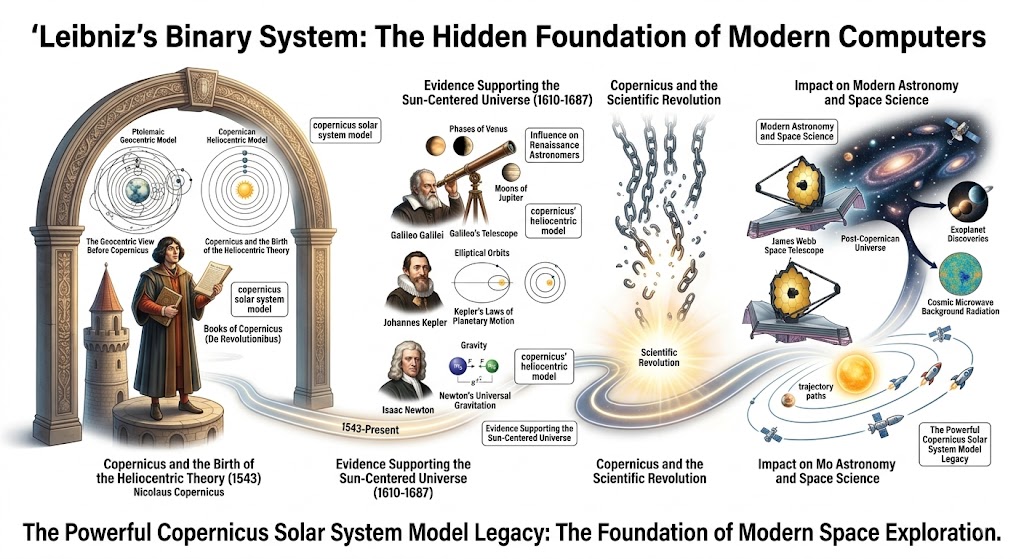
Just as copernicus solar system model shattered the geocentric view to reveal a new cosmic order, and how ancient greek scientists changed modern science by laying the groundwork for empirical thought, Leibniz changed the way we think about information and reasoning. He showed that the complexity of the world could be reduced to simple, binary choices.
As we stand on the brink of quantum computing and advanced artificial intelligence, we are still operating within the paradigm Leibniz initiated—the representation of information through discrete states. For this reason, Leibniz is rightly celebrated as the “Grandfather” of the Computer. His vision of a universal language, written in zeros and ones, has become the universal language of the modern world.