Introduction to Leibniz and the Invention of Calculus
Few intellectual achievements have reshaped human understanding as profoundly as the invention of calculus. This mathematical framework, which allows us to describe motion, change, and the infinite, is the language of modern physics, engineering, and economics. Yet the story of its creation is one of the most controversial and fascinating chapters in scientific history. At the heart of this drama stands Gottfried Wilhelm Leibniz, a German polymath whose leibniz calculus emerged from brilliant independent work in the 1670s. But was Leibniz a true independent genius, or did he merely borrow from his English rival, Isaac Newton? The answer reveals not only the nature of mathematical discovery but also the painful consequences of pride, nationalism, and the desperate human need for credit.
The question of who invented calculus first ignited a firestorm that burned for decades, splitting the scientific community into warring factions. The priority dispute in mathematics between Leibniz and Newton remains one of the most infamous rivalries in intellectual history. Yet modern scholarship overwhelmingly confirms that these two titans developed their methods independently, approaching the same profound truths from different philosophical directions. The leibniz calculus was not a theft but a parallel evolution of genius, a testament to how great minds, when confronted with the mysteries of motion and infinity, arrive at similar conclusions through unique paths.
The Paris Years: Where the Leibnizian Calculus Was Born
To understand the origins of leibniz calculus, we must travel to Paris in the 1670s. Leibniz arrived in the French capital in 1672 as a diplomat and mathematician, but he arrived with relatively limited formal training in advanced mathematics. What he possessed, however, was an insatiable curiosity and a remarkable ability to synthesize ideas from disparate fields.
During his Paris years (1672-1676), Leibniz immersed himself in the work of leading mathematicians. He studied under Christiaan Huygens, the Dutch master of geometry, who became his mentor. Huygens recognized Leibniz’s extraordinary talent and assigned him problems to sharpen his skills. It was during this period that Leibniz began to develop the fundamental concepts that would become leibniz calculus.
The breakthrough came in 1675. While working on problems of area and tangents, Leibniz began to see a deep connection between the two operations. He realized that finding the area under a curve (integration) was the inverse of finding the slope of a tangent line (differentiation). This insight, known as the Fundamental Theorem of Calculus, was the cornerstone upon which leibniz calculus was built.
Leibniz’s approach was distinct from anything Newton was developing in England. While Newton thought in terms of continuous motion and “fluxions,” Leibniz approached problems through the manipulation of infinitesimal quantities. He introduced the now famous notation that makes calculus so powerful and accessible: Leibniz Calculus Notation—the dy/dx for derivatives and the elongated S (∫) for integrals. This notation was not merely a convenience; it reflected Leibniz’s philosophical belief that the right symbols could make complex reasoning almost mechanical.
Independent Discovery: Proving Leibniz Didn’t Copy Newton
The accusation that Leibniz plagiarized Newton has haunted his legacy for centuries. However, a careful examination of the historical record and the mathematical evidence reveals a compelling case for independent discovery of math. Both men arrived at calculus through their own intellectual journeys, driven by different problems and guided by different philosophies.
Differences in Philosophical Approach
The philosophical foundations of leibniz calculus and Newton’s Method of Fluxions could not have been more different. Newton was a physicist at heart. His calculus grew directly from his study of motion and mechanics. He conceived of quantities as flowing continuously, and he called his instantaneous rates of change “fluxions.” His notation used dots above variables (ẋ, ÿ) to represent these rates. Newton’s approach was deeply rooted in physical intuition and the geometry of moving bodies.
Leibniz, by contrast, was a philosopher who approached mathematics as a branch of logic. His leibniz calculus emerged from his work on infinite series and the summation of infinitely small differences. He conceived of curves as composed of infinitesimal triangles and rectangles, and his notation reflected this combinatorial view. The dy/dx notation was not arbitrary; it represented the ratio of two infinitesimal differences, a concept that aligned perfectly with his philosophical commitment to a universal language of thought.
These contrasting approaches produced two versions of calculus that were mathematically equivalent but conceptually distinct. A physicist might naturally gravitate toward Newton’s fluxions, while a mathematician or logician would find Leibniz’s notation more elegant and flexible. This divergence is strong evidence that leibniz discoveries were genuinely independent, rooted in a different intellectual tradition.
The Timeline of 1675: The First Integral
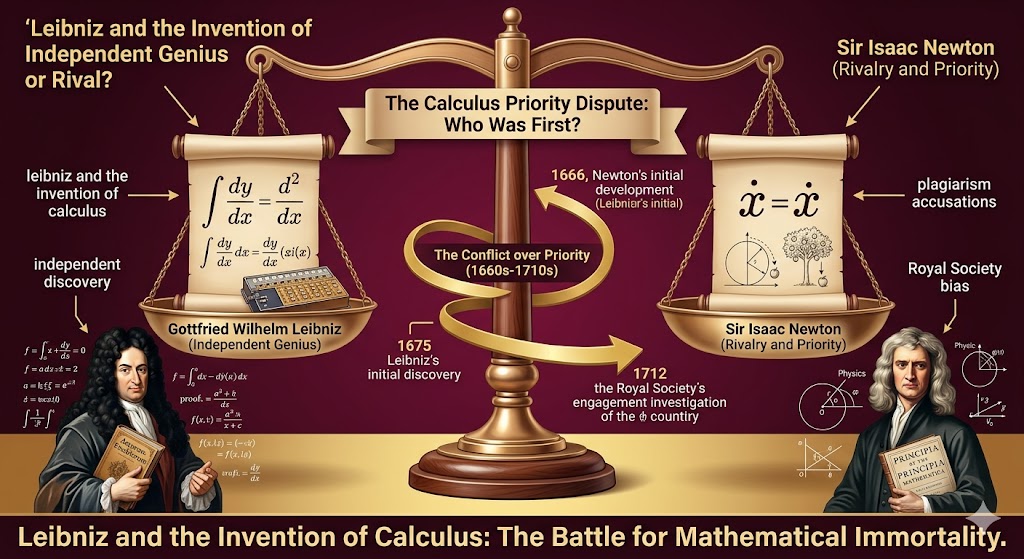
The chronology of discovery provides perhaps the strongest evidence for independence. Newton later claimed to have developed his method of fluxions in 1665-1666, during his “annus mirabilis” when he retreated to Woolsthorpe Manor to escape the plague. However, Newton published nothing on calculus until 1687, when he included a limited exposition in the Principia.
Leibniz, meanwhile, began developing his calculus in 1675. In a surviving manuscript from November 11, 1675, Leibniz first wrote the integral symbol and demonstrated the inverse relationship between differentiation and integration. He wrote:
This was the first explicit statement of the Fundamental Theorem of Calculus in Leibniz’s notation. Over the following months, he developed the rules for differentiating products, quotients, and powers, establishing the foundation of leibniz calculus as a systematic mathematical discipline.
By 1677, Leibniz had a fully developed calculus and began sharing his results in correspondence with mathematicians across Europe. His letters to Henry Oldenburg, secretary of the Royal Society, contained clear expositions of his methods. There is no evidence that Leibniz had access to Newton’s unpublished work before developing his own system. The two men arrived at their discoveries independently, a remarkable example of convergent intellectual evolution.
The Royal Society Scandal and the Fallout of the “War”
Despite the evidence for independent discovery, the relationship between Leibniz and Newton soured dramatically in the early 18th century. The conflict, often called the “Great Feud,” began when supporters of Newton accused Leibniz of plagiarism. The dispute escalated into one of the ugliest controversies in scientific history, fueled by nationalism, personal pride, and the immense stakes of scientific priority.
The flashpoint came in 1704 when Newton published the Opticks with two mathematical appendices that hinted at his priority in calculus. An anonymous review (widely believed to be written by Newton’s supporter John Keill) accused Leibniz of plagiarizing Newton’s method. Leibniz demanded a retraction, and the battle was joined.
In 1712, the Royal Society appointed a committee to investigate the priority dispute in mathematics. The committee, heavily influenced by Newton (who was president of the Society at the time), published the Commercium Epistolicum, a document that presented evidence intended to show that Leibniz had borrowed from Newton. The report concluded in Newton’s favor, effectively accusing Leibniz of intellectual theft.
The Royal Society investigation was a travesty of scientific objectivity. Newton himself wrote the committee’s report, and the evidence was presented selectively to support the desired conclusion. The Commercium Epistolicum damaged Leibniz’s reputation for generations, portraying him as a plagiarist rather than an independent genius.
How the Controversy Split British and Continental Mathematics
The fallout from the priority dispute had profound and lasting consequences for the development of mathematics. The calculus controversy 17th century created a deep schism that separated British mathematicians from their continental counterparts for over a century.
British mathematicians, loyal to Newton, continued to use his Method of Fluxions and his dot notation. They isolated themselves from the innovations taking place across the English Channel. Meanwhile, continental mathematicians embraced leibniz calculus with its superior notation and more flexible algebraic approach. The Leibniz Calculus Notation proved to be far more conducive to further development. Its clarity allowed mathematicians like the Bernoullis, Euler, and Lagrange to extend calculus into new domains, creating differential equations, calculus of variations, and advanced analysis.
The consequences of this schism were dramatic. While British mathematics stagnated in the 18th century, clinging to outdated methods and isolationist practices, continental mathematics flourished. The history of calculus was shaped by this division, with the Leibnizian tradition ultimately triumphing as the global standard. It was not until the early 19th century, when British mathematicians like Charles Babbage and John Herschel formed the Analytical Society to promote Leibnizian notation, that British mathematics began to recover from the damage wrought by the dispute.
Today, the notation used in every calculus classroom around the world is Leibniz’s. Every student who writes dy/dx or ∫ f(x) dx is using the symbols Leibniz created, a testament to the enduring power of his approach.
Frequently Asked Questions (FAQs)
1. Did Leibniz invent calculus independently from Newton?
Yes, modern historical scholarship confirms that Gottfried Wilhelm Leibniz developed his calculus independently. While Newton began his work on fluxions earlier (around 1665-1666), Leibniz developed his own system starting in 1675 without access to Newton’s unpublished manuscripts. The two men arrived at their discoveries through different philosophical approaches and mathematical traditions.
2. What is the difference between Leibniz calculus and Newton’s Method of Fluxions?
The primary difference lies in notation and philosophical approach. Leibniz calculus uses dy/dx for derivatives and the integral symbol (∫) for antiderivatives, reflecting his view of infinitesimals as ratios. Newton’s Method of Fluxions used dots above variables (ẋ) to represent rates of change and was rooted in physical motion and geometry. Leibniz’s notation proved more flexible and became the global standard.
3. Why did the Royal Society investigate the calculus priority dispute?
In 1712, the Royal Society formed a committee to investigate accusations that Leibniz had plagiarized Newton’s calculus. The committee, heavily influenced by Newton who served as Society president, published the Commercium Epistolicum, which concluded that Newton had priority and implied Leibniz was a plagiarist. The investigation is now widely regarded as biased and unscientific.
4. What was the impact of the calculus controversy on mathematics?
The priority dispute split European mathematics for over a century. British mathematicians continued using Newton’s fluxion notation and isolated themselves from continental developments, leading to a period of stagnation. Continental mathematicians embraced leibniz calculus and its notation, driving rapid advances in differential equations, analysis, and applied mathematics. By the 19th century, Leibnizian notation had become the universal standard.
5. What other contributions did Leibniz make to mathematics and science?
Beyond calculus, Leibniz made numerous significant contributions. His Leibniz Binary System established the foundation for modern computing. He invented the Leibniz Step Reckoner, one of the first mechanical calculators. His Leibniz Universal Logic anticipated modern symbolic logic. He also made important contributions to physics, engineering, and philosophy, making him one of the last true polymaths of the Scientific Revolution.
Conclusion: Recognizing Two Giants of the Scientific Revolution
The story of leibniz calculus is ultimately a story of two extraordinary minds reaching toward the same mathematical horizon from different shores. Isaac Newton and Gottfried Wilhelm Leibniz were both giants of the Scientific Revolution, and both deserve recognition for their monumental contributions. The priority dispute, however bitter and destructive, should not obscure the fundamental truth that both men invented calculus independently.
Leibniz’s contributions extended far beyond calculus. His Leibniz Binary System laid the foundation for modern computing. His Leibniz Step Reckoner was a mechanical marvel that advanced the dream of automated calculation. His Leibniz Universal Logic envisioned a language of thought that anticipated modern symbolic logic and artificial intelligence. These leibniz discoveries reveal a mind of astonishing breadth and originality.
Just as copernicus solar system model transformed our understanding of the cosmos by placing the Sun at the center, and just as the intellectual traditions described in how ancient greek scientists changed modern science established the foundations of rational inquiry, Leibniz and Newton together transformed mathematics into the language of modern science. Their calculus gave humanity the tools to describe motion, predict planetary orbits, design bridges, and ultimately build the technological world we inhabit.
The question posed by the title independent genius or rival finds its answer in a generous recognition of both. Leibniz was not a rival in the sense of a competitor who stole his ideas; he was a parallel genius who approached the infinite through his own unique door. The leibniz calculus stands as one of the most powerful intellectual achievements in human history, a monument to the power of independent thought and the enduring beauty of mathematical truth.