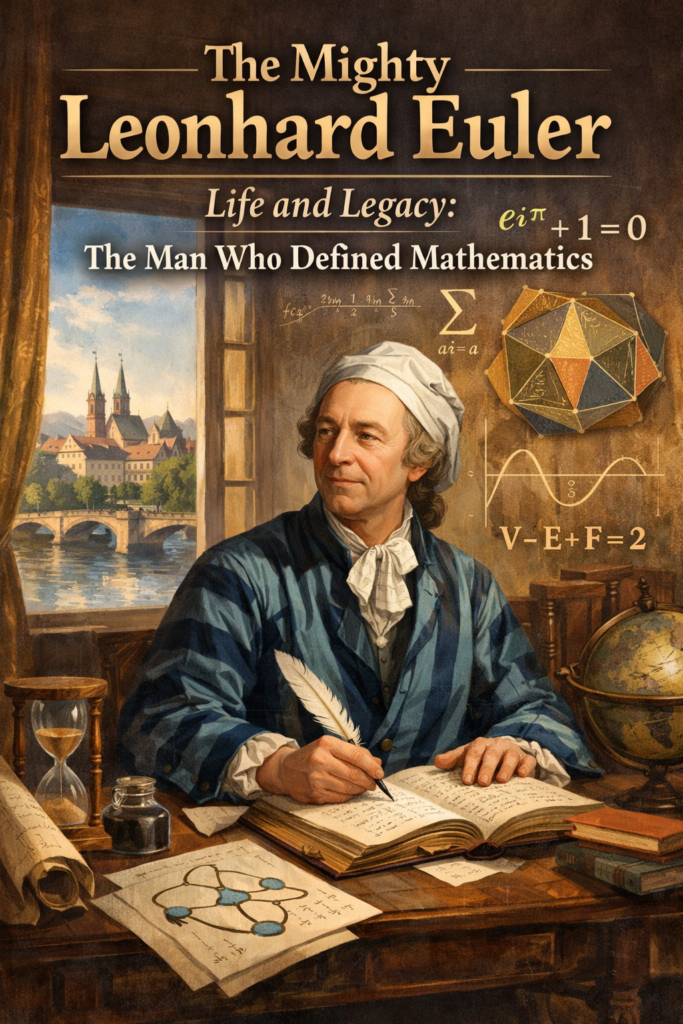
When we look back at the giants who built the world of numbers, one name stands above the rest for his sheer productivity and brilliance. Understanding the leonhard euler life and legacy is like looking at the blueprint of modern science itself. Euler was not just a mathematician; he was a force of nature who authored nearly a third of all the mathematical and scientific research published in the 18th century. His story is one of a legendary mind that refused to be silenced, even by total blindness. From his early days in Switzerland to his dominant years in Russia and Prussia, the leonhard euler life and legacy serves as a testament to the power of human intellect and tireless dedication to the truth of the universe.
Introduction to the Prince of Mathematicians
Leonhard Euler was born on April 15, 1707, in Basel, Switzerland. He lived during the Enlightenment, a period of massive intellectual growth, yet he managed to outshine almost all his contemporaries. The leonhard euler life and legacy began in a modest home where his father, a pastor, hoped Leonhard would follow him into the ministry. However, the universe had different plans.
Euler’s mind was built for the abstract and the complex. He possessed a photographic memory and a mental calculation ability that bordered on the supernatural. It is often said that Euler calculated without effort, “just as men breathe, or as eagles sustain themselves in the air.” This natural ease with numbers is the cornerstone of the leonhard euler life and legacy, leading to a career that spanned every branch of mathematics and physics known at the time.
Early Life and Family Background
The roots of the leonhard euler life and legacy are found in the city of Basel. His father, Paul Euler, was a friend of the Bernoulli family—a dynasty of famous mathematicians. It was this connection that saved Euler from a life of theology. Johann Bernoulli, perhaps the greatest mathematician of that era, recognized Leonhard’s incredible talent and convinced his father that the boy was destined for mathematical greatness.
Euler’s upbringing was scholarly and disciplined. By the age of thirteen, he had already entered the University of Basel. His childhood was not filled with the typical play of youth but with the rigorous pursuit of knowledge. This early start provided the momentum for the leonhard euler life and legacy, allowing him to complete his Master’s degree by the age of 16, defending a thesis that compared the philosophies of Descartes and Newton.
Education: The Influence of the Bernoullis
You cannot talk about the leonhard euler life and legacy without mentioning his education under Johann Bernoulli. While Euler was officially studying theology and Hebrew to please his father, he spent his Saturday afternoons receiving private lessons from Bernoulli. These sessions were the “mighty” catalyst for his career.
Bernoulli didn’t just teach Euler; he challenged him to solve problems that were at the cutting edge of 18th-century research. By the time Euler was 19, he had already published his first scientific paper and won a prize from the Paris Academy for his work on the optimal placement of masts on a ship. This period of his life established the technical foundation for the leonhard euler life and legacy, proving that he was ready to compete on a global stage.
Career in St. Petersburg and Berlin
The professional leonhard euler life and legacy was divided between two major European capitals: St. Petersburg and Berlin. In 1727, Euler moved to Russia to join the Imperial Russian Academy of Sciences. He originally arrived to fill a post in the medical department, but his genius quickly landed him in the mathematics division.
In 1741, due to political instability in Russia, Euler accepted an invitation from Frederick the Great to join the Berlin Academy. He spent 25 years in Berlin, where he wrote hundreds of papers. However, he eventually returned to St. Petersburg in 1766, where he spent the remainder of his life. These two cities provided the resources and the audience needed to cultivate the leonhard euler life and legacy, allowing him to produce work at a pace that has never been matched by any other human being.
A Glimpse into Euler’s Monumental Discoveries
While we will explore these in depth in future articles, the leonhard euler life and legacy is built upon several pillars of discovery. He didn’t just solve problems; he created the very language we use to solve them.
- Mathematical Notation: Euler introduced the notation for a function $f(x), the Greek letter $\Sigma$ for summations, and the letter $i for imaginary numbers.
- Analysis: His euler calculus work redefined the field, moving it away from the geometric methods of the past and into the modern algebraic form we use today.
- Constants: He is the namesake of the euler number e, a constant that is essential to understanding growth and decay in the natural world.
- The Most Beautiful Equation: He formulated what is now known as euler formula, which links trigonometry, complex numbers, and the base of natural logarithms in a single, elegant stroke.
Innovations in Physics and Engineering
The leonhard euler life and legacy was not confined to paper and ink; it extended to the physical world. He was a pioneer in what we now call euler physics work, contributing to the study of fluid dynamics, optics, and the mechanics of rigid bodies. He developed equations that describe how fluids flow and how beams bend under pressure.
His work was essential for the engineering of bridges, ships, and early machinery. He even applied his mind to the movement of the moon and planets, providing tables that were more accurate than any seen before. The “mighty” breadth of his work is a key reason why the leonhard euler life and legacy remains so influential in every STEM field today.
Graph Theory and the Seven Bridges of Königsberg
One of the most unique parts of the leonhard euler life and legacy is his creation of an entirely new branch of mathematics. When asked if it was possible to walk through the city of Königsberg crossing each of its seven bridges exactly once, Euler proved it was impossible.
In doing so, he laid the foundations for euler graph theory. This wasn’t just a puzzle; it was the birth of topology. Today, graph theory is the “power” behind Google Maps, social media algorithms, and internet routing. This single discovery alone would have secured the leonhard euler life and legacy, yet for him, it was just one of many breakthroughs.
Overcoming Adversity: The Blind Mathematician
Perhaps the most inspiring aspect of the leonhard euler life and legacy is his resilience. In his thirties, Euler lost sight in his right eye due to a near-fatal fever. Later in life, a cataract in his left eye left him almost totally blind.
Rather than stopping, Euler increased his output. He used a chalkboard for large-scale calculations and dictated his findings to his sons and assistants. Because of his incredible mental maps, he could “see” complex equations in his mind. Nearly half of his total output was produced after he had lost his sight. This “negative” physical condition was overcome by his “positive” mental strength, cementing the leonhard euler life and legacy as one of the greatest stories of human perseverance.
Euler’s Impact on Modern Science
Today, we live in a world built by Euler. His euler modern math influence is visible every time a student uses a calculator or an engineer designs a skyscraper. He simplified the complex and made the impossible manageable. The leonhard euler life and legacy is not a closed chapter in a history book; it is a living, breathing part of every scientific calculation performed today.
He was a family man, a father of thirteen children, and a deeply religious person who managed to stay humble despite his status as the “mighty” king of mathematics. As we look at how his work survives, we see that the leonhard euler life and legacy is essentially the story of how one man taught the world how to think in numbers.
Frequently Asked Questions (FAQs)
1. Why is Leonhard Euler considered so important?
Euler is vital because he standardized almost all modern mathematical notation and contributed to every branch of math and physics. His work is the foundation for calculus, engineering, and computer science.
2. Did Euler really discover everything?
While not everything, there is a joke in mathematics that discoveries are named after the second person to find them, because Euler usually found them first. His productivity was simply unparalleled.
3. What is Euler’s most famous equation?
Most mathematicians point to $e^{i\pi} + 1 = 0$. It is famous because it connects five of the most important constants in mathematics in one simple equation.
4. How did Euler contribute to physics?
He developed the Euler-Bernoulli beam theory and the Euler equations for inviscid fluid flow, which are still used today in aerospace and civil engineering.
5. Is the leonhard euler life and legacy still relevant today?
Absolutely. From the encryption that secures your credit card to the physics of the planes you fly in, Euler’s formulas are working behind the scenes.
Conclusion
In tracing the leonhard euler life and legacy, we find a man who was as prolific as he was profound. He took the scattered pieces of Renaissance science and organized them into the streamlined tools we use today. Much like how ancient greek scientists changed modern science by introducing logic and geometry, Euler changed the world by introducing the “power” of analytical mathematics. He was a bridge between the old world of philosophy and the new world of high-tech engineering. Whether you are a student or a scientist, the leonhard euler life and legacy offers a roadmap for curiosity, persistence, and the search for universal truth.