Introduction to Euler’s Formula
In the vast landscape of mathematics, few equations command the reverence and wonder inspired by a single elegant expression. It connects five of the most fundamental constants in mathematics, bridges geometry and algebra, and appears across disciplines from quantum mechanics to electrical engineering. This equation is euler formula, and it has been called the most beautiful theorem in all of mathematics.
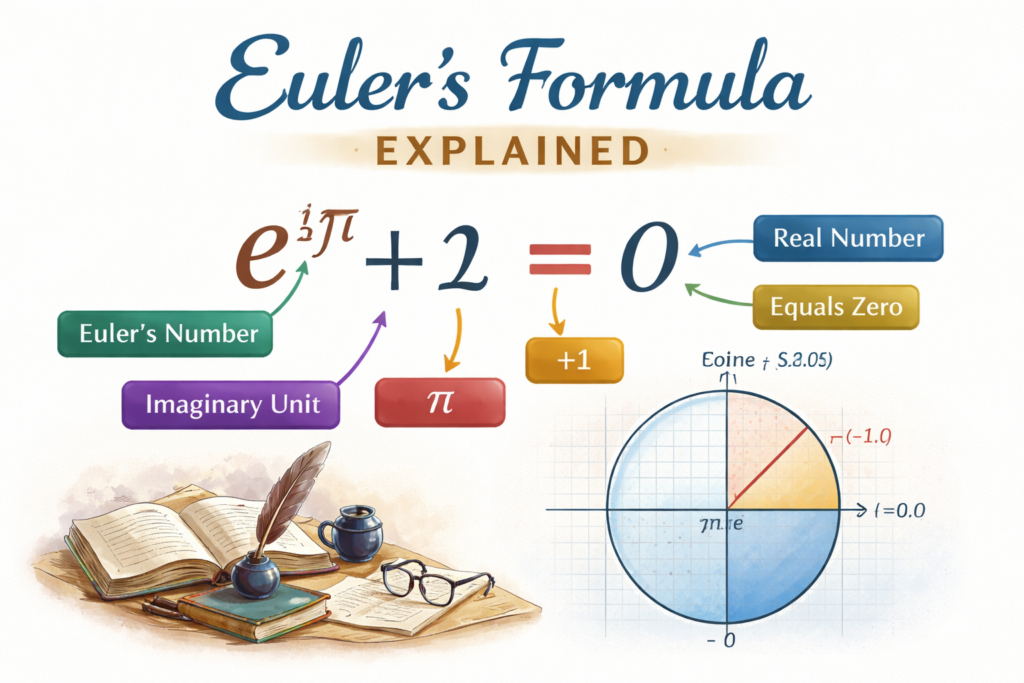
The euler formula is deceptively simple in its written form:
When , it yields the even more celebrated Euler’s identity:
What makes the euler formula so astonishing is how it unites concepts that seem entirely unrelated. The exponential function , which describes growth and decay. The imaginary unit , which defies ordinary intuition by representing the square root of negative one. The trigonometric functions cos and sin, which describe waves and circles. And the constant , which connects to the geometry of the circle itself. That these elements come together in such a harmonious relationship struck mathematicians as nothing short of miraculous when Leonhard Euler first derived it in the 18th century.
Breaking Down the Components: and 1
To truly appreciate the euler formula, we must understand each component and why their union is so remarkable. The equation brings together five constants that define the landscape of modern mathematics.
The Role of the Natural Logarithm Base
The constant , approximately 2.71828, is known as Euler’s number. It arises naturally in problems of continuous growth and decay. If you invest money with continuously compounded interest, or if you study the growth of populations under ideal conditions, you encounter . The function has the remarkable property that it is its own derivative:
This self-similarity makes the natural choice for describing any process where the rate of change is proportional to the current value. The euler number e is one of the most important constants in calculus and analysis.
In the context of the euler formula, the exponential function is extended to handle imaginary arguments. This extension was Euler’s great insight. He recognized that the exponential function, when fed an imaginary number, should produce a rotation rather than growth.
Understanding the Imaginary Unit in the Equation
The imaginary unit is defined as the square root of negative one:
This seemingly simple definition was controversial for centuries. Mathematicians struggled to accept numbers that did not correspond to any physical quantity. Yet proved essential for solving cubic equations and eventually became fundamental to our understanding of the physical world.
The powers of follow a repeating cycle that is crucial to understanding the euler formula:
This cyclical nature hints at rotation, which is exactly how the euler formula interprets imaginary exponents. Multiplying by corresponds to a 90-degree rotation in the complex plane.
The constant appears in the euler formula because of its deep connection to circles. When , the formula produces the celebrated identity . This is often rearranged to , which brings together , , , , and in a single equation.
The Geometry of Euler’s Formula: Motion on the Unit Circle
The true power of the euler formula becomes visible when we interpret it geometrically. The complex plane, with its real axis horizontal and imaginary axis vertical, provides a natural setting for understanding the equation.
Consider the complex number . As varies, this number traces a circle of radius 1 centered at the origin. When , we have , located at the point (1, 0) on the real axis. As increases to , we get , located at (0, 1) on the imaginary axis. At , we reach at (-1, 0). At , we return to 1, completing the circle.
This geometric interpretation reveals that the euler formula is describing rotation. The exponential function rotates a point around the unit circle by an angle radians. The real part gives the horizontal coordinate, and the imaginary part gives the vertical coordinate.
This insight transforms how we think about trigonometric functions. Instead of seeing sine and cosine as abstract ratios in triangles, we can view them as projections of circular motion. The unit circle and Euler concept becomes a unifying framework for understanding periodic phenomena.
The mathematical derivation of the euler formula relies on the Taylor series expansions of the exponential, cosine, and sine functions:
Substituting into the exponential series yields:
Grouping the real and imaginary terms reveals the cosine and sine series:
This derivation, using Taylor series expansion, confirms the validity of the euler formula and shows how the exponential function naturally gives rise to oscillatory behavior.
Why It Is Called the Most Beautiful Theorem
The euler formula has earned the title of the most beautiful equation in mathematics for several compelling reasons. When , it reduces to the even simpler identity of Euler:
This single equation contains five of the most important constants in mathematics. The additive identity 0. The multiplicative identity 1. The base of natural logarithms e, which governs growth and change. The imaginary unit i, which expanded the number system beyond the real line. And π, the ratio of a circle’s circumference to its diameter, linking geometry to analysis.
What makes this equation so astonishing is the beautiful unity it reveals. These constants originated in different times and contexts. Zero and one have been understood since antiquity. was known to the ancient Greeks. emerged from 17th-century studies of compound interest and logarithms. was developed in the Renaissance and Enlightenment as mathematicians grappled with the roots of polynomials. That they should combine in such a simple and elegant relationship seemed to many mathematicians like evidence of a deeper order underlying reality.
The physicist Richard Feynman called euler formula “the most remarkable formula in mathematics.” The philosopher and mathematician Bertrand Russell described the emotion it evoked as akin to that of a lover beholding a beautiful landscape. The mathematical beauty of the equation lies not merely in its simplicity but in the profound connections it reveals between previously separate domains of mathematics.
Practical Applications in Quantum Mechanics and Engineering
Beyond its aesthetic appeal, the euler formula is an indispensable tool across science and engineering. Its ability to represent oscillations as complex exponentials simplifies calculations that would otherwise require tedious trigonometric identities.
In quantum mechanics, the euler formula appears in the Schrödinger equation, which describes how quantum states evolve over time. The wavefunction of a free particle is often written as:
This complex exponential encodes both the wavelength and frequency of the particle. The complex analysis basics provided by the euler formula allow physicists to describe wave-like behavior in a compact and mathematically tractable form. Without this representation, quantum mechanics would be far more cumbersome to express and manipulate.
In electrical engineering, the euler formula is essential for analyzing alternating current circuits. Engineers represent sinusoidal voltages and currents as phasors, which are complex numbers that rotate in the complex plane. The relationship between voltage and current in capacitors and inductors becomes a simple multiplication or division by when expressed using complex exponentials. The frequency domain analysis of signals relies entirely on the Fourier transform, which decomposes signals into sums of complex exponentials using the euler formula.
The euler formula also appears in control theory, signal processing, acoustics, optics, and fluid dynamics. Anywhere oscillations or waves occur, complex exponentials provide the most natural mathematical description. The formula transforms problems involving trigonometric functions into algebraic problems, making analysis and computation vastly simpler.
Frequently Asked Questions (FAQs)
1. What is the euler formula?
The euler formula states that . It connects complex exponentials with trigonometric functions and is one of the most important equations in mathematics.
2. Why is euler formula considered the most beautiful equation?
The euler formula is considered beautiful because it unites five fundamental constants (, , , , and ) in a single elegant expression when , yielding .
3. What are the practical applications of euler formula?
The euler formula is used extensively in quantum mechanics, electrical engineering, signal processing, control theory, acoustics, and optics. It simplifies the analysis of waves, oscillations, and alternating currents.
4. How was the euler formula discovered?
Euler derived the formula using Taylor series expansions of the exponential, cosine, and sine functions. He showed that substituting imaginary numbers into the exponential series yields the trigonometric series.
5. Who was Leonhard Euler?
Leonhard Euler was an 18th-century Swiss mathematician who made foundational contributions to calculus, graph theory, physics, and analysis. He is considered one of the greatest and most prolific mathematicians in history.
Conclusion: The Unifying Power of Euler’s Identity
Leonhard Euler stands as one of history’s most prolific mathematicians, and the euler formula is perhaps his greatest gift to the world. The equation encapsulates his genius for finding connections where others saw separation. It unites the exponential, trigonometric, and algebraic realms into a single coherent framework.
Euler’s contributions extended far beyond this single formula. His leonhard euler life and legacy includes foundational work in euler calculus work, euler graph theory, euler physics work, and countless other fields. His influence on euler modern math influence is so pervasive that he is considered the most productive mathematician in history.
The euler formula continues to inspire new generations of mathematicians, scientists, and engineers. It appears in the equations that describe quantum particles, the signals that transmit information across the internet, and the fundamental laws of electromagnetism. Its elegance and power remind us that mathematics is not merely a collection of rules but a window into the hidden structure of reality.
Just as how ancient greek scientists changed modern science by establishing the foundations of rational inquiry, Euler transformed mathematics by revealing the deep connections between its branches. His formula, so simple to write yet so profound in meaning, stands as a testament to the beautiful unity that mathematics reveals. In the euler formula, we see not only a powerful tool for calculation but also a glimpse of something deeper: the extraordinary harmony underlying the universe.