How Euler Built the Language of Modern Calculus
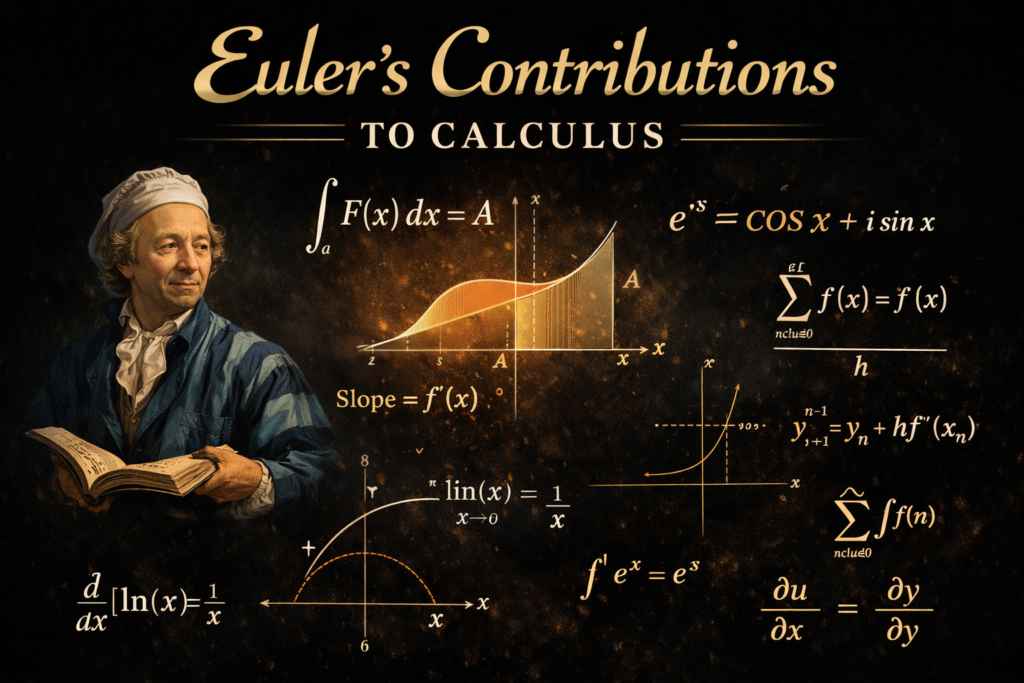
Before Leonhard Euler, calculus was a revolutionary but fragmented collection of ideas. Newton and Leibniz had laid the foundations, but the subject lacked coherence, standardized notation, and systematic methods. By the time Euler finished his work, calculus had become a unified discipline, capable of solving problems that had seemed impossible. The astonishing transformation wrought by euler calculus remains one of the most significant achievements in intellectual history.
Euler did not merely extend calculus; he rebuilt it from the ground up. His textbooks, particularly Introductio in Analysin Infinitorum (Introduction to the Analysis of the Infinite), Institutiones Calculi Differentialis (Foundations of Differential Calculus), and Institutiones Calculi Integralis (Foundations of Integral Calculus), became the standard references for generations. They introduced the notation, concepts, and methods that define calculus to this day. The euler calculus approach emphasized the power of infinite series, the importance of functions, and the deep connections between differential and integral calculus.
What made euler calculus so powerful was its systematic nature. Where earlier mathematicians often approached problems geometrically, Euler treated calculus as an algebraic and analytic discipline. He showed that functions, rather than geometric curves, should be the central objects of study. This shift opened up vast new territories for exploration and made calculus accessible to a much wider audience.
The Shift from Geometry to Analysis
The most fundamental change Euler brought to mathematics was the shift from geometry to analysis. Before Euler, calculus was largely understood through geometric diagrams. Derivatives were slopes of tangent lines. Integrals were areas under curves. While these geometric interpretations remain valuable, they limited the scope of what calculus could describe.
Euler recognized that functions were the proper foundation for calculus. He defined a function as any expression composed of variables and constants combined through algebraic and transcendental operations. This definition allowed him to treat functions abstractly, without constant reference to their geometric meaning.
Consider the function . Its derivative is:
Under the geometric approach, this represents the slope of the parabola at any point. Under Euler’s analytic approach, it is simply the result of applying a rule to an expression. This might seem like a subtle distinction, but it liberated calculus from the constraints of geometry and allowed mathematicians to work with functions that could not be easily visualized.
Standardizing Mathematical Notation
Perhaps Euler’s most visible contribution to euler calculus was his standardization of notation. Many of the symbols we take for granted today were introduced or popularized by Euler.
The notation for a function of x is Euler’s invention. Before Euler, mathematicians often described functions in cumbersome prose. Euler recognized that a compact notation for functions would make calculus much more manageable. This simple innovation allowed mathematicians to write expressions like with ease, facilitating the development of difference quotients and derivatives.
The summation notation was also popularized by Euler. While others had used similar symbols, Euler made the standard way to represent sums of series. For example, the sum of the first squares is written as:
Euler also introduced the symbol e for the base of natural logarithms. He chose this letter because it was the first unoccupied vowel, but the constant itself is deeply connected to his work. The euler number e appears throughout calculus, from the derivative of exponential functions to the solutions of differential equations.
Euler’s commitment to clear notation extended to his textbooks. He organized material systematically, introduced concepts in logical order, and provided numerous examples. This pedagogical approach made euler calculus accessible to students across Europe and helped establish it as the standard approach.
Solving the Unsolvable: The Basel Problem Discovery
One of Euler’s most astonishing achievements was solving the Basel Problem, a challenge that had baffled the greatest mathematicians for nearly a century. The problem asked for the exact sum of the infinite series of reciprocal squares:
Mathematicians knew the series converged to roughly 1.6449, but no one could find its exact value. The problem seemed unsolvable, a testament to the limitations of existing methods.
Euler solved it in 1735, using insights from euler calculus that no one else had thought to apply. He considered the infinite product expansion of the sine function:
He also expressed as an infinite product over its roots:
By expanding this product and comparing the coefficient of with the series expansion, Euler discovered that:
Therefore:
This result was revolutionary. It showed that the seemingly arbitrary number 1.6449 was actually , connecting number theory, analysis, and geometry in a profound way. Euler’s solution to the Basel Problem established him as the preeminent mathematician of his age and demonstrated the extraordinary power of euler calculus when applied to infinite series.
Euler’s Method: A Foundation for Numerical Analysis
Not all problems in calculus can be solved exactly. Many differential equations, particularly those describing real-world phenomena, resist analytic solutions. Euler developed a numerical technique that remains one of the most widely used methods in applied mathematics: Euler’s Method.
Euler’s Method provides a way to approximate solutions to differential equations when exact solutions are unavailable. Consider a first order differential equation:
with initial condition . Euler’s Method approximates the solution by taking small steps:
Here, is the step size. Starting from the initial point, the method uses the derivative to estimate the change in over the interval , then repeats the process.
The error in Euler’s Method is proportional to the step size , meaning that smaller steps yield more accurate approximations. This technique forms the foundation of modern numerical analysis and is used extensively in computer simulations, engineering design, and scientific computing. The differential equations Euler method remains a cornerstone of computational mathematics.
The Calculus of Variations and Its Impact on Physics
Euler’s contributions extended beyond the calculus of functions to the calculus of variations, a field that deals with finding functions that optimize certain quantities. This work had profound implications for physics and engineering.
The calculus of variations asks questions like: what shape of curve minimizes the time a bead takes to slide down a wire? Or what shape of surface minimizes surface tension? These problems cannot be solved with ordinary calculus, which finds maxima and minima of numbers. Instead, they require finding functions that extremize integrals.
Euler developed the fundamental equation of the calculus of variations, now known as the Euler-Lagrange equation. For a functional of the form:
the function that extremizes satisfies:
This equation became the foundation of Lagrangian mechanics, which reformulated classical physics in terms of energy rather than forces. Lagrange later built on Euler’s work to develop his famous mechanics, but the core equation bears Euler’s name alongside Lagrange’s.
The calculus of variations Euler developed also found applications in optimal control theory, economics, and even machine learning. Modern neural networks, which optimize loss functions to learn from data, operate on principles that trace back to Euler’s variational methods.
Frequently Asked Questions (FAQs)
1. What is euler calculus?
euler calculus refers to the body of work Leonhard Euler contributed to the development of calculus, including standardization of notation, systematic methods for differentiation and integration, infinite series analysis, and the calculus of variations.
2. What notation did Euler introduce to calculus?
Euler introduced or popularized for functions, for summation, and the constant for the base of natural logarithms. He also standardized much of the notation used in differential and integral calculus.
3. What was the Basel Problem and how did Euler solve it?
The Basel Problem asked for the exact sum of the reciprocals of squares. Euler proved the sum equals by comparing the series expansion of with its infinite product representation.
4. What is Euler’s Method?
Euler’s Method is a numerical technique for approximating solutions to differential equations. It uses small steps, estimating the next value from the current value and the derivative, making it fundamental to numerical analysis.
5. What is the calculus of variations?
The calculus of variations is a field Euler helped create that finds functions optimizing certain integrals. The Euler-Lagrange equation he developed became the foundation of Lagrangian mechanics and modern optimal control theory.
Conclusion: Why Euler is the Father of Functional Analysis
Leonhard Euler’s contributions to calculus were so extensive and so foundational that he is rightly called the father of modern analysis. His textbooks set the curriculum for generations of mathematicians. His notation became the universal language of the field. His solutions to problems like the Basel Problem demonstrated the extraordinary power of analytic methods. His numerical techniques remain essential tools in science and engineering.
The leonhard euler life and legacy extends across every branch of mathematics. His euler formula, connecting exponentials to trigonometry, is one of the most celebrated equations in all of mathematics. His euler graph theory work laid the foundation for network science. His euler physics work transformed mechanics and optics. Together, these achievements make his euler modern math influence perhaps greater than any other mathematician in history.
Just as how ancient greek scientists changed modern science by establishing the foundations of rational inquiry, Euler transformed mathematics by giving it a unified language and systematic methods. His vision of calculus as the study of functions, expressed through clear notation and powerful techniques, remains the framework within which mathematicians and scientists work today.
Euler’s astonishing productivity meant that he published foundational results in dozens of fields. He continued working even after losing his eyesight, dictating papers to assistants with undiminished clarity. His euler calculus work alone would have secured his place in history, but it represents only a fraction of his total contribution. In the history of mathematics, there is Euler, and then there is everyone else.