The Seven Bridges of Königsberg: The Puzzle That Started It All
In the 18th century, the Prussian city of Königsberg stood as a thriving center of commerce and culture. The Pregel River flowed through the city, dividing it into four distinct land regions connected by seven bridges. For generations, the residents had entertained themselves with a curious puzzle: could a person walk through the city, crossing each of the seven bridges exactly once, and return to their starting point? The problem seemed simple, yet no one could find a solution. No one could prove it impossible either.
The Seven Bridges of Königsberg puzzle became a local legend. Residents would stroll along the river, trying different routes, but always finding themselves either crossing a bridge twice or failing to return home. The puzzle was a delightful but frustrating mystery until it reached the ears of Leonhard Euler, the most brilliant mathematician of his age.
Euler, who was living in Berlin at the time, approached the problem not as a puzzle to be solved through trial and error but as a mathematical question to be analyzed. What made his approach astonishing was his decision to strip away everything irrelevant. He realized that the precise geography of the city did not matter. The length of the bridges was irrelevant. The shape of the riverbanks was irrelevant. What mattered were only two things: the land regions and the bridges connecting them.
In 1736, Euler published his solution in a paper titled Solutio problematis ad geometriam situs pertinentis (The Solution of a Problem Relating to the Geometry of Position). In doing so, he did more than solve a local puzzle. He created an entirely new branch of mathematics. This moment marked the birth of euler graph theory, a field that would grow to become essential in computer science, logistics, biology, and social network analysis.
Defining the Elements: Vertices, Edges, and Faces
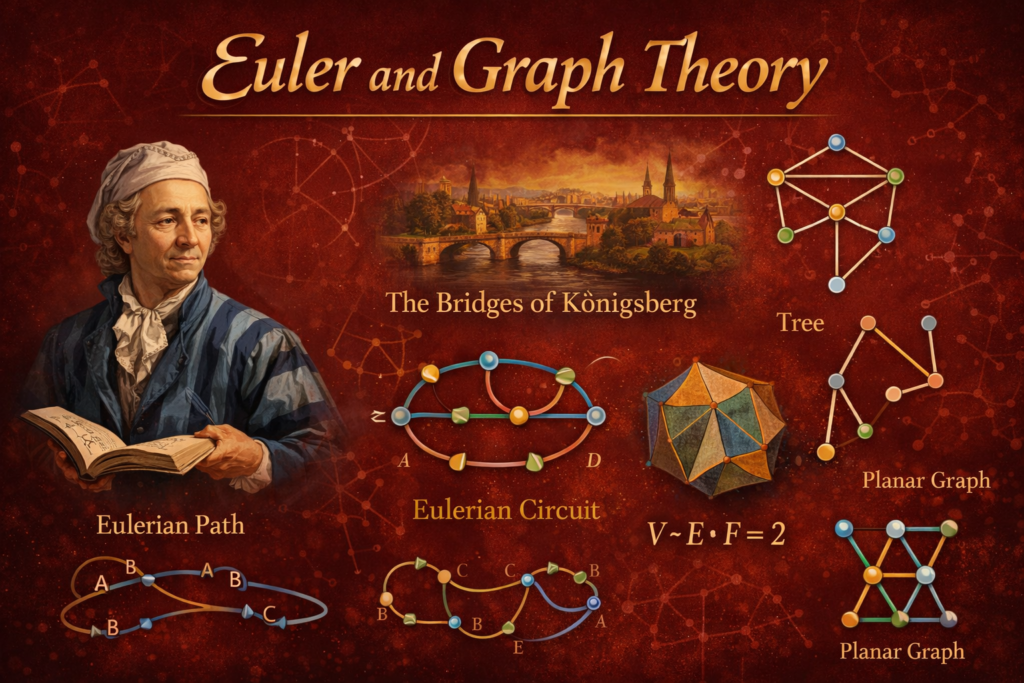
Euler’s genius was to recognize that the Königsberg bridges problem was fundamentally about connections rather than distances. He abstracted the four land regions into points, which he called “vertices,” and the seven bridges into lines connecting those points, which he called “edges.” The resulting structure, a collection of vertices connected by edges, became known as a graph.
In mathematical terms, Euler defined the problem as follows. Let the four land regions be represented by vertices , , , and . The seven bridges become edges connecting these vertices:
- One bridge connected and
- Two bridges connected and
- Two bridges connected and
- One bridge connected and
- One bridge connected and
The question became: does there exist a walk that traverses each edge exactly once and returns to the starting vertex?
Euler introduced a key concept: the degree of a vertex, which is the number of edges incident to that vertex. In the Königsberg graph:
- Vertex A had degree 5 (connected by one bridge to B, two to C, and two to D)
- Vertex B had degree 3 (connected by one bridge to A and one to D, plus a direct connection not to C)
- Vertex C had degree 3
- Vertex D had degree 3
This seemingly simple observation held the key to the entire problem.
The Proof of Impossibility
Euler reasoned that for a walk to traverse every edge exactly once and return to the starting point, the walk must enter and leave each vertex an equal number of times. Every time the walk arrives at a vertex, it must also depart, except for the starting vertex where arrival equals departure. This means that each vertex must be connected by an even number of edges. Every time you enter, you must leave, so the edges must come in pairs.
In mathematical terms, if a graph contains a closed trail that uses every edge exactly once (now called an Eulerian circuit), then every vertex in the graph must have an even degree.
Euler also considered the possibility of a walk that traverses every edge exactly once but does not return to the start (now called an Eulerian path). He proved that such a path exists if and only if exactly zero or two vertices have odd degree. If zero vertices have odd degree, a closed circuit exists. If exactly two vertices have odd degree, an open path exists starting at one odd vertex and ending at the other.
In the Königsberg graph, all four vertices had odd degrees. Therefore, Euler concluded that no walk could cross each bridge exactly once. The puzzle that had confounded generations was mathematically impossible. This was the first theorem in euler graph theory, and it established a framework for analyzing connectivity that remains fundamental today.
Euler’s Polyhedron Formula: The Secret Geometry of Shapes
While solving the bridge problem, Euler was also developing another profound insight that would become central to graph theory and topology. He discovered a remarkable relationship between the vertices, edges, and faces of polyhedra: .
For any convex polyhedron, if you count the number of vertices (), subtract the number of edges (), and add the number of faces (), the result is always 2. Consider a cube: it has 8 vertices, 12 edges, and 6 faces:
Consider a tetrahedron: it has 4 vertices, 6 edges, and 4 faces:4−6+4=2
Consider a dodecahedron: it has 20 vertices, 30 edges, and 12 faces:20−30+12=2
This astonishing formula, now known as Euler’s Polyhedron Formula, reveals a deep invariant in the structure of shapes. It was the first major result in what would become the field of topology, the study of properties that remain unchanged under continuous deformation.
The formula connects euler graph theory to geometry in a profound way. When a polyhedron is projected onto a plane, it becomes a planar graph—a graph drawn on a plane with no edges crossing. For any connected planar graph, Euler’s formula becomes:
where now counts the faces including the outer infinite face. This relationship became a cornerstone of graph theory and has applications in map coloring, network design, and computational geometry.
From Bridges to the Internet: The Evolution of Network Theory
What began as a puzzle about bridges in a Prussian city has evolved into the mathematical foundation for understanding networks of all kinds. The origins of topology and graph theory that Euler established now underpin the study of the internet, social networks, transportation systems, and biological networks.
The internet is perhaps the most dramatic example of euler graph theory in action. The World Wide Web is a graph where web pages are vertices and hyperlinks are edges. Search engines like Google use graph algorithms to rank pages. The PageRank algorithm, which revolutionized web search, relies on analyzing the connectivity structure of the web graph.
Social networks like Facebook, Twitter, and LinkedIn are also graphs. Each person is a vertex, and friendships or follows are edges. Network theory history shows how Euler’s insights enable researchers to study phenomena like information spread, community detection, and influence maximization. The concept of network topology, which Euler pioneered, is essential for understanding how diseases spread, how memes go viral, and how political opinions form.
In biology, graph theory helps map neural connections in the brain, understand protein interaction networks, and model food webs in ecosystems. In logistics, companies like Amazon and FedEx use graph algorithms to optimize delivery routes, solve problems directly descended from Euler’s bridge puzzle. The modern world runs on graphs, and the foundational ideas all trace back to Euler’s 1736 paper.
Eulerian Paths and Their Importance in Modern Logistics
The specific problem Euler solved—finding a path that traverses every edge exactly once—has become known as the Eulerian circuit or Eulerian path problem. While the Königsberg bridge problem had no solution, many real-world applications require finding such paths efficiently.
The Chinese Postman Problem, also known as the route inspection problem, asks for the shortest route that traverses every edge of a graph at least once and returns to the starting point. This problem has direct applications in mail delivery, snow plowing, garbage collection, and street sweeping. The solution builds on Euler’s foundational insight: if a graph has vertices of odd degree, the postman must traverse some edges multiple times to make all degrees even.
In manufacturing, Eulerian paths appear in circuit board testing and robotic path planning. When testing whether every connection on a circuit board is properly soldered, a robot needs to traverse each connection exactly once. Euler’s theorem provides the mathematical guarantee that such a path exists only under specific conditions.
In bioinformatics, Eulerian paths help assemble DNA sequences. The problem of reconstructing a genome from short DNA fragments can be modeled as finding an Eulerian path through a graph where vertices represent overlapping sequences. This application, developed in the 21st century, shows how euler graph theory continues to solve problems Euler never could have imagined.
Frequently Asked Questions (FAQs)
1. What is euler graph theory?
euler graph theory is the branch of mathematics that began with Euler’s solution to the Seven Bridges of Königsberg problem. It studies graphs, which are structures consisting of vertices connected by edges, and explores properties like connectivity, traversability, and planar representation.
2. What was the Seven Bridges of Königsberg problem?
The problem asked whether a person could walk through Königsberg crossing each of the seven bridges exactly once and return to the starting point. Euler proved it was impossible because all four land regions had an odd number of bridges.
3. What is an Eulerian path?
An Eulerian path is a trail that traverses every edge of a graph exactly once. An Eulerian circuit is a closed Eulerian path that starts and ends at the same vertex. Euler proved that such paths exist based on the parity of vertex degrees.
4. What is Euler’s Polyhedron Formula?
Euler’s Polyhedron Formula states that for any convex polyhedron, , where is the number of vertices, is the number of edges, and is the number of faces. This formula is fundamental to graph theory and topology.
5. How is euler graph theory used today?
Graph theory is used extensively in computer science for network analysis, search algorithms, and data structures. It appears in logistics for route optimization, in biology for understanding neural and protein networks, and in social science for analyzing connections between people.
Conclusion: How Euler Taught Us to See Connections
Leonhard Euler’s solution to the Seven Bridges of Königsberg was more than an answer to a parlor puzzle. It was a new way of thinking about the world. By abstracting away irrelevant details and focusing on pure connections, Euler taught us that the essence of many problems lies not in distances or shapes but in relationships.
The leonhard euler life and legacy encompasses so much more than graph theory. His euler formula connects exponentials to trigonometry. His euler calculus work transformed mathematical analysis. His euler physics work advanced mechanics and optics. His discovery of the euler number e gave mathematics one of its most important constants. Together, these achievements make his euler modern math influence unparalleled in history.
Yet graph theory holds a special place in Euler’s work because it was the field he created entirely from scratch. Before Euler, no one thought mathematically about networks of connections. After Euler, graph theory grew into a discipline essential to computer science, operations research, and network science.
Just as how ancient greek scientists changed modern science by introducing rigorous reasoning and mathematical description of nature, Euler changed how we understand connected systems. He showed that a puzzle about bridges could reveal universal truths about connectivity. He taught us that the structure of a network matters more than the distances within it. He gave us the language to describe the invisible connections that bind our world together.
Today, as we navigate the internet, analyze social networks, and optimize supply chains, we are using tools Euler invented more than 250 years ago. The bridges of Königsberg are long gone, but the insights they inspired continue to shape our world in astonishing ways.