What is Euler’s Number? The Constant of Growth
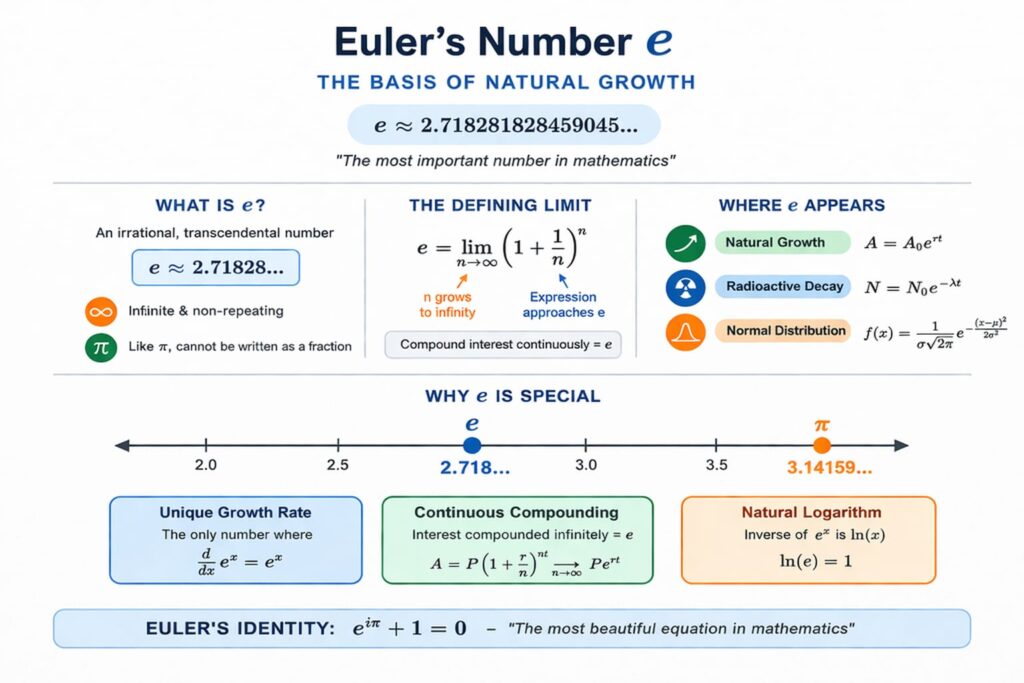
Deep within the fabric of mathematics lies a number as fundamental as π, yet far less understood by the general public. This number, approximately 2.71828, appears wherever things grow, decay, or change continuously. It governs the spread of populations, the decay of radioactive substances, the growth of investments, and the very shape of the universe. This number is the euler number e, and it is one of the most astonishing constants ever discovered.
The euler number e is the base of natural logarithms, but calling it merely a logarithm base is like calling the ocean a body of water. The number e is woven into the deepest structures of mathematics and physics. It appears in the formula for the normal distribution, which describes everything from test scores to measurement errors. It appears in the equation for the shape of a hanging chain, the curve of a telephone wire, and the path of a falling object under air resistance. It appears in quantum mechanics, thermodynamics, and even in the mathematics of prime numbers.
What makes the euler number e so special is its connection to growth. When something grows at a rate proportional to its current size, the euler number e appears naturally. This property makes it the universal language for describing continuous change, and its discovery stands as one of the great intellectual achievements in history.
The Origin Story: Bernoulli, Compound Interest, and Euler
The story of the euler number e begins not with abstract mathematics but with money. In the late 17th century, mathematicians and bankers were exploring the concept of compound interest. They asked a simple question: what happens if you compound interest more and more frequently?
Suppose you invest one dollar at an annual interest rate of 100 percent. After one year, you would have two dollars. But what if the interest is compounded semiannually? After six months, you have dollars. After another six months, you earn 50 percent interest on that amount, giving you dollars. Compounding quarterly yields even more. The formula for compounding n times per year is:
Jacob Bernoulli, a Swiss mathematician, studied this expression in 1683. He calculated values for increasing n and noticed something remarkable. As n grows larger, the expression approaches a specific number. For , the value is 2. For , it is approximately 2.5937. For , it is about 2.7048. For , it is roughly 2.7169. As approaches infinity, the expression approaches a limit of about 2.71828.
Bernoulli had discovered the euler number e, though he did not give it that name. The discovery was revolutionary because it revealed that even with infinite compounding, there is a finite limit to growth. No matter how frequently you compound interest, you cannot exceed this fundamental constant.
It was Leonhard Euler who truly recognized the importance of this number. In the 1730s, Euler began studying the constant systematically. He gave it the symbol e (likely because it was the next vowel after a, which he used for other constants, though some speculate it stands for “exponential”). Euler calculated e to 23 decimal places and proved that it is an irrational number, meaning it cannot be expressed as a simple fraction of two integers. Later mathematicians proved it is also transcendental, meaning it is not the root of any polynomial equation with integer coefficients.
Euler also discovered the remarkable infinite series representation of e:
This series converges quickly and allows e to be calculated with high precision. Euler’s work transformed e from a curiosity of compound interest into a fundamental constant of mathematics.
Why is Essential to Calculus and Rates of Change
The true significance of the euler number e becomes clear when we examine calculus. The exponential function ex has a property that no other function possesses: it is its own derivative.
The Unique Property of the Derivative of ex
Consider the derivative of ex. The definition of the derivative is:
The limit lim turns out to be exactly 1. Therefore:
This property is astonishing. The slope of the function at any point equals the value of the function at that point. No other exponential function with a different base has this property. For a general exponential function , the derivative is , which equals only when .
This means that the euler number e is the natural base for exponential functions in calculus. When mathematicians and scientists model growth processes, they almost always use or its variations because the calculus becomes simplest.
The natural logarithm, denoted lnx, is the inverse function of ex. It has the property that and . This simplicity makes the natural logarithm the preferred logarithm in advanced mathematics, physics, and engineering.
The euler calculus work that Euler developed relied heavily on e. His euler formula is one of the most celebrated equations in all of mathematics, connecting exponentials, trigonometry, and complex numbers in a single beautiful expression.
in the Natural World: From Biology to Physics
The euler number e appears throughout the natural world because nature is filled with processes where the rate of change is proportional to the current quantity. These processes, known as exponential growth or decay, are governed by e.
In biology, populations grow exponentially when resources are unlimited. If a bacterial colony doubles every hour, the number of bacteria after t hours is proportional to ekt, where k is the growth rate. The same mathematics describes the spread of viruses, the growth of tumors, and the dynamics of ecosystems. Even logistic growth, which accounts for resource limits, involves the euler number e in its solution.
In physics, radioactive decay follows an exponential law. The number of undecayed atoms after time t is , where λ is the decay constant. Carbon dating, used to determine the age of ancient artifacts, relies on this exponential decay of carbon-14. The half-life of a substance, the time it takes for half to decay, is directly related to e:
In thermodynamics, the distribution of molecular speeds in a gas follows the Maxwell Boltzmann distribution, which contains . The Boltzmann factor appears throughout statistical mechanics, describing how energy is distributed among particles. In quantum mechanics, wavefunctions often involve , combining e with imaginary numbers to describe the wave nature of matter.
The euler physics work that Euler pioneered in mechanics and fluid dynamics also relies on e. The solutions to many differential equations in physics involve exponential functions with as the base. From the damping of oscillations to the charging of capacitors, appears wherever change occurs.
Comparing , , and : The Trinity of Constants
Mathematics has three constants that appear so frequently and have such profound significance that they are sometimes called the “trinity” of mathematical constants: , , and (the golden ratio). Each represents a different kind of mathematical beauty.
The constant is the ratio of a circle’s circumference to its diameter. It appears in geometry, trigonometry, and anywhere circles or periodic phenomena occur. The euler number e appears in growth, change, and calculus. The golden ratio appears in art, architecture, and certain recursive patterns like the Fibonacci sequence.
What makes these three constants remarkable is that they are all irrational and transcendental (though the transcendence of is less famous). Yet they connect in unexpected ways. The euler formula unites , , and the imaginary unit in a single equation that many consider the most beautiful in mathematics. The golden ratio can be expressed in terms of through the hyperbolic functions:
These connections reveal a hidden unity beneath the surface of mathematics. The same deep structures that give rise to circles, growth, and self similarity are interwoven in ways that continue to astonish mathematicians.
Frequently Asked Questions (FAQs)
1. What is euler number e?
The euler number e is a mathematical constant approximately equal to 2.71828. It is the base of natural logarithms and appears in problems involving continuous growth, decay, and change.
2. How was euler number e discovered?
Jacob Bernoulli discovered e while studying compound interest in 1683. He found that the expression approaches about 2.71828 as increases. Euler later named it and explored its properties extensively.
3. Why is euler number e important in calculus?
The function ex is its own derivative, meaning . This unique property makes the natural base for exponential functions and simplifies calculus dramatically.
4. Where does euler number e appear in nature?
The euler number e appears in population growth, radioactive decay, the distribution of molecular speeds in gases, the charging and discharging of capacitors, and countless other natural processes involving continuous change.
5. How is euler number e related to pi and the golden ratio?
The euler formula connects e and π in one of the most famous equations in mathematics. While , , and are distinct constants, they are connected through deeper mathematical relationships and all appear throughout science and mathematics.
Conclusion: The Invisible Hand Behind Exponential Growth
The euler number e is far more than a number. It is a fundamental constant of nature, a cornerstone of mathematics, and an essential tool for understanding the world. From the compounding of interest to the decay of atoms, from the growth of populations to the behavior of quantum particles, e provides the mathematical language for describing continuous change.
The leonhard euler life and legacy includes this extraordinary constant that bears his name. His euler formula is considered one of the most beautiful equations ever discovered. His euler calculus work made e central to mathematical analysis. His euler physics work used to describe motion, fluids, and celestial mechanics. His euler graph theory gave us the language of networks. His euler modern math influence is felt in every field of science and engineering.
The discovery of e reveals something profound about the nature of mathematics. Numbers are not merely invented; they are discovered. They exist independently of human thought, waiting to be found. Bernoulli found e in the mathematics of finance. Euler recognized its deeper significance. Later generations found it in physics, biology, and statistics.
Just as how ancient greek scientists changed modern science by revealing the mathematical structure of the physical world, Euler revealed the mathematical structure of change itself. The euler number e stands as a monument to human curiosity and the astonishing power of mathematics to describe the universe. It is the invisible hand behind exponential growth, the silent partner in every process of continuous change, and one of the greatest discoveries in the history of human thought.