Introduction
Leonhard Euler died in 1783, but his presence remains alive in every mathematics classroom, every engineering textbook, and every scientific calculation performed today. No other mathematician in history has left such a pervasive and enduring mark on how we understand the world. From the notation we use to the problems we solve, from the physics that launches rockets to the cryptography that secures the internet, the fingerprints of Euler are everywhere. The astonishing scope of euler modern math influence is so vast that it is almost impossible to imagine what mathematics would look like without him.
Euler was not merely a mathematician; he was an institution. Over his long career, he produced more than 850 publications, with an additional 400 discovered after his death. His collected works fill over 70 volumes. He made groundbreaking contributions to calculus, number theory, graph theory, mechanics, optics, astronomy, and countless other fields. Yet beyond his individual discoveries, Euler transformed how mathematics is practiced, taught, and communicated. He gave mathematics its modern language, its systematic methods, and its deep connections to the physical world. The euler modern math influence is the foundation upon which contemporary science and engineering are built.
The Living Legacy: How Euler Shaped the 21st Century
If you have ever written to denote a function, you are using Euler’s notation. If you have ever used to represent the circle constant, that is also due to Euler. If you have ever worked with e for the base of natural logarithms, for summation, or for the imaginary unit, you are writing in a language Euler standardized. This is the first and most visible dimension of euler modern math influence: he gave mathematics its grammar.
But Euler’s influence goes far deeper than symbols. Every student who learns calculus encounters his methods. Every engineer who designs a structure uses his beam theory. Every physicist who studies fluid flow works with his equations. Every computer scientist who analyzes networks builds on his graph theory. The leonhard euler life and legacy is not confined to history books; it is actively used in the most advanced research of our time.
Consider the internet. When you send a secure message, the encryption that protects it relies on the RSA algorithm, which is built on Euler’s totient function. When you navigate using GPS, the calculations that determine your position involve differential equations that Euler helped formulate. When you search the web, the algorithms that rank pages use graph theory that Euler invented. The euler modern math influence is woven into the digital fabric of the 21st century.
Standardization: The Reason All Math Students Speak “Euler”
Before Euler, mathematics was a fragmented discipline. Different mathematicians used different notations, making communication difficult and progress slow. Euler recognized that a universal language was essential for the advancement of mathematics. He set about creating one.
The notation for a function was Euler’s innovation. Before Euler, functions were often described in cumbersome prose or with inconsistent symbols. Euler’s notation was so clear and practical that it was immediately adopted and remains universal today. The summation notation was popularized by Euler, making infinite series manageable. The symbol e for the base of natural logarithms was his choice, and it has become the standard. He also popularized the use of for the circle constant and for the imaginary unit, though these symbols had earlier origins.
Euler’s standardization extended beyond notation to methodology. His textbooks, particularly Introductio in Analysin Infinitorum, organized mathematics in a systematic way that had never been done before. He presented calculus as a coherent discipline rather than a collection of techniques. His three great textbooks on differential calculus, integral calculus, and analysis of the infinite became the models for mathematics education for generations. They established the curriculum that still shapes how mathematics is taught today.
The euler modern math influence in education is so pervasive that it is invisible. When a student learns calculus, they are following a path Euler laid out. When a textbook uses the notation , it is using Euler’s language. When a teacher explains the derivative of , they are teaching Euler’s insights. Mathematics education is, in a very real sense, Euler education.
Euler and Number Theory: The Gateway to Modern Cryptography
Among Euler’s many contributions, his work in number theory has become unexpectedly crucial to the modern world. In the 18th century, number theory was considered pure mathematics, beautiful but without practical application. Euler could not have imagined that his theorems would one day secure global communications.
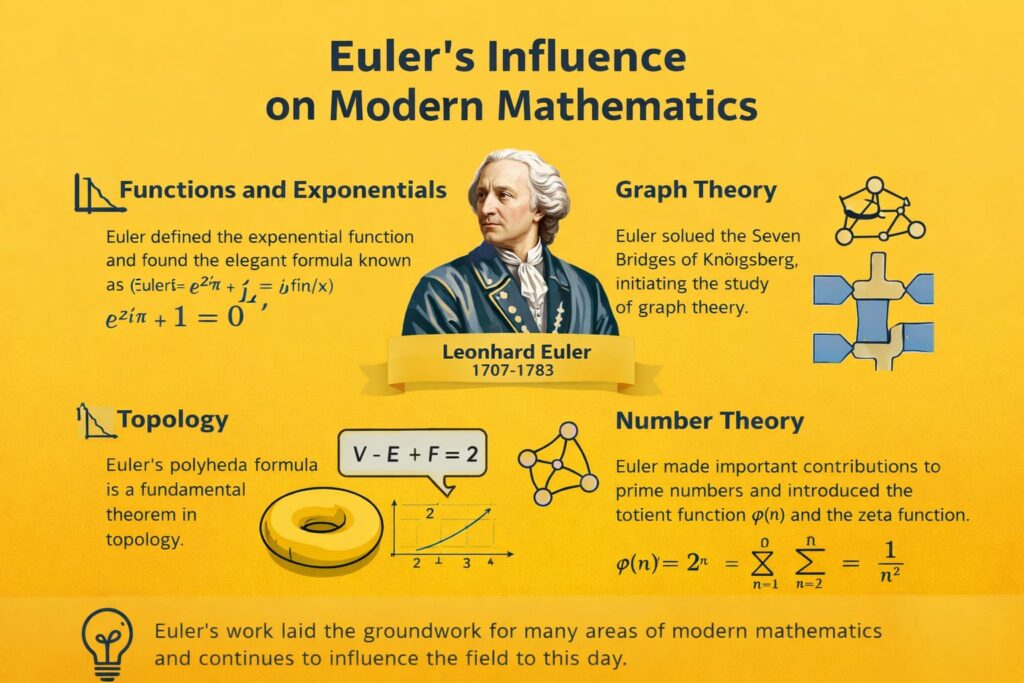
Euler’s totient function, denoted , counts the number of integers between 1 and that are relatively prime to . For a prime number , the totient is:
For a product of two distinct primes and , the totient is:
Euler proved a fundamental theorem: for any integer a coprime to ,
This result, known as Euler’s theorem, was a generalization of Fermat’s little theorem and became a cornerstone of number theory.
In the 1970s, three researchers named Rivest, Shamir, and Adleman developed the RSA cryptosystem, which became the standard for secure communication over the internet. The RSA algorithm relies directly on Euler’s totient function. When you make an online purchase, send a private message, or access a secure website, the encryption that protects your data uses Euler’s theorem. The euler modern math influence in cryptography has made modern e-commerce possible.
Euler’s work on the distribution of prime numbers also laid the foundation for analytic number theory. He proved that the sum of the reciprocals of primes diverges, showing that there are infinitely many primes and that they are relatively abundant. He introduced the zeta function , which later became central to the Riemann hypothesis, one of the greatest unsolved problems in mathematics.
The Totient Function and Secure Data
The connection between Euler’s totient function and modern cryptography illustrates a recurring theme in euler modern math influence: work that seemed purely theoretical in Euler’s time became essential to practical applications centuries later. Euler’s mathematics was so fundamental that it anticipated technologies he could not have imagined.
The totient function is the key to RSA encryption because it allows the creation of a trapdoor function: a mathematical operation that is easy to compute in one direction but extremely difficult to reverse without specific knowledge. In RSA, the difficulty of factoring large numbers into primes provides security, while Euler’s theorem enables the encryption and decryption processes. Every time a credit card number is transmitted securely, Euler’s mathematics is at work.
The “Eulerian” Way: A Methodology for Problem Solving
Beyond his specific discoveries, Euler embodied a particular approach to mathematics that has become a model for generations of scientists. The “Eulerian” way is characterized by several principles that define euler modern math influence at the methodological level.
First, Euler believed in abstraction. When confronted with the Seven Bridges of Königsberg, he stripped away everything irrelevant to the problem, leaving only the essential structure of vertices and edges. This ability to abstract from concrete situations to mathematical structures is now fundamental to applied mathematics.
Second, Euler embraced computation. He was not afraid to calculate. He computed e to 23 decimal places, performed massive series expansions, and derived numerical approximations for countless problems. His willingness to compute, even when the calculations were tedious, allowed him to discover patterns that led to general theorems.
Third, Euler sought connections. He was always looking for relationships between different areas of mathematics. His euler formula connected analysis, geometry, and algebra. His work on the Basel problem connected infinite series to π. This integrative approach is now central to mathematical research.
Fourth, Euler was prolific. He produced an astonishing volume of work, but quantity never came at the expense of quality. His productivity came from a disciplined approach to research and an extraordinary ability to concentrate. Even after losing his eyesight, he continued producing groundbreaking work, dictating papers to assistants with undiminished clarity.
This “Eulerian” methodology has influenced how mathematics is done. The emphasis on abstraction, computation, connection, and productivity defines modern mathematical practice.
Euler’s Reach: From Pure Math to Applied Engineering
The range of euler modern math influence across disciplines is staggering. In pure mathematics, Euler’s contributions to calculus, number theory, graph theory, and analysis are foundational. In applied mathematics, his methods are used in every field of engineering and science.
In civil engineering, the Euler Bernoulli beam theory remains the standard for structural analysis. Every building, bridge, and aircraft is designed using equations Euler derived. The critical buckling load for columns, known as Euler’s critical load, is essential for preventing structural failure.
In mechanical engineering, Euler’s equations for rigid body rotation govern the dynamics of rotating machinery, from turbines to gyroscopes. His work on moments of inertia is fundamental to understanding how objects spin.
In physics, Euler’s equations for fluid dynamics describe the motion of ideal fluids. His work on celestial mechanics provided the mathematical tools for predicting planetary orbits. His euler physics work transformed mechanics from a geometric science into an analytical one.
In computer science, Euler’s graph theory is the foundation of network analysis, algorithm design, and data structures. Every social network, every routing algorithm, every database schema relies on concepts Euler invented.
In economics, exponential growth models based on the euler number e are used to analyze interest rates, population growth, and market dynamics.
This breadth of influence is unique in the history of science. No other individual has made foundational contributions to so many different fields. The euler modern math influence is not limited to mathematics; it extends to every discipline that uses quantitative reasoning.
Frequently Asked Questions (FAQs)
1. What is euler modern math influence?
euler modern math influence refers to the profound and lasting impact of Leonhard Euler’s work across mathematics, physics, engineering, and computer science. His contributions include foundational results in calculus, number theory, graph theory, and mechanics, as well as the standardization of mathematical notation.
2. What notation did Euler standardize?
Euler introduced or popularized for functions, for summation, for the base of natural logarithms, for the circle constant, and for the imaginary unit. His notation became the universal language of mathematics.
3. How did Euler contribute to modern cryptography?
Euler’s totient function and his theorem form the mathematical foundation of the RSA cryptosystem, which secures online communication, e-commerce, and digital privacy.
4. What is the “Eulerian” approach to problem solving?
The “Eulerian” approach emphasizes abstraction to find essential structures, computation to discover patterns, connection between different areas of mathematics, and extraordinary productivity. This methodology has influenced modern mathematical practice.
5. Why is Euler considered the most prolific mathematician?
Euler published over 850 works during his lifetime, with hundreds more discovered after his death. His collected works fill more than 70 volumes. He made foundational contributions to dozens of fields and continued producing groundbreaking research even after losing his eyesight.
Conclusion: The Most Prolific Mind in Human History
Leonhard Euler stands alone in the history of mathematics. His productivity was unmatched. His range was unparalleled. His influence is still growing. Every generation discovers new depths in his work, new applications for his ideas, new ways that his mathematics illuminates the world.
The leonhard euler life and legacy is a testament to what the human mind can achieve. His euler formula is considered one of the most beautiful equations ever written. His euler calculus work gave mathematics its analytical power. His euler graph theory created an entire branch of mathematics. His euler physics work transformed our understanding of motion. His discovery of the euler number e revealed the mathematics of growth.
Euler’s work also connects to the broader history of science. Just as how ancient greek scientists changed modern science by establishing rational inquiry and mathematical description of nature, Euler changed mathematics by giving it a universal language and systematic methods. He built on the foundations laid by the Greeks and extended them into territories they could not have imagined.
When we consider the history of mathematics, there is Euler, and then there is everyone else. His name appears on more theorems, equations, and formulas than any other mathematician. His work is taught to every student who studies calculus. His insights are used in every field of science and engineering. The astonishing truth is that Euler did not merely contribute to modern mathematics; he created it. His influence is so deep that it is invisible, like the air we breathe. We do not notice it because it is everywhere.
Leonhard Euler died on September 18, 1783, in St. Petersburg, having worked until his final moments. His legacy, however, is immortal. As long as humans study mathematics, as long as engineers build structures, as long as scientists explore the universe, the influence of Euler will endure.