Introduction
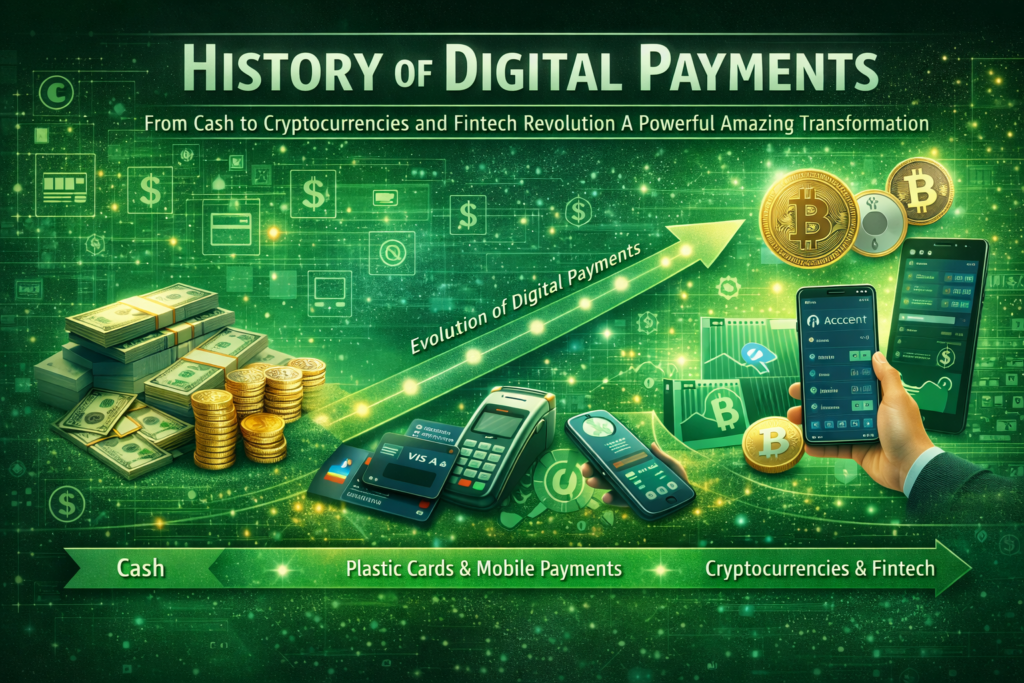
The way humans exchange value has changed more dramatically in the last fifty years than in the previous five thousand. The history of digital payments represents one of the most powerful financial transformations ever witnessed. From clunky magnetic stripes to seamless smartphone taps, from paper checks to instant cross border transfers, this journey has redefined commerce itself. The amazing fintech revolution has brought Financial inclusion to billions who never had bank accounts. It has enabled E-Commerce Evolution to flourish into a multi trillion dollar economy. Understanding the history of digital payments helps us appreciate the brilliant technologies that make modern transactions feel like magic. This article traces that remarkable evolution from physical cash to cryptocurrencies and beyond.
Before Digital: The Cash Dominance Era (Pre 1950)
Before exploring the history of digital payments, we must understand what preceded it. Cash reigned supreme for millennia. Coins appeared around 600 BCE. Paper money emerged in China during the Tang Dynasty. Checks became popular in the 17th century. But every transaction required physical presence or trusted couriers. The Computer Hardware Evolution had not yet begun. Moving money meant moving paper or metal. This system worked for local commerce but struggled with distance. A payment from New York to London took weeks and passed through multiple correspondent banks. Each intermediary took fees. Errors were common. Fraud detection was nearly impossible. The history of digital payments begins when computers finally offered an alternative to this slow, risky, expensive system.
The Magnetic Breakthrough (1950 – 1960)
The first major milestone in the history of digital payments arrived in 1950 with the Diners Club card. Frank McNamara forgot his wallet at a restaurant and conceived the idea of a cardboard charge card. This was not yet electronic, but it planted the seed. In 1958, Bank of America launched the BankAmericard, which would eventually become Visa. The real digital leap came with magnetic stripe technology. IBM engineer Forrest Parry invented the magnetic stripe in 1960. According to Computer History, this invention allowed card data to be encoded and read by machines automatically. The history of digital payments gained its first true electronic foundation.
By the late 1960s, magnetic stripe cards began appearing at gas stations and department stores. The Point of Sale (POS) systems evolved from mechanical cash registers to electronic terminals. These terminals read the magnetic stripe, dialed into a central computer over telephone lines, and verified available credit. The entire transaction took about thirty seconds. Today that sounds slow, but in 1960 it was miraculous. The history of digital payments had taken its first digital step.
The SWIFT Revolution (1970 – 1977)
Global banking needed a standardized messaging system. Before the 1970s, international payments relied on telex messages. Telex was slow, unsecure, and inconsistent. Different banks used different formats. Errors abounded. In 1973, a group of 239 banks from 15 countries founded the Society for Worldwide Interbank Financial Telecommunication. The SWIFT network launched in 1977. SWIFT did not move money directly. Instead, it sent secure standardized messages between banks. Each message followed strict formats that computers could process automatically. This innovation transformed the history of digital payments forever.
The SWIFT network reduced transaction times from days to hours. It eliminated manual rekeying of payment instructions. It introduced robust Transaction security through encryption and authentication. Today, SWIFT handles over 50 million messages daily across 11,000 institutions in 200 countries. The history of digital payments owes a tremendous debt to this Belgian cooperative. SWIFT demonstrated that global digital payment infrastructure was possible. It set the stage for everything that followed, from online shopping to mobile wallets.
The Debit Card and ATM Explosion (1970 – 1980)
While SWIFT handled bank to bank messaging, consumer facing digital payments evolved rapidly. The first ATM appeared at a Barclays branch in London in 1967. But these early machines only dispensed cash against paper vouchers. The real breakthrough came with the debit card. In 1975, Docutel introduced the first ATM that could read magnetic stripes. Customers could withdraw cash anytime without visiting a teller. The history of digital payments became visible and tangible to ordinary people.
Mobile Phones History was still decades away, but the ATM brought digital payments to street corners worldwide. By 1980, over 50,000 ATMs operated globally. Debit cards linked directly to bank accounts. The Point of Sale (POS) systems evolved to accept debit cards directly. The Interlink network launched in 1983, allowing debit card use at merchants. The history of digital payments had moved from bank back offices to every consumer’s wallet. Cash was no longer the only option for everyday purchases.
Online Banking Emerges (1980 – 1995)
The Internet History began intersecting with payments in the 1980s. Online banking started with corporate customers. Banks provided dial up software that let treasurers check balances and initiate wires. The experience was primitive by modern standards. 2400 baud modems. Green monochrome screens. Command line interfaces. But it worked. The history of digital payments entered the networked era.
Stanford Federal Credit Union offered the first internet banking service to all customers in 1994. That same year, President Bill Clinton typed the first White House website into existence. Netscape Navigator launched. The commercial internet was born. Banks rushed to build websites where customers could view accounts and pay bills. The Online banking revolution had begun. E-Commerce Evolution required digital payments to function, creating a symbiotic relationship that accelerated both fields. The history of digital payments was about to enter its most explosive phase.
The E-Commerce Gateway Revolution (1994 – 2000)
Online shopping needed a way to accept credit cards over the internet. In 1994, a company called CyberCash launched the first internet payment service. But the real game changer arrived in 1998. A company called Confinity introduced a service that allowed people to send money using email addresses. This service was called PayPal. The PayPal origins story is legendary. Confinity merged with Elon Musk’s X.com in 2000, and the combined company took the PayPal name. eBay became PayPal’s killer application. By 2002, PayPal processed so many eBay transactions that eBay bought PayPal for $1.5 billion.
The history of digital payments gained a true peer to peer system. Anyone with an email address could send and receive money. No merchant account required. No complicated setup. PayPal democratized online payments. E-commerce gateways multiplied rapidly. Authorize.Net launched in 1996. Stripe would come later. But PayPal proved that digital payments could be simple, friendly, and ubiquitous. The fintech ecosystem had found its first mainstream hero.
Mobile Wallets and NFC Technology (2000 – 2010)
The first decade of the 2000s brought mobile phones into the payment equation. In Japan, NTT DoCoMo launched the iMode mobile wallet in 2004. Using Sony’s FeliCa NFC technology , users could tap their phones at convenience stores, vending machines, and train stations. The history of digital payments went contactless. Near Field Communication (NFC) allowed two devices inches apart to exchange payment data securely. Wireless Communication Evolution made this possible.
In 2007, the iPhone launched and changed everything about mobile computing. Smartphones Evolution accelerated rapidly. In 2011, Google launched Google Wallet (later renamed Google Pay). In 2014, Apple entered the space with Apple Pay. Apple Pay / Google Wallet used NFC and tokenization to secure transactions. Instead of sending the actual credit card number, the phone sent a one time token. Even if intercepted, the token was useless for other transactions. The history of digital payments had solved the security problem that plagued early mobile payment attempts.
Contactless payments exploded in popularity. By 2019, over half of all in person transactions in some countries used contactless methods. The COVID-19 pandemic accelerated this trend dramatically. People wanted to avoid touching keypads and exchanging cash. The history of digital payments showed that convenience and safety could align perfectly.
Stripe and Square Simplify Commerce (2009 – 2011)
Two companies fundamentally changed who could accept digital payments. Stripe and Square launched in 2009 and 2010 respectively. Square, founded by Jack Dorsey, created a tiny card reader that plugged into a smartphone’s headphone jack. Suddenly, any small business could accept credit cards. Food trucks. Farmers markets. Hair stylists. The history of digital payments became inclusive. Square also offered a Point of Sale (POS) systems that ran entirely on iPads. The hardware barrier to accepting payments disappeared.
Stripe took a different approach. Stripe focused on online businesses. Before Stripe, accepting credit cards online required negotiating with merchant account providers, payment gateways, and processors. Stripe reduced the entire process to seven lines of code. Developers loved it. Stripe handled Transaction security, fraud detection, and regulatory compliance automatically. The history of digital payments had reached a new level of abstraction. Businesses could focus on their products while Stripe handled the money plumbing.
Bitcoin and Blockchain Disrupt Everything (2009 – 2017)
In October 2008, a person or group using the name Satoshi Nakamoto published a white paper titled Bitcoin: A Peer to Peer Electronic Cash System. In January 2009, the Bitcoin network launched. Bitcoin and Blockchain introduced a radical idea. A digital currency that required no central authority. No banks. No governments. Transactions verified by a distributed network of computers using cryptography. The history of digital payments gained a completely new paradigm.
Blockchain, the underlying technology, is a Distributed ledger that records transactions across many computers. No single entity controls it. To change a record, an attacker would need to control over half the network’s computing power. This makes blockchain extremely secure. The Encryption History shows that public key cryptography made Bitcoin possible. Each user has a public key (like an account number) and a private key (like a password). Transactions are signed with private keys and verified by the network.
The history of digital payments diverged into two paths after Bitcoin. One path continued improving centralized systems like credit cards and bank transfers. The other path explored decentralized cryptocurrencies. Bitcoin’s price went from near zero to over $60,000. Thousands of alternative cryptocurrencies appeared. Ethereum introduced smart contracts, programmable agreements that execute automatically when conditions are met. The Blockchain Evolution continues to challenge traditional finance.
Peer to Peer Apps Transform Transfers (2010 – 2020)
While cryptocurrencies captured headlines, simpler Peer to Peer (P2P) apps transformed everyday money movement. Venmo, founded in 2009 and acquired by PayPal in 2013, turned sending money into a social experience. Users could see public transaction feeds with emojis and comments. Splitting dinner bills, paying rent, and reimbursing friends became frictionless. Cash App, launched by Square in 2013, added Bitcoin trading and stock investing. Zelle, backed by major US banks, offered instant bank to bank transfers with no app required.
The history of digital payments became social, mobile, and instant. Mobile wallets like Venmo and Cash App stored balances that users could spend using linked debit cards. The fintech ecosystem expanded beyond payments into banking, investing, and lending. These apps brought Financial inclusion to underbanked populations who could not qualify for traditional accounts. All that was needed was a smartphone and an identity.
Central Bank Digital Currencies Arrive (2020 Present)
Governments watched cryptocurrency growth with interest and concern. Some worried about losing control over monetary policy. Others saw opportunity to modernize cash. Central Bank Digital Currencies (CBDC) emerged as the government response. A CBDC is a digital form of fiat money, issued and backed by a central bank. Unlike cryptocurrencies, CBDCs are centralized. Unlike cash, CBDCs are traceable.
China led the way with its digital yuan. Over 250 million people have used it in trials. The Bahamas launched the Sand Dollar in 2020. Nigeria launched the eNaira in 2021. The European Central Bank is investigating a digital euro. The Federal Reserve is studying a digital dollar. The history of digital payments is entering a new chapter where central banks directly issue digital currency. Digital currency may eventually replace physical cash entirely.
The evolution of the first digital computer showed that digitizing information unlocks incredible possibilities. The same principle applies to money. CBDCs could enable programmable money that only spends on certain categories. They could reduce tax evasion and money laundering. They could make stimulus payments instantaneous. But privacy concerns remain. A CBDC gives the government perfect visibility into every transaction. The history of digital payments will need to balance convenience against privacy.
Payment Security and Encryption Evolution
Throughout the history of digital payments, security has been the constant challenge. Early credit card systems stored sensitive data on magnetic stripes in plain text. Fraud was rampant. The 1980s introduced encryption for data in transit. The 1990s brought SSL (Secure Sockets Layer) for web payments. The 2000s introduced PCI DSS (Payment Card Industry Data Security Standard). The 2010s brought tokenization and EMV chip cards. Encryption protocols evolved from simple XOR ciphers to AES 256 and public key infrastructure.
The Cybersecurity Evolution parallels the history of digital payments perfectly. Each new payment method attracts criminals seeking vulnerabilities. Each breach teaches valuable lessons. The Target breach of 2013 exposed 40 million cards. The Equifax breach of 2017 exposed personal data of 147 million Americans. These disasters drove adoption of stronger security. EMV chips reduced counterfeit card fraud. Tokenization made stolen card numbers worthless. 3D Secure 2.0 added biometric authentication. The battle between security and fraud continues, but the history of digital payments shows consistent progress.
The Future of Digital Payments
What comes next in the history of digital payments ? Biometric authentication is already here. Fingerprints and facial recognition replace PINs. Palm scanning, like Amazon One, lets you pay by waving your hand. Voice payments work through smart speakers. Wearable payments embed chips in rings, watches, and clothing. The Wearable Technology trend will make payments invisible and effortless.
Artificial intelligence will drive fraud detection. Machine learning models will analyze transaction patterns in real time, flagging anomalies before they complete. Machine Learning History shows that AI now outperforms humans at pattern recognition tasks. Quantum computing threatens current encryption, but post quantum cryptography is under development. The Quantum Computing section of our technology timeline may hold the key to payment security for the next century.
The history of digital payments is ultimately a story of removing friction. From cash to cards to taps to invisible transactions, each step reduces the effort required to exchange value. The ultimate goal is payments that happen automatically without any user action. Your refrigerator orders milk and pays for it. Your car pays for tolls and parking. Your subscription services adjust automatically when you stop using them. This future is not far away.
Frequently Asked Questions (FAQs)
Q1: What was the first digital payment system?
The first true digital payment system was the magnetic stripe card introduced by IBM in 1960, followed by the first ATM in 1967. However, the SWIFT network (1973-1977) is considered the first global digital payment infrastructure.
Q2: Is cryptocurrency safer than credit cards?
Cryptocurrency offers different security properties. Transactions cannot be reversed, which protects merchants but offers no consumer protection. Credit cards provide fraud protection and chargeback rights. Neither is universally safer; they suit different use cases.
Q3: How do contactless payments work without touching?
Contactless payments use NFC technology which creates a radio field between the card or phone and the terminal. Data exchanges within inches over milliseconds. Tokenization replaces your actual card number with a one time code for each transaction.
Q4: Will cash disappear completely?
Most experts believe cash will not disappear entirely but will become much less common. Some countries like Sweden already function almost cashlessly. However, cash remains important for privacy, disaster preparedness, and serving unbanked populations.
Q5: What is the difference between PayPal and Venmo?
PayPal and Venmo are both owned by the same company. PayPal focuses on online merchant payments and international transfers. Venmo emphasizes social peer to peer payments among friends. Both now offer similar features, but their origins and primary use cases differ.
Q6: How does blockchain ensure Transaction security ?
Blockchain uses cryptographic hashing, distributed consensus, and public private key pairs. Each block contains a hash of the previous block, creating an unbreakable chain. Changing any transaction would require changing all subsequent blocks across the majority of the network, which is computationally impossible for large blockchains.
Q7: What are Central Bank Digital Currencies (CBDCs)?
Central Bank Digital Currencies (CBDC) are digital versions of a country’s fiat currency issued directly by the central bank. Unlike cryptocurrencies, CBDCs are centralized and government backed. Unlike cash, they are digital and traceable. Over 100 countries are currently exploring CBDCs.
Conclusion
The history of digital payments spans just over seventy years but has completely transformed human commerce. From magnetic stripes on cardboard cards to blockchain based cryptocurrencies, from dial up ATMs to instant peer to peer transfers, the journey has been remarkable. The amazing fintech ecosystem continues to evolve. Stripe and Square democratized payment acceptance. Apple Pay / Google Wallet made phones into wallets. Bitcoin and Blockchain challenged the very concept of centralized money. Each innovation built on previous breakthroughs in computing, networking, and cryptography. The history of digital payments proves that technology, when applied to human needs, can create extraordinary progress. As we look toward CBDCs, biometrics, and invisible payments, one thing is certain. The only constant in payments is change.