Introduction
The history of python is one of the most fascinating stories in all of modern software development. What began as a quiet holiday side project in a Dutch programmer’s home office has grown into a global phenomenon that consistently tops the TIOBE index ranking as the most widely used programming language on the planet. From its humble scripting language origins to its current dominance in artificial intelligence, data science, and web development, the history of python reveals how a single person’s quiet determination can permanently reshape how the entire world writes software.
Understanding the evolution of Python means tracing decades of bold decisions, community breakthroughs, and development milestones that unfolded across more than thirty years. This article covers the complete Python timeline every critical version, every painful turning point, and every triumph that defines the language that hundreds of millions of developers and learners rely on today.
The Origins of Python and Where It All Began (1989)
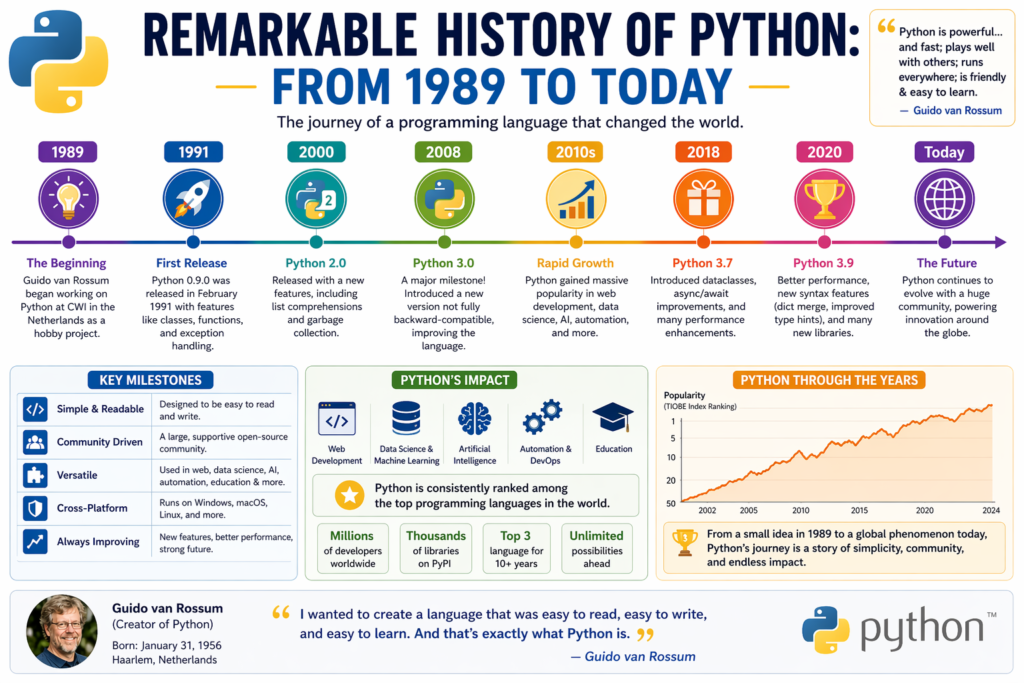
The history of python begins not inside a corporate research lab or a prestigious university department, but during a Christmas holiday break in December 1989. Guido van Rossum, a Dutch programmer at CWI (Centrum Wiskunde & Informatica) in the Netherlands, decided to start writing a new scripting language as a personal project. He had spent years working on the ABC programming language and understood, better than anyone, both what it got right and where it fell short.
He wanted to create something that kept ABC’s greatest strengths clean, readable syntax and a gentle learning curve for newcomers while fixing everything ABC got wrong: its inability to be extended, its lack of exception handling, and its closed nature that prevented community contributions. These scripting language origins were not the product of a corporate strategy or a funded initiative. They were born from one engineer’s vision of what programming could feel like if done thoughtfully.
Van Rossum named the new language Python, not after the reptile, but after the British television comedy series “Monty Python’s Flying Circus.” The name was intentional: short, memorable, and slightly irreverent the same approachable spirit he wanted every line of Python code to carry. These were the early seeds of the Pythonic way, a design philosophy centered on clarity, simplicity, and writing code that humans genuinely enjoy reading.
Python’s First Public Release and the Interpreter History (1991)
The history of python reached its first major public moment in February 1991, when van Rossum released Python version 0.9.0 to the alt.sources newsgroup. This 1991 release was already remarkably capable. It included classes with inheritance, exception handling, functions, and the core built-in data types lists, dictionaries, and strings that Python developers still use every single day more than three decades later.
The interpreter history of this early version showed a language that already understood its own identity. Van Rossum included the Zen of Python, a short set of guiding principles that described the Pythonic way of thinking: “Beautiful is better than ugly. Explicit is better than implicit. Simple is better than complex.” These were not marketing slogans. They were architectural commitments built directly into the language’s DNA.
Looking at the broader history of programming languages, Python’s 1991 release stands out for its immediate readability and the warmth it extended to beginners. Most languages of that era prioritized machine efficiency. Python, from its very first release, prioritized human understanding.
Python 1.0 and the First Development Milestones (1994 – 2000)
January 1994 brought the official Python 1.0 release a landmark in the history of python. This version introduced functional programming tools including lambda expressions, map, filter, and reduce, along with a growing standard library and a proper module system. These were not cosmetic improvements. They were foundational development milestones that transformed Python from a clever experiment into a production-capable tool that developers could rely on for real work.
The language continued evolving through Python 1.5 and 1.6, with improvements to regular expressions, better string handling, and early Unicode support. By the late 1990s, Python had quietly established itself as a solid choice for system administration, scientific computing, and early web development. The ecosystem growth during this period was entirely community-driven developers sharing libraries, reporting bugs, and contributing improvements because they genuinely believed in the language.
If you are just beginning your own programming journey, exploring Python for Beginners resources built on these early design decisions will give you a foundation that is still fully relevant today. The clarity that van Rossum baked into Python 1.0 is the same clarity beginners benefit from right now.
Python 2.0 and the Community Revolution (2000 – 2008)
October 16, 2000 marked one of the most important chapters in the history of python: the release of Python 2.0. This was more than a major version update it was a structural transformation of how Python was governed and developed. Python 2.0 introduced list comprehensions, garbage collection through reference cycle detection, and full Unicode support. But the most significant change was not technical at all.
For the first time, Python adopted a fully transparent, community-based development process powered by PEPs Python Enhancement Proposals. Every significant change to the language now required a formal written proposal that the entire community could read, debate, and contribute to. This shift triggered explosive Python community growth. Engineers at universities, startups, and large enterprises all began participating in shaping the language’s future.
Python 2 continued evolving through major version updates: 2.1, 2.2, 2.3, 2.4, 2.5, 2.6, and eventually 2.7. Each release added powerful new capabilities generators, decorators, context managers, advanced string formatting that steadily expanded what developers could build with Python. Language adoption climbed dramatically. Python was no longer a niche scripting tool for system administrators. It was becoming the backbone of serious commercial software.
The Great Divide: Python 2.0 vs 3.0 (2008 – 2010)
On December 3, 2008, the history of python entered its most controversial and debated chapter. Python 3.0 was officially released and it was intentionally not backward compatible with Python 2. This Python 2.0 vs 3.0 divide became one of the most discussed transitions in the entire history of open source software, sparking arguments that would echo through the developer community for more than a decade.
The history of python makes clear that Python 3 was not a rushed or impulsive decision. The development of Python 3, formally outlined in PEP 3000, had been years in the making. Van Rossum and the core development team had identified deep structural flaws in Python 2 inconsistent Unicode handling, confusing integer division behavior, print as a statement rather than a function that simply could not be corrected while maintaining backward compatibility with existing code.
Python 3’s most significant changes included mandatory Unicode strings, cleaner integer division, the transformation of print into a proper function, and a reorganized standard library that eliminated years of accumulated inconsistencies. These were the right decisions for the long-term software evolution of the language. But they came at a steep short-term cost. Every Python 2 codebase in the world contained legacy code that now needed to be rewritten, retested, and redeployed.
The Python 3 release date triggered years of hesitation and fragmentation. Developers who had invested heavily in Python 2 were understandably reluctant to abandon working systems. Major frameworks, enterprise applications, and scientific tools all needed time to migrate. The ecosystem was split down the middle.
The Long Road to End-of-Life (EOL) Python 2 (2010 – 2020)
The decade between 2010 and 2020 was defined, in large part, by the effort to complete Python’s transition from version 2 to version 3. The history of python during this period is a story of patience, community organizing, and slow but steady progress. For years, both Python 2 and Python 3 coexisted as active versions, creating a fragmented landscape where developers, library maintainers, and organizations had to carefully manage which version their code supported.
The Python core development team set January 1, 2020, as the final date for end-of-life (EOL) Python 2. This announcement created a real deadline that forced organizations and library maintainers to act. The Python community responded with remarkable creativity and collaboration. Tools like 2to3, the “six” compatibility library, and python-future emerged specifically to ease the migration path, helping developers build libraries and applications that could support both versions simultaneously while transitioning to Python 3.
By the EOL Python 2 deadline, virtually all major Python Libraries including NumPy, Pandas, Django, Flask, and Requests had fully completed their migration to Python 3. The ecosystem had moved on. The painful but necessary chapter of the Python 2 versus Python 3 split had finally closed.
Python Rises to Global Dominance (2013 – 2022)
With Python 2 officially sunset, Python 3 began an extraordinary rise to the top of nearly every global programming language ranking. The TIOBE index ranking tracked Python’s ascent through the top ten, into the top five, and eventually to the number one position a milestone that no one had predicted when Python was first released from a home office in 1989.
The explosion of data science, machine learning, and artificial intelligence during this decade turned Python into something far more significant than a general-purpose scripting language. Libraries like NumPy, Pandas, Matplotlib, Scikit-learn, TensorFlow, and PyTorch built their foundations entirely on Python 3, establishing it as the undisputed standard language for Python for Data Science and machine learning research worldwide.
Python also became the language of choice for web development through Django and Flask, for automation and DevOps scripting, for cloud infrastructure management through tools like Ansible and Terraform, and for scientific research across biology, physics, finance, and economics. The software evolution from a modest scripting language into the world’s most versatile programming tool was now complete. Every major technology company Google, Meta, Netflix, Spotify used Python at scale.
Python 3.14 Features and the Exciting Road Ahead (2024 – Today)
The history of python is still being actively written, and the current chapter is one of the most exciting yet. Python 3.14, currently in active development and preview releases, continues the language’s proud tradition of thoughtful, incremental improvement. Among the most anticipated Python 3.14 features are significant performance gains through the ongoing “faster CPython” initiative, refinements to the type annotation system, and dramatically improved error messages that make debugging more intuitive for developers at every level.
The “faster CPython” project championed in part by van Rossum himself since joining Microsoft as a Distinguished Engineer in 2020 has already delivered measurable speed improvements across Python 3.11, 3.12, and 3.13. Python is now meaningfully faster than it was just a few years ago, addressing what had long been one of the language’s most common criticisms. The Future of Python is increasingly focused on performance without sacrificing the readability and simplicity that made Python beloved in the first place.
The community steering the language has never been more globally diverse or more technically capable. With the Python Software Foundation overseeing governance, thousands of contributors actively proposing and reviewing PEPs, and major technology companies investing directly in Python’s development speed and ecosystem, the language enters this new chapter stronger than at any previous point in the history of python.
FAQs About the History of Python
Q1: When was Python first created?
Python was created in December 1989 by Guido van Rossum during a Christmas holiday. The first public version (0.9.0) was released to the alt.sources newsgroup in February 1991.
Q2: Why was Python 3 not backward compatible with Python 2?
Python 3 was deliberately designed to break backward compatibility in order to fix deep structural problems in Python 2 particularly inconsistent Unicode handling, confusing integer division, and the print statement that could not be corrected any other way.
Q3: When did Python 2 officially reach end-of-life?
End-of-life (EOL) Python 2 was declared on January 1, 2020. After that date, no further security patches or updates were released for Python 2.
Q4: What is PEP 3000 and why does it matter?
PEP 3000 was the official Python Enhancement Proposal that documented the design goals, scope, and development process for Python 3.0. It served as the formal roadmap for the entire Python 3 transition.
Q5: What are the most notable Python 3.14 features?
Python 3.14 focuses on continued performance improvements through the faster CPython initiative, enhanced type annotation support, and cleaner, more helpful error messages designed to assist developers in debugging code more efficiently.
Q6: How did Python become the world’s most popular programming language?
Python’s rise is the result of its simple syntax, massive library ecosystem, adoption by the data science and machine learning communities, and decades of consistent, community-driven development guided by the Pythonic philosophy of clarity and accessibility.
Q7: Why is understanding the history of python useful for developers?
Understanding the history of python helps developers appreciate why the language is designed the way it is, make informed decisions when encountering legacy Python 2 code, and understand the direction in which Python is heading with each new release.
Conclusion
The history of python is not simply a record of version numbers and release dates. It is a thirty-five-year story of vision, community resilience, painful trade-offs, and the relentless pursuit of a simple idea: that programming should be readable, accessible, and even enjoyable. From a Christmas holiday side project in 1989 to the language that now powers artificial intelligence, scientific research, and web infrastructure across every continent, Python’s journey stands as one of the most remarkable achievements in software history.
Every challenge Python faced the early doubts about a scripting language from nowhere, the decade-long fracture of the Python 2.0 vs 3.0 divide, the enormous effort required to retire legacy code only made the language and its community stronger. The history of python teaches developers something important: the best technologies are not the ones that avoid hard decisions. They are the ones that make hard decisions wisely and see them through with patience.
As Python 3.14 and future versions continue pushing the boundaries of performance and usability, the language shows no signs of slowing its evolution. The next chapter of the history of python is still being written and it may well include contributions from you.