Introduction
When people explore the history of programming languages, few stories are as remarkable as the one behind Python. At the heart of that story is guido van rossum, a Dutch programmer who transformed software development with one elegant idea born during a holiday break. He did not just build a programming language he built a philosophy that tens of millions of developers live by every day.
Whether you are a student writing your very first script or a machine learning engineer processing billions of data points, you owe a piece of that journey to guido van rossum. His creation, Python, is now one of the most widely used programming languages on the entire planet. But who is the man behind the language? Let us dive deep into the life, work, and lasting legacy of the programmer the world calls the “King of Python.”
Early Life and Education of Guido van Rossum (1956 – 1982)
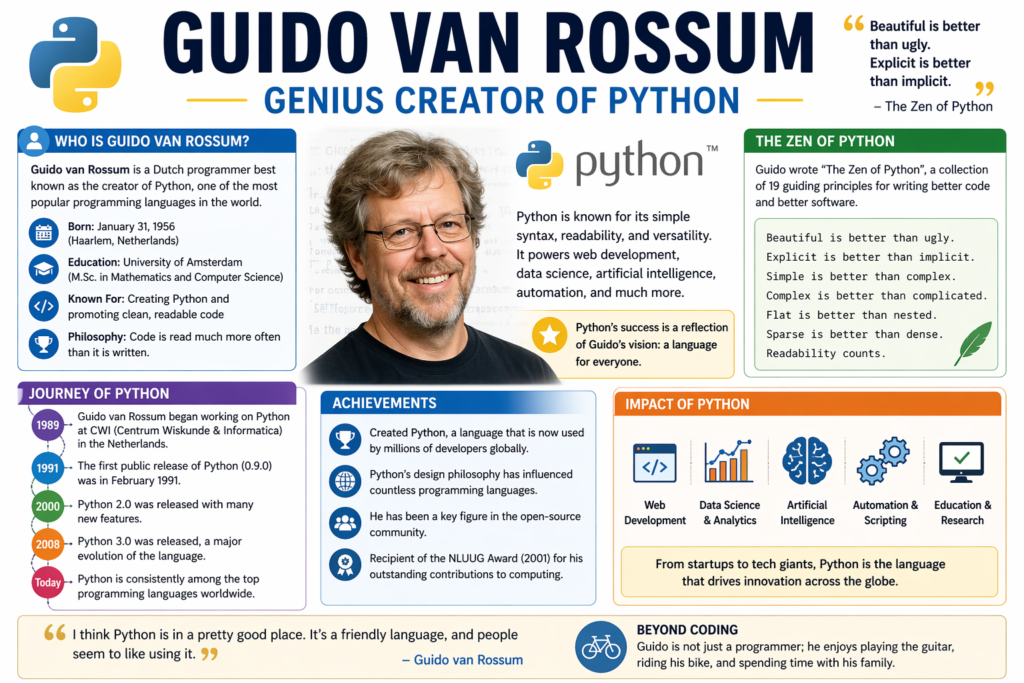
Guido van rossum was born on January 31, 1956, in Haarlem, Netherlands. Growing up in a country known for its engineering precision and analytical culture, he developed a deep interest in mathematics and logical thinking from a very young age. He later studied at the University of Amsterdam, earning a master’s degree in mathematics and computer science.
During his university years, guido van rossum was exposed to multiple programming paradigms and noticed something important: most languages of the era were either too complex, too rigid, or simply too painful to read. He observed that programmers spent enormous amounts of time deciphering code written by others. These observations quietly planted the seed for what would eventually become Python — a language designed to be as pleasant to read as it is to write.
Working at CWI and the ABC Programming Language (1982 – 1989)
After completing his education, guido van rossum joined CWI (Centrum Wiskunde & Informatica), the national research institute for mathematics and computer science in the Netherlands. It was at CWI that he worked on the ABC programming language, a teaching language specifically designed to make programming accessible to beginners without sacrificing expressive power.
The ABC programming language had admirable goals: readability, simplicity, and a clean syntax that reduced the learning curve for newcomers. However, it had significant limitations. It could not be extended with external modules, lacked proper exception handling, and was largely closed to community contributions. Guido van rossum absorbed the strengths of ABC deeply while mentally cataloguing everything he would do differently.
His time at CWI shaped him into the kind of open source advocate who genuinely believed that programming tools should empower everyone — not just the academics and professionals who already spoke the language of machines.
The Birth of Python at CWI (1989 – 1991)
During the Christmas holiday of 1989, guido van rossum began working on a new scripting language as a personal side project. He wanted a language that could bridge the gap between shell scripting and full C programming, handle exceptions gracefully, and remain highly readable. He chose the name Python — not after the snake, but after the British television comedy series “Monty Python’s Flying Circus,” which he was a devoted fan of at the time.
You can explore more about the Why Python Got Its Name story and how a love of British comedy influenced one of the most consequential technical decisions in the entire history of computing.
Python was designed from its very first line with a clear principle in mind. Guido van rossum believed that code is read far more often than it is written. That philosophy became the cornerstone of Python’s design: indentation as structure, plain English keywords over symbolic shortcuts, and a commitment to explicitness over cleverness.
Python 1.0 Release and Community Growth (1991 – 2000)
The first public version of Python appeared in February 1991. Then came the landmark Python 1.0 release in January 1994, which introduced powerful features including lambda functions, map, filter, and reduce. This version marked Python’s transition from a personal experiment into a legitimate programming language with a real and growing community.
The History of Python throughout the 1990s is a story of quiet, community-driven momentum. Developers around the world began contributing libraries, improvements, and ideas. The Zen of Python, a set of guiding principles drafted by Tim Peters and fully endorsed by guido van rossum, captured the spirit of this movement beautifully. Its opening lines — “Beautiful is better than ugly. Explicit is better than implicit. Simple is better than complex.” — became a kind of software creed for an entire generation of programmers.
CNRI, the CP4E Initiative, and a Bold Vision (1995 – 2000)
In 1995, guido van rossum relocated to the United States to join CNRI (Corporation for National Research Initiatives). There, he led the Computer Programming for Everybody (CP4E) initiative, a forward-thinking DARPA proposal aimed at making programming a foundational literacy skill comparable to reading and writing.
CP4E imagined a world where ordinary people could use programming to solve everyday problems. While the initiative did not fully achieve its ambitious goals, it reinforced and deepened Python’s core identity as a language for everyone. Guido van rossum consistently pushed back against any tendency to make Python elitist or unnecessarily complex. This was open source advocacy not just in word, but in every design decision he made.
The Benevolent Dictator for Life (BDFL)
As Python’s global community expanded through the late 1990s and into the 2000s, guido van rossum assumed a unique role in open source history. He was informally titled the Benevolent Dictator for Life, or BDFL. This meant he held final authority over all decisions shaping Python’s development and direction. Unlike traditional open source governance models that rely on committee votes, the BDFL model centered on one deeply trusted leader.
Central to this model was the PEP (Python Enhancement Proposal) system. Every significant change to the language required a formal PEP, which could be accepted, rejected, or sent back by the BDFL. This structured process gave Python a coherent sense of direction and prevented the fragmentation that has weakened many other open source projects. Guido van rossum as BDFL was known universally for his thoughtful, measured decision-making and genuine benevolent leadership.
Guido van Rossum at Google and Dropbox (2005 – 2012)
In 2005, guido van rossum joined Google as a software engineer. Google was already one of Python’s biggest early enterprise adopters, and having its creator on the engineering team reinforced the language’s credibility at an institutional level. He contributed to internal tools and continued to guide Python’s community evolution from within one of the world’s most influential technology companies.
In 2012, he transitioned to Dropbox as a Dropbox engineer, a role he held until 2019. During this period, Python had firmly established itself across multiple industries. Its dominance in Python for Data Science was already shaping fields from genomics to financial modeling. His presence at these landmark technology companies helped authenticate Python as a serious enterprise-grade language while keeping its open source soul intact.
BDFL Retirement and Joining Microsoft (2018 – 2021)
In July 2018, guido van rossum made a stunning announcement: he was stepping down from the BDFL role. He cited exhaustion and frustration surrounding a particularly contentious PEP decision as the reason. For nearly thirty years, he had been the single guiding force behind Python. The Python community responded with a mixture of shock, gratitude, and deep respect.
After retiring from Dropbox in 2019, he briefly considered a permanent step back from active software development. However, in November 2020, guido van rossum joined Microsoft as a Microsoft Distinguished Engineer. His stated mission was direct and ambitious: make Python faster. The ongoing CPython performance initiative he has championed at Microsoft has already delivered measurable speed improvements across multiple versions of the language.
This chapter represents a bold new direction for the Future of Python, with real performance gains that could expand Python’s reach even further into systems programming and high-performance computing.
The Python Software Foundation and a Global Legacy
Throughout every career transition and life change, guido van rossum remained connected to the Python Software Foundation (PSF), the nonprofit organization responsible for managing Python’s intellectual property, funding community grants, and organizing global events like PyCon. The PSF ensures that Python remains a free, open, and universally accessible tool regardless of who controls it commercially.
The software architecture decisions guido van rossum made in 1989 now power artificial intelligence models, scientific research, financial systems, government databases, and educational platforms across every continent. If you are beginning your own journey into code, the best starting point carries on the tradition he started explore Python for Beginners resources built on the principles he established: simplicity, clarity, and accessibility for all.
FAQs About Guido van Rossum
Q1: Who is Guido van Rossum?
Guido van rossum is a Dutch programmer and the creator of the Python programming language, widely regarded as one of the most influential software designers in modern computing history.
Q2: When did Guido van Rossum create Python?
He began developing Python in December 1989 during a Christmas holiday, and the first public version was released in February 1991.
Q3: What does BDFL mean?
BDFL stands for Benevolent Dictator for Life, an informal title recognizing guido van rossum’s final decision-making authority over Python’s development and design.
Q4: Why is Python named Python and not something else?
Guido van rossum named it after the British TV comedy series “Monty Python’s Flying Circus,” not the reptile. He wanted a short, unique, and slightly irreverent name.
Q5: Where does Guido van Rossum work today?
As of 2020, guido van rossum works at Microsoft as a Microsoft Distinguished Engineer, focusing primarily on improving Python’s performance and execution speed.
Q6: What is the Python Software Foundation?
The Python Software Foundation (PSF) is a nonprofit that manages Python’s intellectual property, supports community events including PyCon, and promotes global access to Python education and development.
Q7: What was the ABC programming language’s role in Python’s creation?
The ABC programming language, which guido van rossum worked on at CWI, directly inspired Python’s emphasis on readability and beginner accessibility, while its limitations drove him to build something more extensible and open.
Conclusion
The story of guido van rossum is the story of Python itself — quiet, deliberate, and profoundly transformative. From a holiday coding experiment in 1989 to a language that now powers artificial intelligence, web development, scientific research, and automation across every industry, his journey stands as one of the most inspiring in the entire history of computing.
He gave the world not just a programming language but a new way of thinking about software: that it should be simple, readable, and accessible to everyone regardless of background. The principles guido van rossum embedded into Python’s very DNA have shaped how an entire generation of humans and computers communicate with each other. As performance improvements and new applications continue to emerge, his influence will only deepen — proof that the most powerful ideas are always the ones built to last.