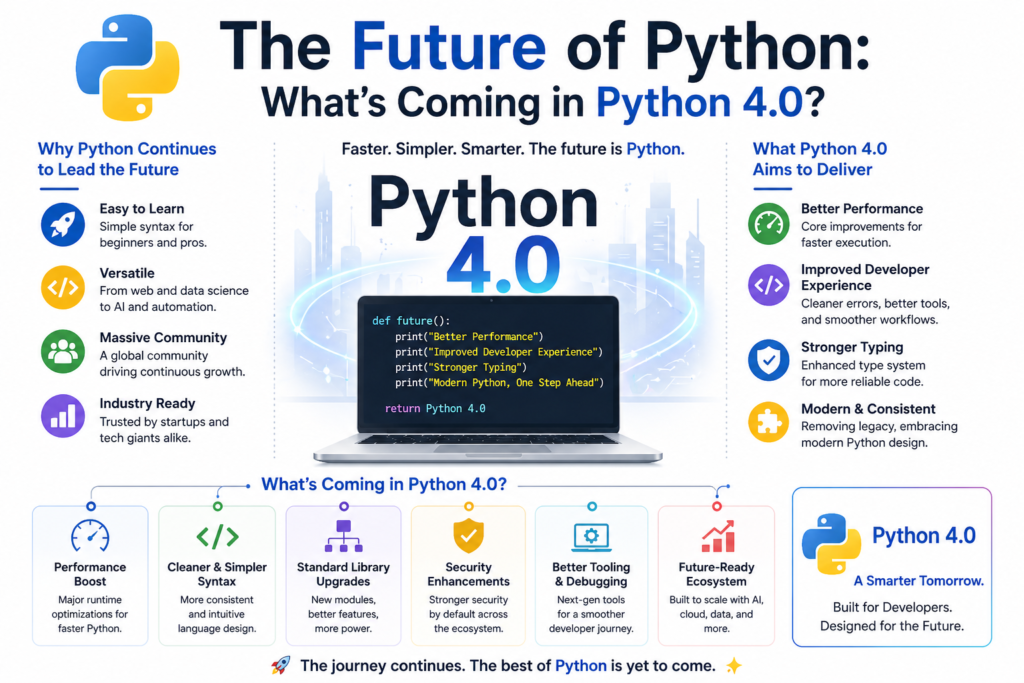
Python has dominated programming for years. It powers data science, artificial intelligence, web development, and automation. But what comes next? The future of python is incredibly exciting. Major changes are coming. Python 4.0 is on the horizon. This will not be a small update. It will be revolutionary. The language roadmap includes removing the Global Interpreter Lock (GIL), adding a Just In Time (JIT) compiler, and potentially breaking backward compatibility. These changes will make Python faster, more scalable, and ready for the multicore era. This excellent guide explores everything you need to know about the future of python . I will cover expected release dates, performance improvements, potential breaking changes, and how these updates will affect developers like you. Let me share a fascinating fact from history of python . Guido van Rossum stepped down as Python’s leader in 2018. But he returned in 2020 to help guide these revolutionary changes. The future of python is being shaped by a new generation of developers while respecting Python’s 30 year legacy.
A Brief History Python 1.x to 3.x (1994 – 2026)
To understand the future of python , you need to understand its past. Python 1.0 was released in 1994. It had lambda, map, filter, and reduce. Python 2.0 came in 2000. It added list comprehensions and garbage collection. Python 3.0 arrived in 2008. This was controversial. Python 3 broke backward compatibility. Code written for Python 2 did not run on Python 3. The transition took over a decade. Python 2 finally ended in 2020. Since then, Python 3 has received annual releases. Python 3.9, 3.10, 3.11, 3.12, and 3.13 added features like pattern matching, faster performance, and better error messages. The future of python with Python 4.0 will likely be smoother than the 2 to 3 transition. The core team has learned from past mistakes. They promise a gradual approach. Many features will appear in Python 3.x first. Then Python 4.0 will be a “cleanup” release removing old features. This software engineering trends approach minimizes disruption.
Python 4.0 Release Date Speculations
When will Python 4.0 arrive? The official python 4.0 release date has not been announced. Based on current language roadmap discussions, 2027 or 2028 is most likely. Here is why. The biggest change, removing the Global Interpreter Lock (GIL), is tracked in PEP 703 . This proposal was accepted in 2023. Implementation is ongoing. A no GIL build of Python 3.13 is available for testing. But production readiness takes years. The steering council wants to move carefully. They want to avoid the Python 3 transition pain. The future of python will likely follow this pattern. Python 3.14, 3.15, and 3.16 will introduce major features incrementally. Then Python 4.0 will remove deprecated features and increase the major version number. Some developers predict Python 4.0 by late 2027. Others say 2028 or 2029. The exact date matters less than the direction. Python is evolving faster now than at any time since 2008.
Global Interpreter Lock (GIL) Removal The Biggest Change
The most revolutionary change in the future of python is Global Interpreter Lock (GIL) removal . What is the GIL? It is a mutex that protects access to Python objects. It prevents multiple threads from executing Python bytecode simultaneously. This makes Python simpler to implement. But it also prevents true parallelism . On a multicore CPU, Python threads cannot run in parallel. Only one thread runs at a time. This limits performance for CPU intensive tasks. The GIL has been criticized for decades. Removing it is the holy grail of python performance improvements . PEP 703 proposes making the GIL optional. A special build called “no GIL” Python would run without the lock. This enables true multicore parallelism. Multiple threads can run simultaneously on different CPU cores. Early benchmarks show 3x to 10x speedups for multithreaded CPU bound code. For concurrency heavy workloads like web servers and data processing, the gains could be massive.
Here is code that currently suffers from the GIL:
import threading
import time
def cpu_intensive():
total = 0
for i in range(100_000_000):
total += i * i
return total
threads = []
start = time.time()
for _ in range(4):
t = threading.Thread(target=cpu_intensive)
t.start()
threads.append(t)
for t in threads:
t.join()
end = time.time()
print(f"Time with GIL: {end - start} seconds")
With the GIL, four threads take about the same time as one thread. The other three wait. Without the GIL, four threads run in parallel. The time drops by nearly 75% on a quad core CPU. This changes everything. The future of python with no GIL will compete with Java, Go, and Rust for CPU bound workloads.
JIT Compiler Performance Revolution
Another massive future of python improvement is the JIT compiler . JIT stands for Just In Time compilation. Currently, Python is interpreted. It reads and executes code line by line. This is flexible but slow. A JIT compiler analyzes code as it runs. It identifies hot paths (frequently executed code). Then it compiles those paths to machine code. That machine code runs at native speed. Several projects have attempted Python JITs. PyPy has one. Numba does it for numerical code. But now CPython (the official Python) is getting its own JIT. This was announced for Python 3.13. The first version is a copying JIT. It is simple but shows the path forward. Future versions will be more sophisticated. The JIT will dramatically improve CPython performance . Early estimates suggest 20% to 50% speedups for general code. For numerical loops, speedups could be 2x to 5x. Combined with no GIL, the future of python looks incredibly fast. Python could approach C performance for many workloads while keeping its friendly syntax.
What Python 4.0 Might Remove
The future of python with Python 4.0 may also remove old features. Python 3 kept many Python 2 features for compatibility. Python 4.0 could finally remove them. Potential removals include. The print statement (already gone in Python 3). The unicode type (str handles this now). Many deprecated modules in the standard library like distutils (replaced by setuptools). urllib legacy APIs. The asyncore module. These removals will affect almost no modern code. But old scripts may need updates. The steering council emphasizes that Python 4.0 will be more evolutionary than revolutionary. Most Python 3 code will run unchanged. This is different from the disastrous Python 2 to 3 transition. The future of python learning from that mistake.
Faster CPython Continuing the Momentum
The future of python includes ongoing faster CPython work. This project started with Python 3.11. That version was 10% to 60% faster than 3.10. Python 3.12 added more optimizations. Python 3.13 introduced the JIT foundation. This trend will continue. Each release gets faster. The Faster CPython team is funded by Microsoft and work full time on performance. Specific optimizations coming include. Better cache locality for objects. Improved memory management. Specialized bytecode for common operations. Adaptive interpreter that learns which code paths are common. These incremental improvements add up. By Python 4.0, typical Python code could be 3x to 5x faster than Python 3.10 without any code changes. For python for data science , this means faster data processing. For python web development , this means higher request throughput. For python automation , this means scripts finish quicker.
Type Hinting Evolution
Python added optional type hints in 3.5 (2015). They have improved steadily. The future of python will continue this trend. Expected type system improvements include. Typed dictionaries with more precision. Variadic generics (generics that take variable numbers of type arguments). Precise typing for Python’s *args and **kwargs. Performance optimizations for typed code. JIT compilers can optimize typed code better than untyped code. As type hinting evolves, Python may become more like TypeScript. Types remain optional but provide better tooling and performance. Major Python projects already use type hints heavily. The future of python ecosystem will likely require types for production code. This improves reliability and maintainability.
WebAssembly and Mobile Support
Python has traditionally been limited to servers and desktops. The future of python includes new platforms. WebAssembly (Wasm) is a binary format for running code in web browsers. Python can now run in the browser using Wasm. Projects like Pyodide and PyScript let you write Python that runs in HTML pages. This enables interactive data science notebooks in the browser. It also allows Python to compete with JavaScript. Mobile support is also improving. BeeWare and Kivy let you write Python apps for iOS and Android. The CPython team is working on better mobile builds. The future of python may include first class mobile support. You could write one Python codebase for web, server, mobile, and desktop. This is the dream of many developers. It is getting closer to reality.
Impact on Data Science and AI
Python dominates future of AI and python . TensorFlow, PyTorch, and JAX are Python based. The future of python with performance improvements directly benefits AI. Training large models becomes faster. Data preprocessing becomes quicker. Model inference becomes more efficient. The no GIL Python enables true parallel data loading. JIT compilation speeds up numerical code. For python for data science , these changes are transformative. A data scientist might see 3x faster pandas operations. The growing python libraries ecosystem will adopt these improvements automatically. Popular libraries like NumPy and Pandas will run faster without code changes. This ensures Python remains the dominant language for AI and data science.
Community Governance and Leadership
The future of python depends on community governance. After Guido van Rossum stepped down, Python adopted a steering council model. Five council members are elected every term. They make major decisions including language features and release schedules. The council has worked well. It prevented contentious fights like the Python 3 transition. The steering council for 2025 to 2026 includes experienced core developers. They are committed to gradual, well tested changes. This governance model ensures the future of python remains stable. No single person can make rash decisions. Major changes like GIL removal go through multiple PEPs (Python Enhancement Proposals). They are discussed for years before implementation. This is slow but deliberate. It protects the millions of companies relying on Python.
Backward Compatibility The Hard Question
Will Python 4.0 break my code? This is every developer’s fear. The steering council promises minimal breakage. Unlike Python 3, Python 4 will be mostly compatible. The plan is to deprecate features in Python 3.x versions first. You will see warnings for years before removal. Python 4.0 will then remove those deprecated features. Most modern Python code will run unchanged. The biggest potential breakage relates to C extensions. Extensions that rely on internal CPython APIs may break. Extensions using stable APIs will continue working. Developers should ensure their libraries use stable APIs. The future of python includes better tooling to detect compatibility issues. Automated migration tools will likely appear. The transition from Python 3 to 4 should feel like any other annual release. Just slightly bigger.
Adoption Timeline and Industry Response
How quickly will companies adopt Python 4.0? Based on past patterns, slowly. Large companies still run Python 3.8 and 3.9 today. They skip yearly releases. Python 3.11 is the current “modern baseline” for many. Python 4.0 will likely see similar adoption patterns. Early adopters will switch within months. Conservative enterprises will wait 2 to 3 years. Cloud providers like AWS, Google, and Azure will support Python 4.0 quickly. Most python web development frameworks (Django, Flask, FastAPI) will support Python 4.0 before release. The ecosystem will be ready. The future of python looks bright. The Python Software Foundation has strong financial support. Major companies including Google, Microsoft, Meta, and Bloomberg employ core developers. Python will not disappear. It will evolve.
What Stays The Same Zen of Python
Amid all these changes, the core philosophy remains. The future of python still follows the Zen of Python. Beautiful is better than ugly. Explicit is better than implicit. Simple is better than complex. Readability counts. Python will remain readable, expressive, and beginner friendly. The no GIL Python will still feel like Python. The JIT compiler will be invisible to developers. Type hints stay optional. The standard library will continue its “batteries included” approach. The community will remain welcoming. These constants matter more than version numbers. Python’s success came from its design philosophy, not from raw performance. Performance improvements only enhance what already works. The future of python adds speed without sacrificing soul.
Frequently Asked Questions (FAQs)
Q1: When is the Python 4.0 release date expected?
No official date yet. Based on the language roadmap, 2027 or 2028 is most likely.
Q2: Will Python 4.0 break my existing Python 3 code?
Most code will work unchanged. Deprecated features will have warnings years in advance.
Q3: What is Global Interpreter Lock (GIL) removal and why does it matter?
Removing the GIL allows true multithreaded parallelism on multicore CPUs. This can speed up CPU intensive code by 3x to 10x.
Q4: How much faster will Python 4.0 be than Python 3.10?
Early estimates suggest 3x to 5x faster for general code, and even more for numerical workloads.
Q5: Is the future of python still secure given AI advancements?
Yes. Python is the primary language for AI. Python’s ecosystem and community ensure it remains dominant.
Conclusion
The future of python is extraordinarily exciting. Python 4.0 will bring revolutionary changes. The Global Interpreter Lock (GIL) will become optional enabling true multicore parallelism. A JIT compiler will dramatically accelerate CPython performance . Python could be 5x faster by 2028. Yet Python will remain Python. Readable, expressive, and beginner friendly. The language roadmap includes careful deprecation. Your code will keep working. The future of AI and python is intertwined. Python will power the next generation of artificial intelligence. WebAssembly (Wasm) support brings Python to the browser. Mobile support expands Python’s reach. The history of python from Guido van Rossum’s 1991 creation to today’s global dominance is remarkable. The next chapter is being written now. Whether you are doing python for data science , python web development , or python automation , the future holds incredible opportunities. Stay curious. Keep learning. The best days of Python are ahead.