Imagine searching for a tiny speck of rock in the endless darkness of the solar system. The year is 1801. Your telescope finds a new world, but clouds roll in, and the planet vanishes. You have only a few weeks of data. Most astronomers would weep with frustration. But one man, sitting quietly at his desk in Germany, decided to find it using nothing but a pencil and numbers. This is the astonishing story of gauss and ceres, a tale where mathematics defeated impossible odds. The prince of mathematics did not look through a lens to recover this lost world; he looked through equations. His success changed astronomy forever and gave us a gift we still use today: the ability to predict the unpredictable. Let us explore how a young carl friedrich gauss turned a disaster into one of the greatest triumphs of celestial mechanics.
The Disappearance of a New World
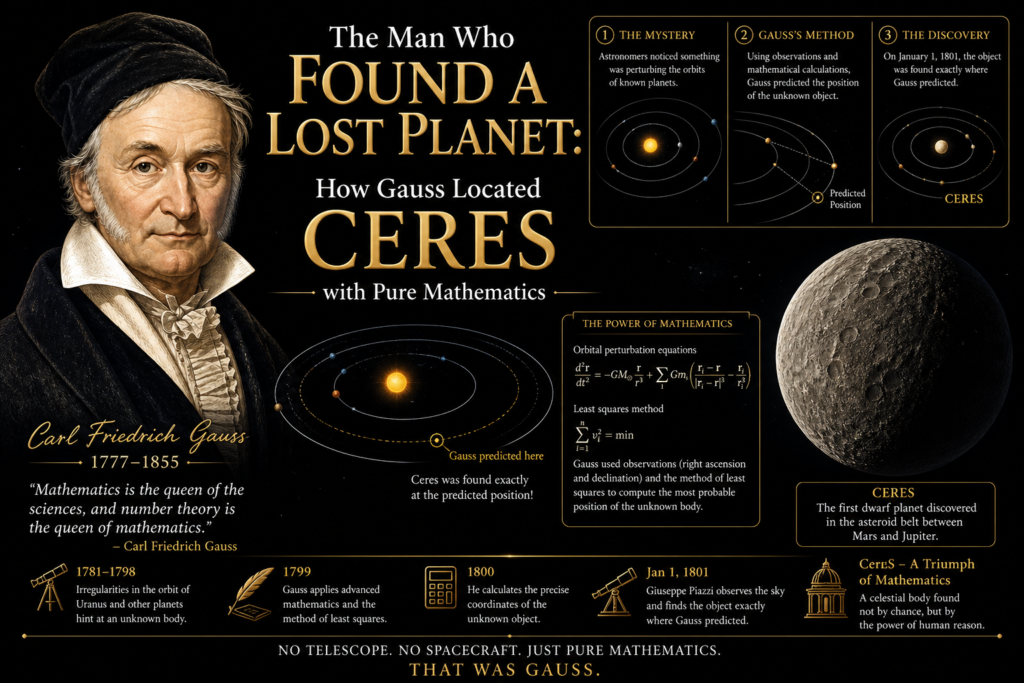
On the very first day of the 19th century, January 1, 1801, an Italian astronomer named Giuseppe Piazzi noticed a tiny star like object moving against the background of fixed stars. He had discovered what he thought was a comet, but it was actually a new planet. We now call it Ceres, a dwarf planet in the vast asteroid belt. Piazzi tracked his discovery for 41 days until February 11, 1801. Then, disaster struck. Ceres moved too close to the blinding light of the sun. When the sun moved away, and the skies cleared, Ceres had completely disappeared. Astronomers across Europe pointed their telescopes at the predicted region, but they found nothing. Without a mathematical model, the planet was lost forever. The astronomy history books were full of such lost objects. Most scientists gave up. But a 24 year old mathematician in Brunswick, Germany, saw an irresistible challenge.
The Young Mathematician Who Accepted the Challenge
Carl friedrich gauss was not yet famous. He had published his masterpiece Disquisitiones Arithmeticae on gauss number theory, but the world of astronomy did not know his name yet. He had a secret weapon: a burning passion for orbit determination. The problem was brutally difficult. To predict where a planet will be tomorrow, you need to know the complete shape of its path around the sun. According to Kepler’s Laws, planets move in elliptical orbits. To describe an ellipse, you need six numbers: the size, shape, orientation, and the planet’s position in time. Piazzi had given the world only 41 days of observations, barely a tiny arc of the full orbit. Most experts said it was impossible to calculate a full ellipse from such a small slice. Gauss disagreed. He invented a completely new mathematical method to solve the unsolvable connection between gauss and ceres.
The Mathematics Behind the Miracle
What was the secret formula that cracked the case of gauss and ceres? Gauss did not use a single equation; he built an entire system. He started by assuming that the orbit was a conic section (an ellipse, parabola, or hyperbola). From three accurate observations in the sky (the position of the planet on three different nights), he could calculate what astronomers call the “geocentric longitude and latitude.” But to turn these Earth centered coordinates into a sun centered orbit, he needed to solve an equation that had no direct solution. He used a technique called the method of least squares, which he had invented for exactly this purpose. The mathematics behind the method of least squares is elegant. If you have more observations than unknown variables (which Gauss did), there will be small errors. Gauss proved that the best estimate of the true value minimizes the sum of the squared differences between observed and predicted values. In mathematical notation, if ei are the errors, Gauss minimized:
This seemingly simple equation turned chaos into order. By applying this to the gauss and ceres problem, he calculated the most probable orbit. He also used advanced numerical analysis to predict where Ceres would appear months later.
The Triumphant Recovery
In late 1801, Gauss sent his predictions to the astronomer Franz Xaver von Zach. Gauss calculated where Ceres would be in December 1801. He did not just give a vague region of the sky. He provided precise coordinates. On December 7, 1801, Zach pointed his telescope exactly where gauss and ceres predicted. There it was. Ceres shone exactly where mathematics said it would, less than half a degree from Gauss’s calculated position. The astronomical world erupted in shock and admiration. A man who had never looked through a telescope had found a planet using only the power of pure reason. The story of gauss and ceres spread like wildfire through Europe. Suddenly, the prince of mathematics was a household name. He was offered the directorship of the Göttingen Observatory, a position he held for the rest of his life.
Why This Discovery Mattered So Much
The successful recovery of Ceres was not just a lucky guess. It proved that celestial mechanics had matured into a predictive science. Before Gauss, astronomers relied on guesswork and rough approximations. After gauss and ceres, they had a rigorous mathematical framework for tracking asteroids and minor planets. The method of least squares became the gold standard for every scientific field that involved measurement error. Geodesists used it to measure the size and shape of the Earth. Physicists used it to calibrate their instruments. Even today, when you fit a trendline to a scatter plot in Excel, you are using Gauss’s algorithm. The story of gauss and ceres also had a profound psychological impact on planetary motion research. Astronomers realized that they did not need continuous observations. A short arc, combined with brilliant mathematics, was enough.
The Method of Least Squares Explained Simply
Let us take a moment to appreciate the genius of the method of least squares in the context of gauss and ceres. Imagine you are trying to draw a straight line through several scattered points on a graph. If you move the line up, some points are above the line; if you move it down, others are below. Which line is correct? Gauss said the correct line is the one that makes the total of the squared vertical distances as small as possible. Why square the distances? Because squaring eliminates negative signs (so errors on both sides count equally) and penalizes large errors much more than small errors. This was a revolutionary insight. In the case of gauss and ceres, he was not fitting a line but an ellipse in three dimensional space. The principle remained the same: find the orbital parameters that minimize the sum of squared residuals. This approach is now a cornerstone of statistical modeling and data analysis.
Ceres Today and Gauss’s Lasting Legacy
What happened to Ceres after gauss and ceres changed history? For decades, Ceres was classified as a planet. As more minor planets were discovered in the same region, astronomers realized that Ceres was just the largest member of a vast asteroid belt between Mars and Jupiter. In 2006, the International Astronomical Union reclassified Ceres as a dwarf planet (the same category as Pluto). In 2015, NASA’s Dawn spacecraft arrived at Ceres, sending back stunning images of a frozen, cratered world. None of this would have been possible without the initial recovery by Gauss. Every mission to the asteroid belt stands on the mathematical shoulders of gauss and ceres. The prince of mathematics did not just find a rock; he proved that the universe operates according to discoverable mathematical laws.
Gauss’s Other Giant Contributions
While the story of gauss and ceres made him famous, Gauss never stopped working. He later collaborated with Wilhelm Weber to invent the gauss-weber telegraph, a precursor to modern communication. He gave the world the gauss normal distribution, that famous bell curve used in every statistics classroom. His work on curved surfaces created gaussian curvature, which Einstein later used to describe gravity. He even laid the foundations of gauss non euclidean geometry, a revolutionary idea that space itself might be curved. Many of these discoveries remained unpublished for years because Gauss was a perfectionist who feared controversy. Yet, the story of gauss and ceres remains the most dramatic moment of his career, the moment when the hidden power of pure mathematics became visible to the entire world.
Why Every Student Should Know This Story
There is a powerful lesson in the tale of gauss and ceres for every young scientist and mathematician. You do not need the most expensive telescope or the biggest laboratory to make a world changing discovery. You need patience, logic, and courage. Gauss had no special advantage except his brain. He sat at a desk with paper, ink, and the mathematical tools he invented himself. When the rest of the world said “impossible,” he said “let me calculate.” That is the spirit of scientific discovery. The method he invented, the method of least squares, now powers everything from self driving cars to weather forecasting. Every time you see a GPS calculate your position from noisy satellite signals, you are witnessing the legacy of gauss and ceres.
Frequently Asked Questions (FAQs)
What exactly was Gauss trying to find?
Gauss was trying to find Ceres, a dwarf planet located in the asteroid belt between Mars and Jupiter. Giuseppe Piazzi had discovered Ceres in 1801 but lost it after only 41 days of observation. Without a precise orbit, no telescope could locate it again. The challenge of gauss and ceres was to predict its position months later using only a tiny arc of observational data.
How did Gauss calculate the orbit without computers?
Gauss used pure mathematics, specifically his newly invented method of least squares. He also developed advanced numerical analysis techniques to solve complex equations by hand. He calculated an ephemeris (a table of positions) for Ceres month by month. This required thousands of individual arithmetic operations, all done with pencil and paper. The fact that he succeeded is a testament to his obsessive precision and patience.
Is the method of least squares still used today?
Absolutely. The method of least squares is one of the most widely used mathematical techniques in the world. It is the foundation of regression analysis in economics, psychology, biology, and engineering. When you fit a trendline to data in Microsoft Excel, the software is using the method of least squares. Every time a scientist calibrates an instrument or a data scientist builds a predictive model, they are using Gauss’s 1801 breakthrough.
Was Ceres the only planet Gauss helped find?
Gauss directly helped find Ceres. However, his mathematical methods were used by other astronomers to discover many subsequent minor planets in the asteroid belt. His work on perturbation theory (how planets gravitationally tug on each other) also helped refine the orbits of known planets like Uranus and Neptune. The story of gauss and ceres opened the floodgates for 19th century asteroid discovery.
Why is Carl Friedrich Gauss called the Prince of Mathematics?
He is called the prince of mathematics because of his profound and elegant contributions to nearly every branch of mathematics. Unlike kings who rule with force, Gauss ruled with intellectual authority. The story of gauss and ceres shows why he deserved this title. He solved problems that seemed impossible, and he did so with such perfection that his proofs are still studied today. He was the prince of mathematics because he made the complex look effortless.
Conclusion
The tale of gauss and ceres is one of the most inspiring episodes in the history of science. It proves that human reason, armed with the right mathematics, can reach across millions of miles and find a speck of rock in the dark. Carl friedrich Gauss did not flinch when the planet vanished. He sharpened his pencil and invented a new kind of astronomy. His method of least squares and his orbit determination techniques remain fundamental tools for every scientist who studies planetary motion. From the gauss-weber telegraph to modern space exploration, his fingerprints are everywhere. In many ways, how ancient greek scientists changed modern science by creating geometry and logic, Carl Friedrich Gauss completed their work by adding the mathematics of uncertainty and prediction. The prince of mathematics looked at a lost world and said, “I know where you are.” And the universe obeyed.