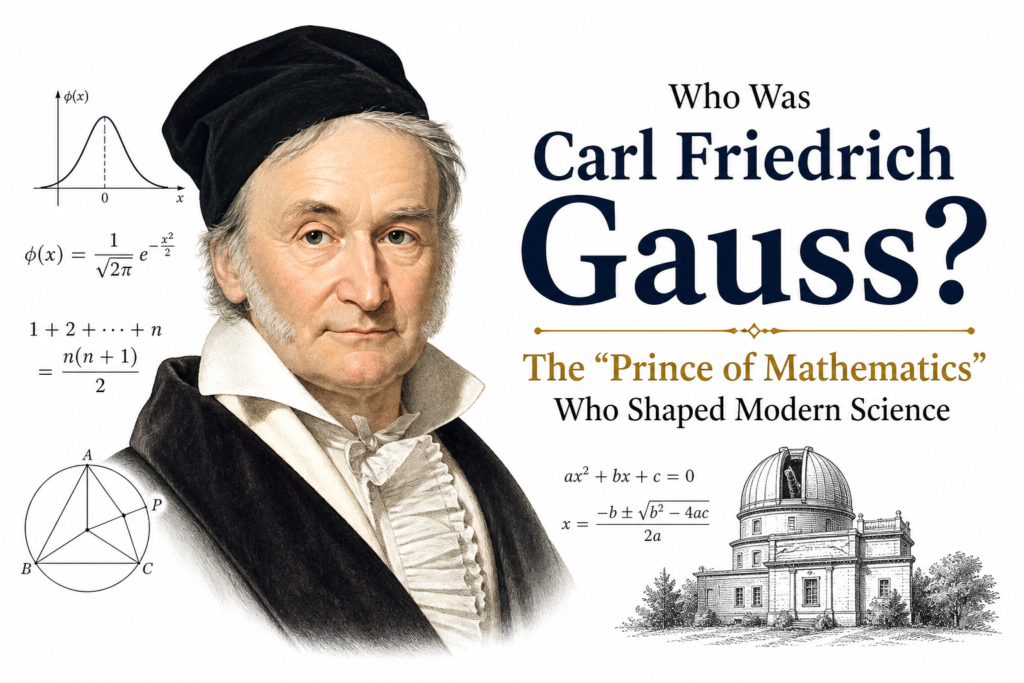
When historians list the most influential minds in human history, three names dominate the ancient and classical eras: Archimedes, Isaac Newton, and Leonhard Euler. Yet, standing confidently beside these titans is a German mathematician whose work silently powers almost every branch of modern science. So, who was carl friedrich gauss? Born in a humble house in Brunswick, this intellectual giant rewrote the rules of mathematics, physics, and astronomy. He was not just a theorist living in an ivory tower; he was a practical genius who invented new ways to measure the world. His obsession with precision and perfection earned him the nickname the prince of mathematics, a title that reflects his royal status in the kingdom of numbers. To understand the 19th century scientific revolution, one must first understand the mind of Gauss. He did not merely solve problems; he created the tools we still use to solve them today, from number theory to electromagnetism.
Early Life and a Child Prodigy
The story of carl friedrich gauss begins on April 30, 1777, in Brunswick, Duchy of Brunswick-Wolfenbüttel. His family was poor. His father, Gebhard, worked as a gardener and bricklayer, and he wanted young Carl to become a laborer as well. Fortunately, Gauss had a fierce protector in his mother, Dorothea, and a brilliant uncle who recognized the spark of genius early on. By the age of three, the gauss child prodigy was already correcting his father’s arithmetic. He could perform complex calculations in his head before he could properly write.
The most famous legend from his childhood involves a classroom punishment. To keep the class busy, a teacher asked the students to add all the whole numbers from 1 to 100. While his classmates struggled with paper and chalk, the young Gauss almost immediately wrote down the correct answer: 5050. He had not added sequentially. Instead, he realized that 1 plus 100 equals 101, 2 plus 99 equals 101, and so on. There were 50 pairs of 101, leading to a simple multiplication. This moment revealed his rare ability to see patterns where others saw brute force. Thanks to the intervention of a supportive duke, Gauss was allowed to attend the Collegium Carolinum, bypassing the harsh manual labor his father had planned for him. This early exposure to language and mathematics set the stage for his relentless pursuit of truth.
Higher Education and The University Years
Between 1795 and 1798, carl friedrich gauss attended the University of Göttingen, one of the most respected centers of learning in Europe. This period was explosive with creativity. He was studying philology and philosophy, but his heart belonged to mathematics. He read the works of Leonhard Euler and Isaac Newton voraciously, but he was never satisfied with just repeating their results. He wanted to open doors that had been locked for centuries.
While still a teenager, Gauss made his first monumental discovery. He solved a problem that had remained unsolved since the time of the ancient Greeks: how to construct a regular 17 sided polygon using only a compass and straightedge. For over 2,000 years, geometers believed such a construction was impossible. Gauss proved them wrong. This breakthrough convinced him to dedicate his life to mathematics. He famously wrote that he would give up his study of languages for the “goddess of mathematics.” At university, he began his famous mathematical diary, a small notebook where he scribbled cryptic notes about his discoveries. For decades, no one knew what most of them meant. When the diary was finally decoded, historians realized that Gauss had discovered many theorems years, sometimes decades, before the mathematicians who later received credit for them.
The Revolutionary Disquisitiones Arithmeticae
In 1801, at just 24 years old, carl friedrich gauss published his masterpiece: Disquisitiones Arithmeticae. This book is arguably the most influential book in the history of number theory. Before Gauss, number theory was a collection of random tricks and puzzles. After Gauss, it became a systematic, rigorous science. In this text, he introduced the concept of congruences, a mathematical notation that simplified the study of divisibility.
This is where we see the depth of his gauss number theory. He proved the Law of Quadratic Reciprocity, which he called the “Golden Theorem.” He was so proud of this theorem that he would publish six different proofs for it during his lifetime. He also tackled the theory of binary quadratic forms and laid the groundwork for modular arithmetic. Every time a modern computer encrypts a credit card number using RSA encryption, it relies on the mathematical principles first organized by carl friedrich gauss. The Disquisitiones was so dense and advanced that it was nearly impossible for the average mathematician of the time to understand. But those who could grasp it, like the young Evariste Galois or Niels Henrik Abel, found their entire worldview changed. It remains a pillar of number theory to this day.
The Astronomer: Finding a Lost Planet
While number theory was his first love, life forced Gauss to look toward the stars. In the early 1800s, astronomers discovered a new dwarf planet named Ceres. They tracked it for a few weeks, but then it disappeared behind the blinding light of the sun. When it emerged, no one could find it. Predicting a planet’s location based on sparse data was mathematically impossible using existing methods. Most astronomers gave up looking.
However, carl friedrich gauss accepted the challenge. He developed a revolutionary new mathematical technique to predict orbital motion using only three observations. This was the method of least squares, a statistical tool used to minimize the sum of squared errors in a set of data. He applied his calculations to the mystery of gauss and ceres. When the night sky cleared, astronomers pointed their telescopes exactly where Gauss had predicted. There it was, less than half a degree from his calculated position. The successful recovery of Ceres made the relatively unknown mathematician a European celebrity overnight. He was appointed director of the Göttingen Observatory, a position he held until his death. This work solidified the method of least squares as a cornerstone of modern statistics, data science, and regression analysis.
The Polymath: Physics, Magnetism, and Geometry
Gauss rarely stuck to one subject for long. Once he solved a problem, he often put it aside and moved to something entirely new. In the 1830s, he teamed up with a young physicist named Wilhelm Weber to investigate magnetism. Together, they constructed the first electromagnetic telegraph in 1833. This gauss-weber telegraph could send signals over a distance of about one kilometer using a binary code. While crude, it was the direct ancestor of the internet, telephones, and every wireless device we use today.
Meanwhile, he was revolutionizing geometry. For thousands of years, mathematicians accepted Euclid’s geometry as the absolute truth of physical space. But Gauss suspected otherwise. He secretly developed the foundations of gauss non euclidean geometry, a system where parallel lines can diverge or converge on curved surfaces. He was terrified of the “uproar of the Boeotians” (the unenlightened people), so he did not publish this work. Yet, when applied to surfaces, his work on gaussian curvature became essential. This concept measures how a surface bends. Without gaussian curvature, Albert Einstein could not have formulated his General Theory of Relativity, which describes gravity as the curvature of spacetime.
Later Life and Lasting Legacy
In his later years, carl friedrich gauss became a revered, if somewhat intimidating, figure at the University of Göttingen. He was known for his harsh critiques but also for his deep insights. He supervised many doctoral students, though he rarely collaborated. He continued working on gauss geodesy, conducting the extensive survey of the Kingdom of Hanover. This practical work led him to invent the heliotrope, an instrument that reflected sunlight to measure large distances with extreme accuracy. Even in his seventies, he was learning new things, including Russian to read the works of a young Russian mathematician.
When he died on February 23, 1855, scientists around the world felt the loss. His brain was preserved and studied; scientists noted its highly developed convolutions, confirming what everyone already knew: this was a unique human mind. carl friedrich gauss influenced everything from the gauss normal distribution (the famous bell curve used in statistics and social sciences) to the mathematical foundations of gauss fast fourier transform which allows us to process digital signals and images today. He is buried in Göttingen, but his ideas are everywhere: in the stock market, in GPS satellites, and in the physics that explains light.
Frequently Asked Questions (FAQs)
Why is Carl Friedrich Gauss called the “Prince of Mathematics”?
He is called the prince of mathematics because of his profound influence on every field of mathematics he touched. Unlike kings who conquer territories, a prince represents the highest nobility. Gauss was given this nickname by his contemporaries because of his rigorous, polished, and perfect proofs. He solved problems that had stood for millennia, such as the construction of the 17 sided polygon, and he organized number theory into a coherent discipline. The name stuck because it perfectly captures his elegance, power, and aristocratic precision in logic.
What is the most famous mathematical formula by Gauss?
While he has hundreds of formulas, the one most people encounter daily is the gauss normal distribution, often called the Gaussian distribution or bell curve. This formula describes how data clusters around a mean. For example, heights, test scores, and measurement errors all follow this curve. However, in pure mathematics, the “Gauss Bonnet theorem” (connecting geometry and topology) and the “fundamental theorem of algebra” (proving every polynomial equation has a solution) are arguably his most profound contributions.
Did Carl Friedrich Gauss invent the telegraph?
No, he did not invent the concept of the telegraph, but he and his collaborator Wilhelm Weber built the gauss-weber telegraph in 1833, which was one of the first functional electromagnetic telegraphs in the world. It was used for communication between the physics institute and the astronomical observatory in Göttingen. While Samuel Morse later popularized a more practical commercial version in the United States, Gauss and Weber’s work proved that electricity could be used for long distance communication.
Why did Gauss not publish his work on non Euclidean geometry?
Gauss was a perfectionist who feared controversy. He realized that our physical space might not be Euclidean, and he developed gauss non euclidean geometry in private as early as 1813. However, he did not publish it because he knew it would challenge the teachings of philosopher Immanuel Kant and the church, leading to an “uproar.” He wanted a quiet life of research. He only admitted to his discoveries after others like János Bolyai and Nikolai Lobachevsky published similar works, praising them while privately noting he had done the same decades earlier.
Where did Gauss do most of his work?
Most of his major theoretical work was done at the University of Göttingen, where he served as the director of the astronomical observatory. He lived in an apartment inside the observatory. This environment allowed him to pursue both theoretical mathematics and practical astronomy. He also spent significant time in the field during his work on gauss geodesy, measuring the Kingdom of Hanover. His childhood home in Brunswick is where the gauss child prodigy first discovered his love for numbers.
Conclusion
To ask “who was carl friedrich gauss?” is to ask about the architect of modern precision. He bridged the gap between pure thought and physical reality. From the orbits of planets to the curvature of space, from the statistics of a classroom to the encryption of the internet, his fingerprints are everywhere. He embodied the scientific revolution of the 19th century, proving that a quiet life of calculation could change the world more dramatically than a thousand armies. His legacy is a testament to human potential. Just as how ancient greek scientists changed modern science through geometry and logic, Gauss changed the future through algebra and rigor. The prince of mathematics may have left the physical world in 1855, but in every equation we solve and every satellite we launch, his genius remains eternally present.