The invention of the electric motor stands among the greatest technological breakthroughs in human history. From factory machines and electric vehicles to fans, refrigerators, trains, and robots, electric motors power the modern world. Almost every industry today depends on the revolutionary idea first demonstrated by Michael Faraday in the early 19th century.
Before Faraday’s discovery, machines mainly relied on steam engines, animal labor, or human effort. Everything changed when Faraday proved that electricity and magnetism could create continuous motion. This discovery transformed science, engineering, transportation, and civilization forever.
The invention of the electric motor was not simply about creating a spinning machine. It was the birth of a completely new way of converting electrical input into mechanical output.
This article explores the fascinating history, experiments, physics, equations, scientific controversies, and global impact behind the invention of the electric motor.
The Scientific World Before Electric Motors (1800 – 1820)
In the early 1800s, electricity was still mysterious. Scientists understood static electricity and batteries, but they did not know how electricity could produce motion.
The situation changed dramatically in 1820 when Hans Christian Oersted discovered that electric current produced magnetic effects around a wire.
Soon afterward, Andre Marie Ampere developed mathematical theories explaining electromagnetic interactions.
These discoveries inspired Michael Faraday to investigate whether electricity could produce continuous motion.
Faraday believed magnetic forces could create mechanical movement through electromagnetic rotation.
This question eventually led to one of the greatest physics breakthroughs in history.
Faraday’s Curiosity and Scientific Vision
Faraday was fascinated by invisible magnetic forces.
Unlike many scientists focused only on theory, Faraday preferred experiments. He believed nature revealed its secrets through careful observation.
His scientific imagination helped him visualize magnetic field lines moving through space.
Later, these ideas became central to field theory and lines of force.
Faraday’s deep curiosity drove him to search for a way to transform electricity into motion continuously rather than temporarily.
This vision directly led to the invention of the electric motor
The 1821 Experiment That Changed the World
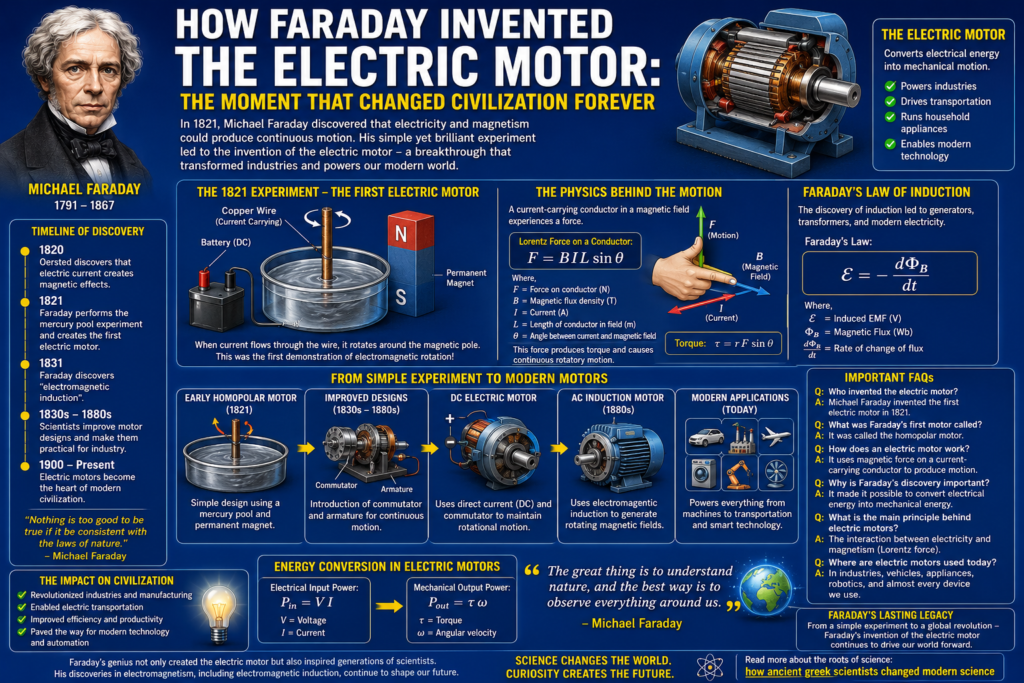
In 1821, Faraday performed one of the most important experiments in scientific history.
This famous 1821 experiment demonstrated electromagnetic rotation for the first time.
Faraday placed:
- A permanent magnet in a mercury pool
- A conducting wire carrying direct current (DC) nearby
When current flowed, the wire began rotating continuously around the magnetic pole.
This became the first electric motor in history.
The experiment proved that electricity and magnetism could generate continuous motion.
Faraday’s setup became known as the homopolar motor.
Understanding the Homopolar Motor
The homopolar motor was simple but revolutionary.
Its components included:
- A battery
- Copper wire
- Mercury pool experiment setup
- Permanent magnet
- Conductive liquid
The current flowing through the wire interacted with the magnetic field.
This interaction created force and motion.
The experiment showed that electrical energy could become kinetic energy.
This discovery became the foundation of all future motor technology.
Modern motors are far more advanced, but they still follow the same principles discovered by Faraday.
The Physics Behind Electric Motors
The invention of the electric motor depends on electromagnetic force.
When electric current moves through a magnetic field, force acts on the conductor.
This force is described mathematically by the Lorentz force equation:
Where:
- = Magnetic force
- = Electric charge
- = Velocity of charge
- = Magnetic field
For current carrying wires, the force equation becomes:
Where:
- = Force on conductor
- = Magnetic flux density
- = Current
- = Length of conductor
- = Angle between field and conductor
This force creates torque and rotational motion.
Electromagnetic Rotation and Continuous Motion
Faraday’s greatest achievement was creating continuous motion rather than one time movement.
Scientists already knew magnets could attract or repel objects temporarily.
Faraday discovered how electromagnetic rotation could continue endlessly while current flowed.
This idea completely transformed machine technology.
Continuous motion became possible because magnetic forces constantly acted on the conductor.
The rotational force generated in motors is called torque.
The torque equation is:
Where:
- = Torque
- = Radius
- = Force
Torque became one of the most important concepts in motor engineering.
The William Hyde Wollaston Controversy
Faraday’s motor experiments created controversy.
Scientist William Hyde Wollaston believed he deserved credit for similar ideas regarding electromagnetic rotation.
This disagreement became known as the William Hyde Wollaston controversy.
Although tensions existed, Faraday’s successful experiment clearly demonstrated the first practical electric motor.
His experimental skill and scientific honesty eventually earned him worldwide recognition.
The controversy also showed how competitive scientific discovery had become during the scientific revolution of the 19th century.
Faraday’s Law and Motor Technology
The invention of the electric motor closely connects with faraday’s law of induction.
Faraday later discovered that changing magnetic fields could induce electricity.
This law is expressed as:
Where:
- = Induced EMF
- = Magnetic flux
Although motors mainly convert electricity into motion, generators reverse the process.
Together, motors and generators became the foundation of modern electrical engineering.
Relation Between Motors and Generators
The invention of motors later inspired the electric generator discovery.
These two machines are closely related:
- Motors convert electricity into mechanical output
- Generators convert motion into electricity
Generators operate using electromagnetic induction principles.
Motor generator systems became essential for factories, transportation, and power stations.
Modern civilization depends on both inventions equally.
Electrical Energy and Mechanical Output
Electric motors work through energy conversion.
The electrical power entering the motor is:
Where:
- = Power
- = Voltage
- = Current
Mechanical output power is:
Where:
- = Torque
- = Angular velocity
This relationship explains how motors transform electrical energy into useful motion.
Every modern machine using motors follows these principles.
Early Motor Development (1830 – 1880)
After Faraday’s discovery, scientists and engineers improved motor technology rapidly.
New inventions included:
- Better armature designs
- Rotating coils
- Improved commutator systems
- Stronger magnets
The commutator became especially important in direct current motors.
A commutator reverses current direction continuously, allowing steady rotational movement.
These improvements made motors more practical for industry and transportation.
Industrial Revolution and Motor Technology
The invention of the electric motor accelerated industrial growth enormously.
Factories no longer depended entirely on steam engines.
Electric motors offered:
- Cleaner energy
- Smaller machines
- Better efficiency
- Easier control
- Continuous operation
Industries rapidly adopted motor driven machinery.
Electric motors transformed:
- Manufacturing
- Mining
- Transportation
- Agriculture
- Communication systems
This technological revolution changed civilization forever.
Electromagnetic Induction and Motors
Motor technology also relies on electromagnetic induction principles.
Changing magnetic fields inside motors produce additional electrical effects.
Induction motors later became some of the most important machines in industry.
These motors operate without direct electrical contact inside the rotating system.
Induction motor technology remains essential today.
Modern Electric Motors (1900 – Present)
Today, electric motors exist everywhere.
Modern applications include:
- Electric vehicles
- Robotics
- Air conditioners
- Washing machines
- Drones
- Elevators
- Industrial automation
- High speed trains
Billions of electric motors operate globally every day.
The invention of the electric motor became one of the foundations of modern civilization.
Faraday and Maxwell Connection
Faraday’s experimental discoveries later inspired James Clerk Maxwell.
The faraday and maxwell connection transformed electromagnetism into advanced mathematics.
Maxwell’s equations explained electric and magnetic fields scientifically.
One important equation is:
This equation helped engineers design modern motor systems.
Without Maxwell’s mathematical work, advanced electrical engineering would have developed much more slowly.
Electric Motors and Renewable Energy
Modern renewable energy systems depend heavily on electric motors and generators.
Wind turbines use rotating systems connected to generators.
Electric vehicles use highly efficient motor technology.
Modern energy systems continue improving Faraday’s original ideas.
This proves how powerful his discovery truly was.
Faraday’s Scientific Legacy
Faraday’s genius extended beyond motors.
He also worked on:
- Electrochemistry
- Magnetism
- Optics
- Chemistry
His discoveries eventually contributed to faraday’s electrochemical laws and many other scientific breakthroughs.
Despite worldwide fame, Faraday remained humble and deeply committed to science education.
His public lectures inspired generations of scientists and engineers.
Why the Invention of the Electric Motor Still Matters
Modern civilization cannot function without electric motors.
Motors power:
- Factories
- Hospitals
- Transportation systems
- Home appliances
- Communication networks
Without electric motors:
- Industrial production would collapse
- Transportation would slow dramatically
- Modern cities could not operate efficiently
Faraday’s discovery changed humanity permanently.
The Global Impact of Electric Motors
The invention of the electric motor reshaped global civilization.
It accelerated:
- Economic growth
- Industrialization
- Scientific research
- Urban development
- Technological innovation
Few scientific discoveries have influenced humanity more deeply.
Faraday’s simple experiment in 1821 eventually powered the modern world.
FAQs About the Invention of the Electric Motor
Who invented the electric motor?
Michael Faraday created the first electric motor in 1821 using electromagnetic rotation experiments.
What was Faraday’s first motor called?
It was called the homopolar motor.
How does an electric motor work?
An electric motor works by using magnetic force to convert electrical energy into motion.
What is electromagnetic rotation?
Electromagnetic rotation is continuous movement created by the interaction of electricity and magnetism.
Why was the invention of the electric motor important?
It transformed industry, transportation, manufacturing, and modern technology worldwide.
What is the Lorentz force?
The Lorentz force describes the force acting on charged particles moving in magnetic fields.
Conclusion
The invention of the electric motor was one of the most revolutionary moments in scientific history. Michael Faraday’s experiments proved that electricity and magnetism could create continuous motion, transforming civilization forever.
From simple laboratory demonstrations to modern electric vehicles and industrial machines, Faraday’s ideas continue shaping the world today. His discoveries connected physics, engineering, and energy conversion into one powerful scientific framework.
Modern civilization depends on the principles Faraday uncovered nearly two centuries ago. His work inspired future advances in generators, electromagnetic theory, and electrical engineering.
The impact of Faraday’s electric motor is as transformative as how ancient greek scientists changed modern science, proving once again that scientific curiosity can completely reshape human civilization.