The electric generator discovery was one of the most revolutionary moments in human history. It changed civilization forever by making large scale electricity generation possible. Every modern city, factory, hospital, and home depends on generators that operate using the principles discovered by Michael Faraday in the 19th century.
Before generators existed, electricity was difficult to produce and impossible to distribute widely. Everything changed when Faraday discovered that moving magnets could generate electric current. This simple but powerful idea became the foundation of modern electrical power systems.
Today, power plants, wind turbines, hydroelectric dams, and industrial generators all operate using the same scientific principles Faraday discovered nearly two centuries ago.
This article explores the history, science, equations, experiments, and global impact behind the electric generator discovery in simple and engaging language.
The Scientific World Before Generators (1800 – 1830)
In the early 1800s, scientists were still trying to understand electricity and magnetism.
Experiments by Hans Christian Oersted showed that electric current produced magnetic effects. Andre Marie Ampere later expanded these ideas mathematically.
However, one important question remained unanswered:
Could magnetism create electricity?
This question fascinated Michael Faraday deeply.
Faraday believed forces in nature were connected through invisible fields. His experiments eventually proved that changing magnetic fields could induce electric current.
This discovery became the basis of electromagnetic induction and later transformed civilization completely.
Faraday’s Revolutionary Experiment (1831)
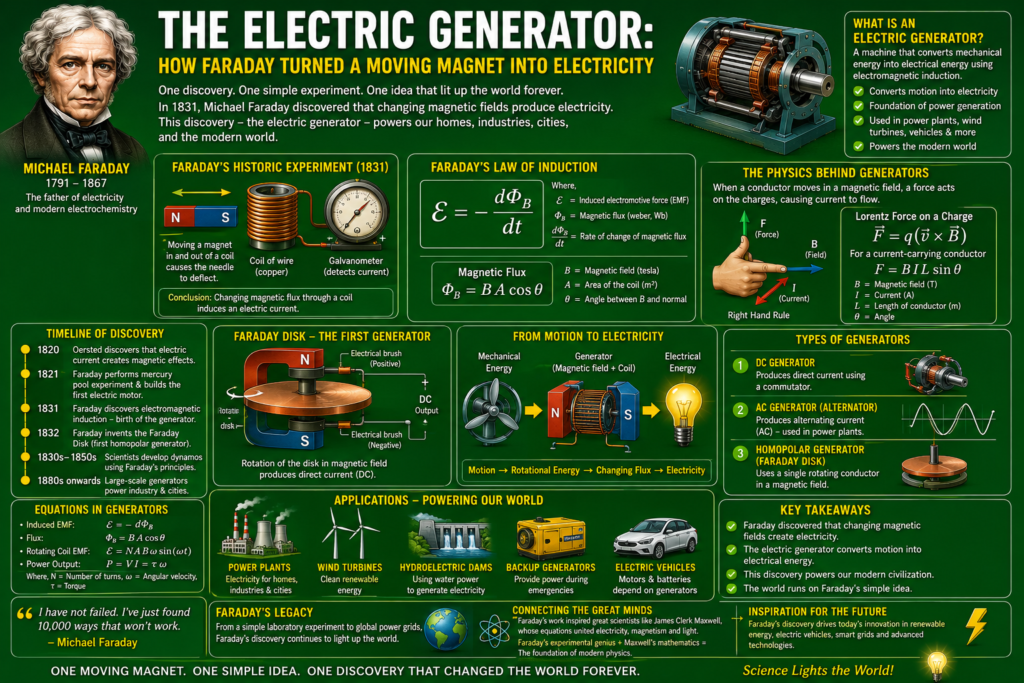
In 1831, Faraday performed one of the most important experiments in scientific history.
He moved a magnet through a copper wire coil connected to a galvanometer.
Something extraordinary happened.
The galvanometer needle moved whenever the magnet moved.
Faraday realized that motion inside a magnetic field could create electricity.
This became the foundation of the electric generator discovery.
The experiment showed:
- Moving magnets create changing magnetic flux
- Changing magnetic flux induces electric current
- Mechanical motion can become electrical energy
This simple experiment eventually powered the entire modern world.
What Is an Electric Generator?
An electric generator is a machine that converts mechanical to electrical energy.
Generators operate using magnetic fields and conductive coils.
In simple terms:
- Motion rotates a coil or magnet
- Magnetic flux changes continuously
- Electric current is induced
Generators follow faraday’s law of induction, which states:
Where:
- = Induced electromotive force (EMF)
- = Magnetic flux
- = Rate of change of flux
This equation explains how moving magnets generate electricity.
Understanding Magnetic Flux
Magnetic flux is one of the most important concepts in generator physics.
It measures how much magnetic field passes through a surface.
The formula is:
Where:
- = Magnetic flux
- = Magnetic field strength
- = Area of coil
- = Angle between field and surface
As coils rotate inside magnetic fields, flux changes continuously.
This changing flux produces electrical induction.
Without changing magnetic flux, generators cannot work.
Faraday Disk and the First Generator
Faraday soon developed one of the earliest generators called the Faraday disk.
The Faraday disk was a homopolar generator using:
- A rotating copper disk
- Permanent magnets
- Electrical brushes
As the copper disk rotated inside a magnetic field, electricity flowed through the circuit.
This was the first practical demonstration of converting rotational energy into electrical power.
The Faraday disk became one of the foundations of modern generator engineering.
The Physics Behind Electric Generators
Electric generators work because magnetic forces interact with moving conductors.
When a conductor moves through a magnetic field, charges experience force.
The Lorentz force equation is:
Where:
- = Magnetic force
- = Electric charge
- = Velocity
- = Magnetic field
In generators, this force pushes electrons through conductors, creating electric current.
The induced voltage in rotating systems can also be written as:
Where:
- = Number of turns
- = Area of coil
- = Magnetic field strength
- = Angular velocity
This equation powers the modern electrical world.
The Dynamo Principle
The dynamo principle became one of the greatest engineering achievements of the Industrial Revolution.
A dynamo converts mechanical energy into electrical energy using rotating magnetic systems.
The history of the dynamo began directly from Faraday’s experiments.
Early dynamos improved generator efficiency using:
- Stronger magnetic fields
- Rotating armatures
- Better conductive materials
- Improved electrical brushes
These developments made large scale electricity generation possible.
Rotational Energy and Generator Systems
Generators rely on rotational energy produced by external forces.
Modern generator systems use:
- Steam turbines
- Water turbines
- Wind turbines
- Gas turbines
- Diesel engines
These systems rotate generator coils or magnets continuously.
Mechanical power entering a generator is:
Where:
- = Mechanical power
- = Torque
- = Angular velocity
The generator converts this power into electrical output.
Alternating Current and Generator Technology (1880 – 1900)
As generator technology improved, alternating current (AC) became extremely important.
Alternating current changes direction continuously, making power transmission more efficient.
AC generators produce sinusoidal voltage:
Where:
- = Maximum voltage
- = Angular frequency
This type of electricity powers modern homes and industries worldwide.
The competition between Nikola Tesla and Thomas Edison shaped the development of electrical systems globally.
Tesla strongly supported alternating current because it allowed long distance power transmission.
Electric Generators and Power Plants
Modern power plant technology depends entirely on generators.
Power plants use turbines connected to giant generators.
Examples include:
- Hydroelectric plants
- Nuclear stations
- Coal plants
- Wind farms
- Geothermal systems
All these systems operate using the same induction principles discovered by Faraday.
The generator became the heart of the global power grid.
Without generators, modern civilization could not function.
Renewable Energy and Modern Generators
Today, renewable energy systems rely heavily on generator technology.
Wind turbines convert wind motion into electrical power through generators.
Hydroelectric dams use flowing water to rotate turbines.
Modern renewable energy systems still depend on Faraday’s original discovery.
This proves the timeless importance of Faraday’s scientific work.
The Relation Between Motors and Generators
Generators and motors are closely connected technologies.
The invention of the electric motor allowed electricity to produce motion.
Generators perform the opposite process.
- Motors convert electrical energy into motion
- Generators convert motion into electricity
Both machines depend on magnetic fields and induction principles.
Together, they became the foundation of industrial technology.
Electromagnetic Fields and Maxwell
Faraday’s discoveries later inspired James Clerk Maxwell.
The faraday and maxwell connection transformed experimental ideas into mathematical physics.
Maxwell’s equation describing induction is:
This equation explains how changing magnetic fields create electric fields.
Modern electrical engineering depends heavily on Maxwell’s mathematical framework.
Energy Conservation in Generators
Generators follow the law of energy conservation.
Electrical energy cannot appear from nowhere.
Mechanical energy entering the generator becomes electrical energy.
The efficiency equation is:
Where:
- = Efficiency
- = Electrical output power
- = Mechanical input power
Modern generators can achieve extremely high efficiency levels.
Magnetic Saturation and Generator Design
Large generators must carefully control magnetic saturation.
Magnetic saturation occurs when materials cannot support stronger magnetic fields.
This effect limits generator performance.
Engineers design magnetic circuits carefully to optimize:
- Flux density
- Coil turns
- Rotational speed
- Cooling systems
These engineering improvements make modern generators powerful and reliable.
Industrial Revolution and Electricity
The electric generator discovery accelerated the Industrial Revolution dramatically.
Factories gained reliable electrical power.
Cities became illuminated.
Communication systems expanded rapidly.
Generators transformed:
- Manufacturing
- Transportation
- Medicine
- Telecommunications
- Computing
Few scientific discoveries have influenced civilization more deeply.
Modern Generator Applications (2000 – Present)
Today, generators operate almost everywhere.
Applications include:
- Emergency backup systems
- Data centers
- Aircraft systems
- Renewable energy farms
- Electric vehicles
- Industrial plants
Modern civilization depends completely on generator technology.
Faraday’s discovery continues shaping the future of humanity.
Faraday’s Scientific Legacy
Faraday’s genius extended far beyond generators.
His work also contributed to:
- Magnetism
- Chemistry
- Electrochemistry
- Optics
His discoveries later influenced faraday effect research and many other scientific breakthroughs.
Faraday remained humble despite worldwide fame and inspired generations of scientists.
Why the Electric Generator Discovery Still Matters
Without generators:
- Modern electricity would disappear
- Power grids would collapse
- Factories would stop operating
- Communication systems would fail
The electric generator discovery made modern civilization possible.
Every modern electrical system depends on Faraday’s revolutionary ideas.
FAQs About the Electric Generator Discovery
Who discovered the electric generator?
Michael Faraday discovered the principles behind electric generators in 1831.
How does an electric generator work?
A generator converts mechanical energy into electricity using changing magnetic fields.
What is the Faraday disk?
The Faraday disk was one of the first homopolar generators using a rotating copper disk and magnets.
Why are generators important?
Generators produce electricity for homes, industries, hospitals, and modern infrastructure.
What is alternating current?
Alternating current (AC) is electricity that changes direction periodically.
What powers modern generators?
Modern generators are powered by turbines driven by steam, water, wind, or engines.
Conclusion
The electric generator discovery completely transformed human civilization. Michael Faraday proved that moving magnets could create electricity, unlocking the foundation of modern electrical power systems.
From giant power plants to renewable energy systems, Faraday’s discovery powers the modern world every single day. His experiments connected motion, magnetism, and electricity into one of the greatest scientific breakthroughs in history.
Modern civilization depends heavily on the principles Faraday uncovered in 1831. His ideas inspired motors, generators, transformers, and advanced electrical engineering systems that continue shaping humanity’s future.
The impact of the electric generator discovery is as revolutionary as how ancient greek scientists changed modern science, proving once again that scientific curiosity can transform the world forever.