The chemical history of a candle is one of the most famous science lectures ever delivered. In the 19th century, Michael Faraday transformed a simple candle flame into one of the greatest educational tools in scientific history. Through his brilliant demonstrations, Faraday showed that ordinary everyday objects could reveal the deepest secrets of chemistry, physics, heat, energy, and life itself.
Faraday’s candle lectures were not just lessons about fire. They became powerful examples of science education and experimental thinking. Using only a candle, Faraday explained combustion, gases, heat transfer, convection currents, oxygen consumption, and chemical reactions in ways ordinary people could understand.
Today, the chemical history of a candle remains one of the greatest examples of public scientific communication ever created. The lectures continue inspiring students, scientists, teachers, and engineers around the world.
This article explores the history, chemistry, equations, experiments, and scientific importance behind Faraday’s legendary candle lectures.
Science Education Before Faraday (1800 – 1850)
During the early 19th century, science education was often difficult and inaccessible.
Scientific lectures frequently relied on:
- Complex mathematics
- Formal language
- Technical terminology
Ordinary people struggled to understand scientific ideas.
Faraday believed science should be understandable to everyone, including children.
This belief shaped his famous Christmas Lectures at the Royal Institution.
Faraday wanted to teach scientific principles using familiar objects from daily life.
He chose one of the simplest objects imaginable:
A candle.
Michael Faraday and Public Lectures
Michael Faraday became one of history’s greatest scientific communicators.
Although famous for discoveries like electromagnetic induction, Faraday also believed deeply in public science education.
His lectures combined:
- Demonstrations
- Experiments
- Clear explanations
- Visual learning
Faraday understood that curiosity drives scientific understanding.
His teaching style transformed science communication forever.
The chemical history of a candle became the most famous example of his educational genius.
The Royal Institution Christmas Lectures (1860 – 1861)
Faraday delivered The Chemical History of a Candle during the Royal Institution Christmas Lectures in 1860 and 1861.
The lectures targeted young audiences but fascinated adults equally.
Faraday showed that a candle flame could explain:
- Chemistry
- Physics
- Heat
- Air composition
- Energy transformation
The lectures later became one of the most influential science books ever published.
Faraday demonstrated that scientific truth could emerge from ordinary observations.
What Happens When a Candle Burns?
At first glance, a candle seems simple.
However, Faraday showed that candle burning involves extremely complex scientific processes.
A candle flame depends on:
- Wax evaporation
- Capillary action
- Oxygen consumption
- Combustion reactions
- Heat transfer
The candle transforms chemical energy into:
- Heat radiation
- Light
- Motion of gases
Faraday used these processes to explain fundamental chemistry.
Understanding Candle Wax Chemistry
Most candles contain hydrocarbons made from carbon and hydrogen atoms.
Paraffin wax can be represented approximately as:
When heated, the wax melts and rises through the wick by capillary action.
Capillary action occurs because liquid wax moves upward through tiny spaces inside the wick fibers.
The melted wax then evaporates near the flame.
This vaporized fuel supports combustion.
Faraday carefully demonstrated each stage during his lectures.
The Combustion Process Explained
Combustion is a chemical reaction between fuel and oxygen.
The simplified combustion equation for candle wax is:
This equation shows:
- Wax reacts with oxygen
- Carbon dioxide forms
- Water vapor forms
- Heat energy is released
The candle flame continuously transforms matter and energy.
Faraday used this simple reaction to explain chemical transformations clearly.
Oxygen Consumption and Air Composition
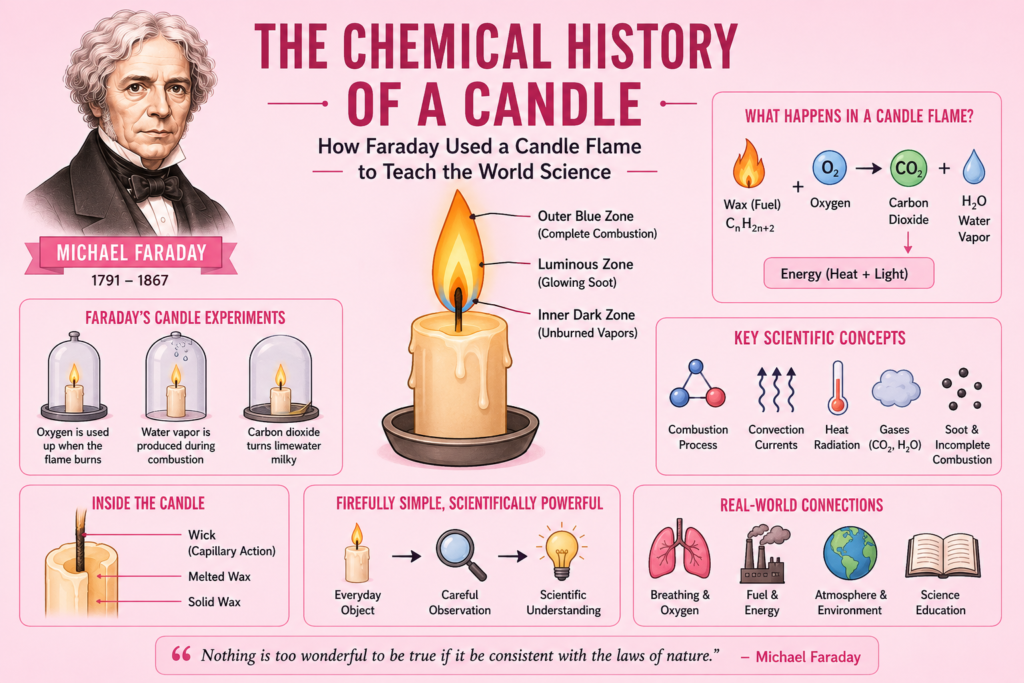
Faraday showed that candle flames consume oxygen from air.
Air contains approximately:
- 78% nitrogen
- 21% oxygen
- Small amounts of other gases
The flame cannot continue without oxygen.
Faraday demonstrated this by placing jars over candles.
As oxygen levels dropped, the flame weakened and eventually extinguished.
This simple experiment helped audiences understand the importance of oxygen in combustion.
Water Vapor Produced by Candle Flames
Faraday also proved that candle flames produce water vapor.
When hydrocarbon fuels burn, hydrogen atoms combine with oxygen.
The reaction forms water:
Faraday held cool surfaces above candle flames and observed condensed water droplets.
This surprised many audience members.
People rarely imagined fire could produce water.
Faraday used these demonstrations to reveal hidden chemical processes.
Carbon Dioxide and Combustion
Another important product of combustion is carbon dioxide.
Carbon atoms from wax combine with oxygen:
Faraday showed that candle flames release invisible gases into the air.
He explained how carbon dioxide affects combustion and respiration.
This helped audiences understand the connection between chemistry and human life.
Candle Flame Structure Explained
Faraday carefully studied candle flame structure.
He identified different flame regions including:
- Inner dark zone
- Luminous zone
- Outer blue zone
Each region contains different chemical processes.
Inner Dark Zone
Contains unburned wax vapor.
Luminous Zone
Produces bright yellow light due to glowing soot particles.
Outer Blue Zone
Contains complete combustion with highest oxygen availability.
These observations became important in combustion science.
Incomplete Combustion and Soot
Faraday demonstrated incomplete combustion using candle flames.
When oxygen becomes limited:
- Carbon particles form
- Soot appears
- Smoke increases
Incomplete combustion can be represented as:
This reaction forms carbon monoxide rather than carbon dioxide.
Faraday used soot experiments to explain why flames glow brightly.
Convection Currents and Heat Transfer
Faraday also used candles to demonstrate convection currents.
Hot gases rise because heated air becomes less dense.
The buoyancy force can be described as:
Where:
- = Buoyant force
- = Fluid density
- = Gravitational acceleration
- = Volume displaced
Faraday showed smoke movement around flames to visualize convection currents.
These demonstrations helped explain heat transfer naturally.
Heat Radiation and Energy Transformation
Candles convert chemical energy into heat and light.
Energy conservation plays a central role in combustion.
The heat energy released depends on fuel combustion:
Where:
- = Heat energy
- = Mass
- = Specific heat capacity
- = Temperature change
Faraday explained how flames radiate heat in all directions.
This helped audiences understand energy transfer processes.
Scientific Demonstration and Faraday’s Teaching Style
Faraday’s greatest strength was scientific demonstration.
He believed experiments should:
- Be simple
- Be visual
- Inspire curiosity
Rather than overwhelming audiences with theory, Faraday let experiments reveal scientific truth naturally.
His candle lectures became a masterpiece of educational communication.
Modern science communicators still study Faraday’s teaching methods today.
Candle Flames and Atmospheric Science
Faraday connected candle chemistry to atmospheric science.
He explained that both respiration and combustion involve oxygen consumption.
Humans breathe oxygen and release carbon dioxide similarly to burning fuels.
This helped audiences understand chemistry as part of everyday life.
Faraday transformed ordinary observations into deep scientific insights.
Faraday’s Scientific Philosophy
Faraday believed nature followed universal laws.
His work on candles reflected the same scientific mindset that later produced faraday’s law of induction and electrical discoveries.
Faraday saw connections between chemistry, physics, heat, and matter.
His experiments encouraged people to observe the natural world carefully.
This scientific philosophy helped inspire modern interdisciplinary science.
The Candle Lectures and Modern Education
The chemical history of a candle remains highly influential today.
Teachers worldwide still use candle experiments to explain:
- Combustion
- Heat transfer
- Gas chemistry
- Convection currents
- Scientific observation
Faraday’s educational methods became the foundation of modern interactive science teaching.
Candle Science and Industrial Chemistry
Faraday’s candle lectures also influenced industrial chemistry.
Understanding combustion became essential for:
- Engines
- Furnaces
- Energy systems
- Industrial heating
Combustion science later helped improve steam engines, fuels, and energy efficiency.
Faraday showed that even small flames reveal universal scientific principles.
Faraday and Chemistry Research
Faraday’s chemistry work extended beyond candles.
His discoveries included:
- faraday discovery of benzene
- Gas liquefaction
- Electrochemistry
- Chemical analysis
His work also contributed to faraday’s law of electrolysis and modern chemistry.
Few scientists combined research and education as effectively as Faraday.
The Lasting Influence of the Candle Lectures
The chemical history of a candle remains important because it demonstrates how science can emerge from ordinary experiences.
Faraday proved that:
- Simple experiments matter
- Curiosity drives discovery
- Science belongs to everyone
His lectures inspired generations of scientists and educators worldwide.
FAQs About Chemical History of a Candle
What is The Chemical History of a Candle?
It is a famous series of science lectures delivered by Michael Faraday explaining chemistry and physics through candle flames.
Why did Faraday use candles in his lectures?
Faraday used candles because they were simple objects that revealed important scientific principles.
What gases are produced by candle flames?
Candle flames produce carbon dioxide and water vapor during combustion.
What is capillary action in candles?
Capillary action pulls melted wax upward through the wick to feed the flame.
Why does a candle flame glow yellow?
The yellow glow comes from heated soot particles during incomplete combustion.
Why are Faraday’s candle lectures still important today?
They remain one of the greatest examples of science education and public scientific communication.
Conclusion
The chemical history of a candle remains one of the most brilliant achievements in science education. Michael Faraday transformed a simple candle flame into a gateway for understanding chemistry, physics, heat, gases, and energy.
Through elegant demonstrations and clear explanations, Faraday showed that science exists in ordinary everyday life. His candle lectures inspired curiosity, observation, and critical thinking while making complex scientific ideas understandable to everyone.
Faraday’s educational legacy continues influencing classrooms, laboratories, and science communication worldwide. His work proved that even the smallest flame can illuminate the deepest truths about nature and matter.
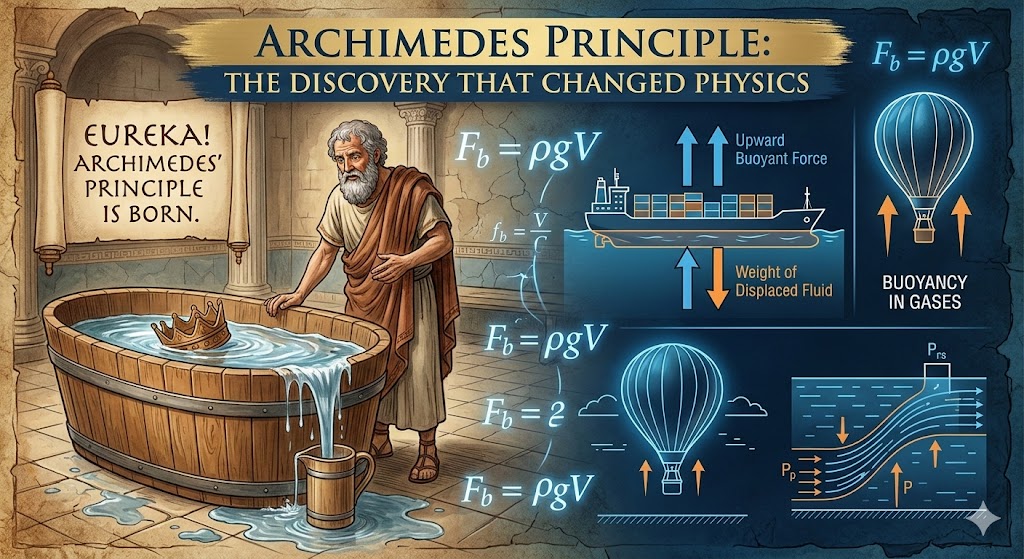
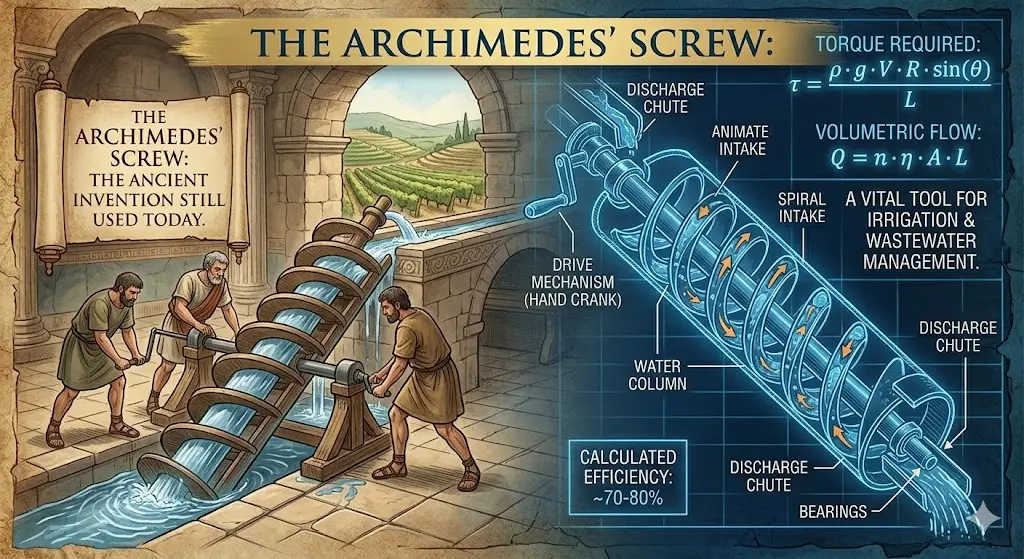
The lasting influence of The Chemical History of a Candle on scientific education is as revolutionary as how ancient greek scientists changed modern science, proving once again that simple observations can transform humanity’s understanding of the universe forever.