The faraday effect is one of the most revolutionary discoveries in the history of physics. In 1845, Michael Faraday proved for the first time that light and magnetism are directly connected. This groundbreaking discovery transformed optics, electromagnetism, photonics, and modern physics forever.
Before Faraday’s experiments, scientists treated light and magnetism as completely separate phenomena. Light belonged to optics while magnetism belonged to electricity and magnetic science. Faraday challenged this belief through bold experiments involving polarized light, heavy glass, and magnetic fields.
His discovery became known as the Faraday Effect or magneto-optical effect. It showed that magnetic fields could rotate the polarization of light passing through certain materials.
Decades later, James Clerk Maxwell mathematically proved Faraday’s intuition correct by showing that light itself is an electromagnetic wave.
Today, the faraday effect remains essential in photonics, fiber optics, optical communication, and laser technology.
This article explores the history, experiments, equations, physics, and modern applications behind Faraday’s extraordinary discovery.
The Scientific World Before the Faraday Effect (1800 – 1845)
During the early 19th century, optics and magnetism were considered unrelated sciences.
Scientists already understood important optical concepts such as:
- Reflection
- Refraction
- Polarization of light
- Birefringence
Meanwhile, researchers studying electricity focused on:
- Electric currents
- Magnets
- Electromagnetic induction
- Conductors
Very few scientists believed these subjects were connected.
However, Michael Faraday suspected nature operated through unified forces.
His ideas later inspired field theory and lines of force, which transformed modern physics.
Faraday believed light might somehow interact with magnetic fields.
This bold idea led directly to the faraday effect.
Michael Faraday and Experimental Science
Faraday relied heavily on experimentation rather than advanced mathematics.
Although he lacked formal mathematical training, his scientific imagination was extraordinary.
Much of his success came through michael faraday self education, which allowed him to master physics and chemistry independently.
Faraday constantly searched for hidden relationships in nature.
After discovering electromagnetic induction, he became increasingly convinced that electricity, magnetism, and light were deeply connected.
This belief guided his famous optics experiments.
The Heavy Glass Experiment (1845)
In 1845, Faraday performed one of the greatest experiments in scientific history.
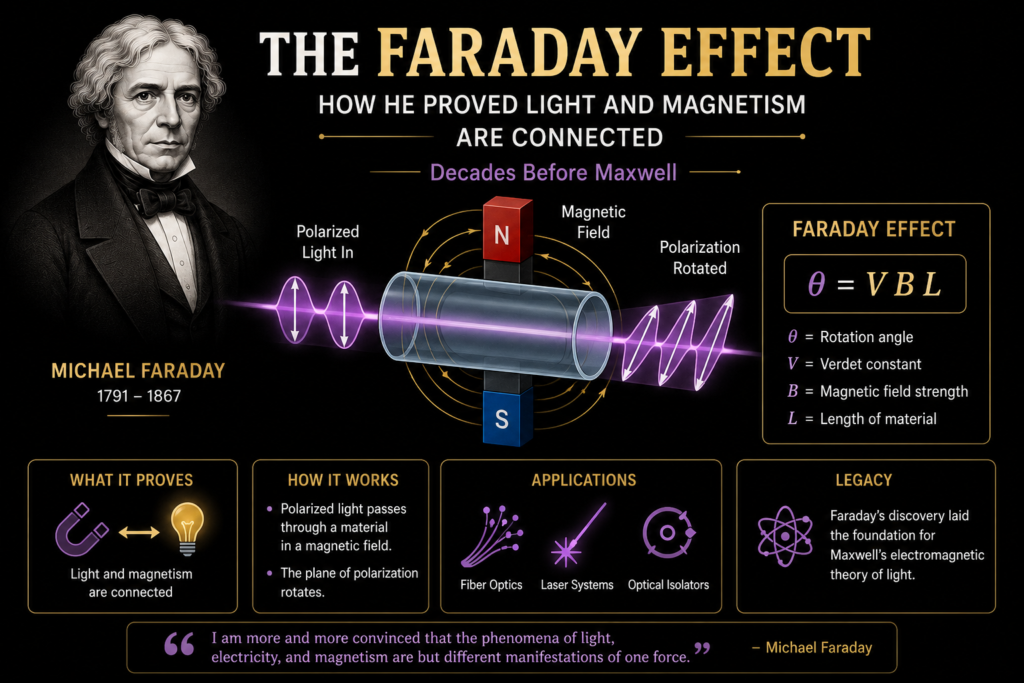
He passed polarized light through a special piece of heavy glass placed inside a strong magnetic field.
To his surprise, the plane of polarization rotated.
This proved magnetic fields could influence light directly.
The rotation angle depended on:
- Magnetic field strength
- Length of material
- Optical properties of the medium
This phenomenon became known as the Faraday Effect.
It was the first successful demonstration connecting light and magnetism experimentally.
What Is Polarized Light?
Ordinary light waves vibrate in many directions.
Polarized light vibrates mainly in one direction.
Faraday used polarized light because small changes in orientation could be measured accurately.
The electric field of polarized light can be represented as:
Where:
- = Electric field amplitude
- = Maximum amplitude
- = Wave number
- = Angular frequency
- = Time
Faraday discovered magnetic fields could rotate this polarization direction.
Understanding the Faraday Effect
The faraday effect occurs when polarized light travels through a material exposed to a magnetic field aligned with the direction of light propagation.
The rotation angle is:
Where:
- = Rotation angle
- = Verdet constant
- = Magnetic field strength
- = Length of material
This equation became fundamental in magneto-optical physics.
It showed mathematically how light and magnetism interact.
The Verdet Constant Explained
The Verdet constant measures how strongly a material responds to magnetic fields optically.
Different materials rotate light differently.
The value depends on:
- Material composition
- Light wavelength
- Temperature
Materials with larger Verdet constants produce stronger optical rotation.
Faraday’s heavy glass showed unusually strong magneto-optical behavior.
This made the experiment successful.
Optical Rotation and Magnetic Fields
The Faraday Effect is a special type of optical rotation.
Normally, some materials rotate polarized light naturally.
Faraday discovered magnetic fields could also create rotation artificially.
This was revolutionary because it proved magnetic field influence extended into optics.
Faraday showed magnetism could affect light waves traveling through matter.
This discovery transformed the history of optics forever.
Light and Magnetism Become Connected
Before Faraday, scientists viewed light and magnetism separately.
The faraday effect proved they were connected physically.
Faraday realized magnetic forces might extend through space similarly to light waves.
Faraday’s experiments helped create the foundation of electromagnetic theory of light.
This insight later inspired the faraday and maxwell connection, which unified electromagnetism mathematically.
Maxwell and Electromagnetic Theory (1860 – 1870)
James Clerk Maxwell later transformed Faraday’s experimental ideas into mathematical equations.
Maxwell discovered that electromagnetic waves travel at the speed of light.
One important electromagnetic wave equation is:
Where:
- = Speed of light
- = Magnetic permeability
- = Electric permittivity
The calculated value matched the measured speed of light.
Maxwell concluded:
Light itself is an electromagnetic wave.
Faraday’s intuition had been correct decades earlier.
Faraday Rotators and Optical Technology
Modern photonics uses devices called Faraday rotators.
A Faraday rotator uses the Faraday Effect to rotate polarized light inside optical systems.
Applications include:
- Laser systems
- Optical isolators
- Fiber optics
- Telecommunications
These devices protect lasers from reflected light interference.
Modern internet communication depends heavily on such optical technologies.
Optical Isolators and Laser Protection
Optical isolators are important devices using the Faraday Effect.
They allow light to move in one direction only.
This protects sensitive lasers from harmful reflections.
The optical isolation principle depends directly on non-reversible polarization rotation caused by magnetic fields.
Without Faraday rotators:
- Fiber optic communication would suffer
- Laser systems would become unstable
- Modern photonics would struggle
Faraday’s discovery continues shaping communication technology today.
Refractive Index and Light Propagation
The Faraday Effect also depends on refractive index properties.
Light slows when traveling through materials.
The refractive index equation is:
Where:
- = Refractive index
- = Speed of light in vacuum
- = Speed of light in material
Magnetic fields slightly modify light propagation behavior inside certain materials.
This creates polarization rotation.
Wave Particle Duality and Modern Physics
Faraday’s work indirectly influenced modern quantum physics.
Later discoveries revealed light behaves both as:
- Waves
- Particles
This concept became known as wave-particle duality.
Faraday’s experiments helped scientists understand that light interacts deeply with electromagnetic forces.
His discoveries opened doors to quantum optics and photonics.
Birefringence and Optical Materials
Faraday also studied birefringence and optical behavior in transparent materials.
Birefringence occurs when materials split light into different polarization directions.
Magnetic fields can influence these optical properties further.
Modern optical materials research continues using principles connected to Faraday’s experiments.
Magneto Optical Effect and Modern Applications
Today, the magneto-optical effect appears in many technologies.
Applications include:
- Optical communication
- Magnetic field sensors
- Laser systems
- Data storage technology
- Fiber optic networks
Faraday’s discovery remains essential in modern engineering and photonics.
Photonics and Fiber Optics (1900 – Present)
Modern photonics heavily depends on Faraday’s discoveries.
Fiber optic communication systems use light signals traveling through thin glass fibers.
Optical isolation and polarization control rely on Faraday rotators.
Billions of internet connections depend indirectly on the faraday effect.
Faraday’s 1845 experiment continues shaping modern digital civilization.
Faraday’s Scientific Philosophy
Faraday believed nature operated through unified invisible forces.
This idea also influenced discoveries involving:
- Electricity
- Magnetism
- Optics
- Chemistry
His work on diamagnetism and paramagnetism further expanded understanding of magnetic interactions.
Faraday constantly searched for hidden connections between natural phenomena.
Faraday’s Influence on Modern Physics
Faraday’s discoveries influenced nearly every major development in electromagnetism.
His experiments helped inspire:
- Maxwell’s equations
- Electromagnetic wave theory
- Modern optics
- Quantum physics
- Photonics engineering
Few scientists changed physics as deeply as Faraday.
Why the Faraday Effect Still Matters
Without the faraday effect:
- Fiber optic communication would suffer
- Laser systems would become unstable
- Modern photonics would develop more slowly
- Optical isolation technology would struggle
Faraday’s discovery remains essential in modern technology and scientific research.
Faraday’s Scientific Legacy
Faraday’s scientific legacy extends across chemistry, optics, electricity, and magnetism.
His discoveries transformed:
- Electromagnetic science
- Optical engineering
- Communication systems
- Modern physics
Faraday proved experimental curiosity could reveal deep truths about the universe.
FAQs About the Faraday Effect
What is the Faraday Effect?
The Faraday Effect is the rotation of polarized light caused by magnetic fields.
Who discovered the Faraday Effect?
Michael Faraday discovered the Faraday Effect in 1845.
Why was the Faraday Effect important?
It proved that light and magnetism are physically connected.
What is polarized light?
Polarized light vibrates mainly in one direction instead of many directions.
What is a Faraday rotator?
A Faraday rotator is a device that rotates polarized light using magnetic fields.
Where is the Faraday Effect used today?
It is used in photonics, lasers, fiber optics, and optical communication systems.
Conclusion
The faraday effect was one of the most revolutionary discoveries in scientific history. Michael Faraday proved that magnetic fields could influence light directly, revealing a deep connection between optics and electromagnetism decades before Maxwell’s equations explained it mathematically.
This extraordinary experiment transformed physics forever and became one of the foundations of modern electromagnetic theory, photonics, and optical engineering. Today, Faraday’s discovery powers technologies including fiber optics, laser systems, optical isolators, and advanced communication networks.
Faraday’s work demonstrated the incredible power of scientific intuition and experimentation. His discoveries continue influencing modern science nearly two centuries later.
The impact of the faraday effect on human understanding is as revolutionary as how ancient greek scientists changed modern science, proving once again that simple experiments can completely reshape humanity’s view of the universe forever.