The diamagnetism and paramagnetism discoveries made by Michael Faraday transformed humanity’s understanding of magnetism forever. Before Faraday’s experiments, most scientists believed magnetism only affected a few materials such as iron. However, Faraday proved something astonishing: nearly all matter responds to magnetic fields in some way.
Through careful experiments involving liquids, crystals, metals, and gases, Faraday discovered that materials could either weakly repel magnetic fields or weakly attract them. These behaviors became known as diamagnetism and paramagnetism.
Faraday’s work opened entirely new branches of material science, molecular physics, quantum theory, and magnetic research. Today, diamagnetism and paramagnetism remain essential in chemistry, physics, superconductors, MRI technology, levitation systems, and quantum materials.
This article explores the history, experiments, equations, scientific principles, and modern applications behind Faraday’s revolutionary magnetic discoveries.
The Scientific World Before Magnetic Matter Research (1800 – 1845)
Before Faraday, scientists mainly associated magnetism with a few special materials.
Iron, nickel, and cobalt were known to behave strongly around magnets.
However, most materials appeared nonmagnetic.
Scientists assumed ordinary substances such as water, wood, glass, and gases were unaffected by magnetic fields.
Michael Faraday suspected otherwise.
Faraday believed magnetism was a universal force influencing all matter to some degree.
This idea connected closely to his revolutionary work on field theory and lines of force.
Faraday wanted to determine whether magnetic effects existed throughout nature.
Michael Faraday and Experimental Curiosity
Faraday relied heavily on experimentation and observation.
He constantly tested materials inside strong magnetic fields to observe subtle effects.
Much of Faraday’s success came through michael faraday self education, which encouraged independent thinking and creativity.
Faraday’s scientific philosophy emphasized:
- Careful observation
- Repeated experiments
- Visual evidence
- Physical intuition
This approach helped him discover weak magnetic behaviors most scientists had overlooked.
The Discovery of Diamagnetism (1845)
In 1845, Faraday observed something extraordinary.
Certain materials moved away from magnetic fields instead of toward them.
This magnetic repulsion contradicted earlier assumptions.
Faraday called this phenomenon diamagnetism.
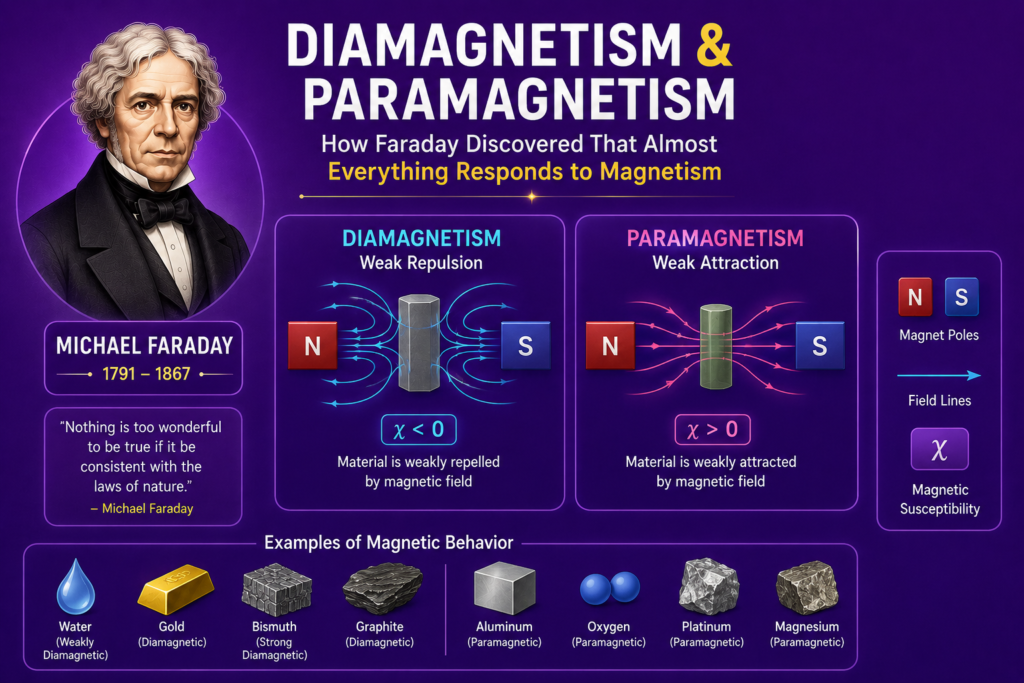
Diamagnetic materials produce weak magnetic fields opposing external magnetic fields.
Examples include:
- Bismuth
- Copper
- Water
- Gold
- Carbon
Faraday demonstrated that diamagnetism existed throughout many ordinary substances.
This became one of the greatest discoveries in material science.
What Is Diamagnetism?
Diamagnetism occurs when materials weakly repel magnetic fields.
When exposed to an external field:
- Electrons adjust orbital motion
- Opposing magnetic moments form
- Weak magnetic repulsion appears
Diamagnetic susceptibility is negative:
Where:
- = Magnetic susceptibility
This means the material slightly weakens the external magnetic field inside itself.
Diamagnetism is usually weak but universal in matter.
Bismuth Magnetism and Faraday’s Experiments
Faraday discovered bismuth magnetism was especially strong among diamagnetic materials.
Bismuth visibly moved away from magnetic poles during experiments.
This dramatic behavior helped Faraday study magnetic repulsion more clearly.
Bismuth remains one of the strongest naturally occurring diamagnetic substances today.
Faraday’s experiments proved magnetic behavior extended beyond iron based materials.
Paramagnetism and Magnetic Attraction
Faraday also discovered certain materials weakly attract magnetic fields.
He called this phenomenon paramagnetism.
Paramagnetic materials include:
- Aluminum
- Platinum
- Oxygen
- Magnesium
Paramagnetic susceptibility is positive:
These materials align slightly with external magnetic fields.
Unlike ferromagnetism, paramagnetism disappears when the magnetic field is removed.
Understanding Magnetic Moments
Magnetic behavior depends heavily on magnetic moments produced by electrons.
Electrons behave like tiny magnets because of:
- Electron spin
- Orbital motion
The magnetic moment equation is approximately:
Where:
- = Magnetic moment
- = Electric current equivalent
- = Area of electron orbit
Faraday did not fully understand quantum mechanics, but his experiments revealed magnetic effects at the microscopic level.
Electron Spin and Modern Physics
Later quantum physics explained diamagnetism and paramagnetism more deeply.
Electron spin became central to magnetic theory.
Electrons possess intrinsic angular momentum represented as:
Where:
- = Electron spin
- = Reduced Planck constant
Unpaired electrons create paramagnetic behavior.
Paired electrons often contribute to diamagnetism.
Faraday’s discoveries eventually helped scientists understand atomic structure itself.
Magnetic Permeability and Material Response
Magnetic permeability measures how materials respond to magnetic fields.
The permeability equation is:
Where:
- = Magnetic flux density
- = Magnetic permeability
- = Magnetic field strength
Diamagnetic materials slightly reduce magnetic fields.
Paramagnetic materials slightly enhance them.
These principles became fundamental in material science and engineering.
Ferromagnetism vs Diamagnetism and Paramagnetism
Faraday distinguished weak magnetic effects from ferromagnetism.
Ferromagnetic materials such as iron display extremely strong magnetic attraction because atomic magnetic moments align together permanently.
Diamagnetism and paramagnetism are much weaker effects.
However, Faraday proved they exist almost everywhere in nature.
This discovery expanded magnetism far beyond simple magnets.
Magnetic Properties of Matter
Faraday’s work revealed that magnetic properties of matter are universal.
Every material responds to magnetic fields in some way because atoms contain charged particles and moving electrons.
This idea transformed scientific understanding completely.
Modern chemistry, condensed matter physics, and materials engineering all rely on this insight.
Magnetism in Liquids and Gases
Faraday experimented with liquids and gases as well as solids.
He demonstrated that even oxygen gas is paramagnetic.
Water, however, is diamagnetic.
These experiments proved magnetism was not limited to solid metals.
Faraday’s discoveries greatly expanded the study of molecular magnetism.
Curie’s Law and Paramagnetism
Later scientists developed Curie’s Law to describe paramagnetic behavior mathematically.
Curie’s Law states:
Where:
- = Magnetic susceptibility
- = Curie constant
- = Temperature
This equation shows paramagnetism weakens as temperature increases.
Faraday’s early observations helped inspire this later theoretical development.
Heavy Glass and Optical Magnetism
Faraday’s studies of magnetism also influenced optics.
During experiments involving heavy glass and magnetic fields, he discovered the faraday effect, proving light and magnetism are connected.
This extraordinary insight helped unify optics and electromagnetism.
Faraday constantly searched for hidden relationships throughout nature.
Superconductors and Diamagnetic Levitation
Modern superconductors display extremely strong diamagnetism.
Superconductors can repel magnetic fields completely through the Meissner effect.
This allows magnetic levitation.
The magnetic force equation is:
Where:
- = Magnetic force
- = Charge
- = Velocity
- = Magnetic field
Levitation technology today relies heavily on principles connected to Faraday’s discoveries.
MRI Machines and Modern Medicine
MRI technology depends heavily on magnetic behavior of matter.
Hydrogen atoms inside the human body respond to magnetic fields.
MRI systems detect these responses to create detailed medical images.
Faraday’s research into material magnetism helped lay foundations for this technology.
Modern medicine still benefits directly from his experiments.
Electromagnetism and Faraday’s Influence
Faraday’s discoveries in magnetism connected closely with his work on electromagnetic induction and electricity.
Together, these discoveries transformed:
- Physics
- Chemistry
- Engineering
- Medical science
Few scientists influenced magnetism as deeply as Faraday.
Material Science and Industrial Applications (1900 – Present)
Today, diamagnetism and paramagnetism are essential in:
- Quantum materials
- Data storage systems
- Magnetic sensors
- MRI systems
- Superconductors
- Electronics
Modern material science continues building upon Faraday’s discoveries nearly two centuries later.
Molecular Magnetism and Quantum Theory
Faraday’s work eventually influenced quantum mechanics and molecular magnetism.
Scientists realized magnetic behavior depends on:
- Electron arrangement
- Atomic structure
- Quantum spin states
Modern condensed matter physics developed partly from Faraday’s original magnetic experiments.
Why Diamagnetism and Paramagnetism Still Matter
Without Faraday’s discoveries:
- MRI technology would suffer
- Quantum material research would slow
- Superconductors would remain poorly understood
- Modern magnetic engineering would struggle
Diamagnetism and paramagnetism remain central to modern science and technology.
Faraday’s Scientific Legacy
Faraday’s magnetic discoveries transformed scientific understanding of matter itself.
His work influenced:
- Quantum physics
- Material science
- Electromagnetism
- Medical imaging
- Superconductivity
Faraday proved that even weak invisible forces can reveal deep truths about nature.
FAQs About Diamagnetism and Paramagnetism
What is diamagnetism?
Diamagnetism is the weak repulsion of materials from magnetic fields.
What is paramagnetism?
Paramagnetism is the weak attraction of materials toward magnetic fields.
Who discovered diamagnetism and paramagnetism?
Michael Faraday discovered and studied these magnetic properties during the 1840s.
Why is bismuth important in diamagnetism?
Bismuth is one of the strongest naturally occurring diamagnetic materials.
What causes paramagnetism?
Paramagnetism occurs because of unpaired electron magnetic moments.
Where are these magnetic effects used today?
They are used in MRI machines, superconductors, quantum materials, and magnetic technologies.
Conclusion
The diamagnetism and paramagnetism discoveries made by Michael Faraday completely transformed humanity’s understanding of magnetism and matter. Faraday proved that nearly every substance in nature responds to magnetic fields in some way, revealing that magnetism is a universal property of matter itself.
His experiments opened entirely new scientific fields involving molecular magnetism, quantum physics, superconductivity, and advanced materials research. Modern technologies including MRI machines, levitation systems, and quantum devices continue relying on principles connected to Faraday’s work.
Faraday’s discoveries demonstrated the extraordinary power of careful experimentation and scientific imagination. His magnetic research continues influencing modern science nearly two centuries later.
The impact of diamagnetism and paramagnetism on civilization is as revolutionary as how ancient greek scientists changed modern science, proving once again that invisible forces can reshape humanity’s understanding of the universe forever.