The field theory and lines of force concept was one of the greatest revolutions in the history of physics. Before Michael Faraday introduced his revolutionary idea, most scientists believed forces acted instantly across empty space without any physical connection. This older idea, strongly associated with Isaac Newton, became known as “action at a distance.”
Faraday challenged this centuries old belief through experimental observations involving electricity and magnetism. Instead of invisible objects mysteriously pulling or pushing one another across space, Faraday proposed that space itself contained force fields filled with invisible lines of force.
This radical idea transformed theoretical physics forever. Modern concepts including electromagnetic fields, gravitational fields, quantum field theory, and relativity all grew from Faraday’s revolutionary insight.
Today, field theory and lines of force remain fundamental to modern science, engineering, astronomy, and quantum physics.
This article explores the history, experiments, equations, scientific debates, and modern impact behind Faraday’s extraordinary field theory.
The Scientific World Before Field Theory (1600 – 1800)
Before Faraday, most physicists followed Newtonian mechanics.
Isaac Newton’s law of gravity explained how masses attract each other:
Where:
- = Gravitational force
- = Gravitational constant
- = Masses
- = Distance between objects
The equation worked extremely well mathematically.
However, Newton himself admitted something troubling.
How could one object influence another across empty space instantly?
This mysterious process became known as action at a distance.
Scientists accepted the mathematics but struggled with the physical explanation.
Newtonian Mechanics vs Field Theory
Newtonian mechanics described forces as direct interactions between distant objects.
Faraday disagreed with this interpretation.
He believed forces must travel through space physically rather than acting magically across emptiness.
This disagreement became central to the debate between:
- Newtonian mechanics vs. field theory
- Instant action vs. local interaction
- Empty space vs. space filled with force fields
Faraday’s ideas eventually transformed the foundations of physics completely.
Michael Faraday and Experimental Science
Michael Faraday approached science differently from many mathematicians.
He relied heavily on experiments, visualization, and physical intuition.
Faraday lacked advanced mathematical education, but his imagination was extraordinary.
Much of his success came through michael faraday self education, which helped him develop independent scientific thinking.
Faraday constantly searched for physical explanations behind invisible forces.
This search led directly to field theory and lines of force.
Magnetism and Iron Filings Experiments
Faraday became fascinated with magnetism early in his career.
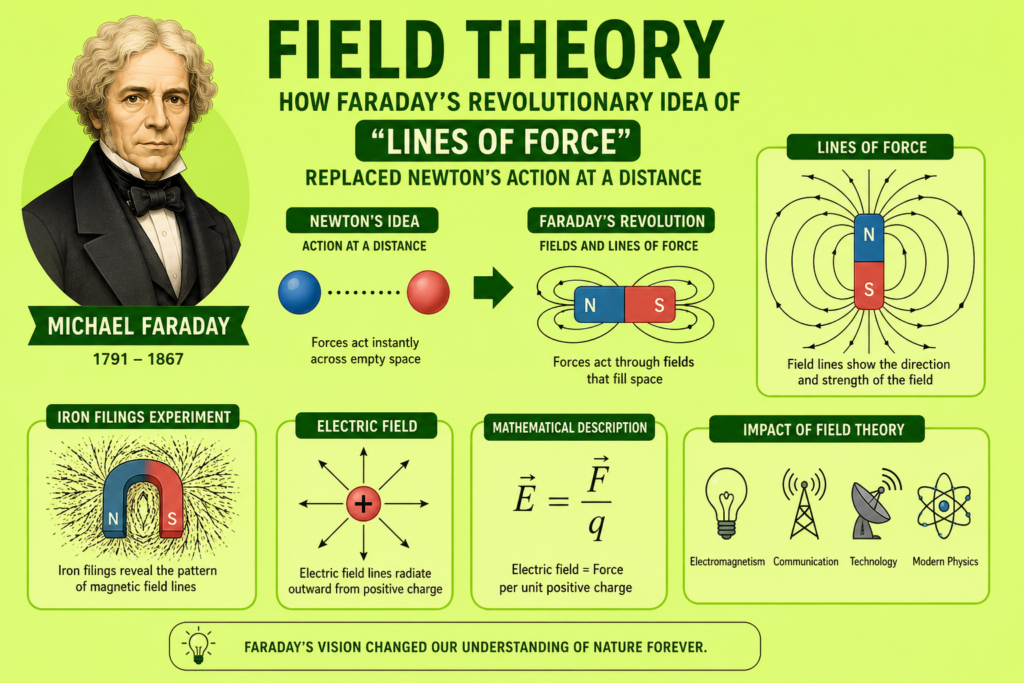
One important experiment involved sprinkling iron filings around magnets.
The filings arranged themselves into beautiful curved patterns.
These patterns revealed magnetic field lines surrounding the magnet.
Faraday realized these were not merely visual effects.
He believed the lines represented real physical structures existing throughout space.
This insight changed physics forever.
What Are Lines of Force?
Faraday’s lines of force represented invisible pathways showing the direction and intensity of forces in space.
For magnetic fields:
- Lines emerge from the north pole
- Curve through space
- Enter the south pole
The density of lines indicates field intensity.
Stronger fields contain more concentrated flux lines.
Faraday believed these force fields physically filled space rather than acting instantly across emptiness.
This became the foundation of modern field theory.
Field Visualization and Space Filling Fields
Faraday introduced the revolutionary idea of space-filling fields.
According to Faraday:
- Space is not empty
- Forces spread continuously through space
- Fields store energy and transmit interactions locally
This idea transformed field visualization in science.
Modern physics now describes many natural phenomena using vector fields and force distributions.
Faraday’s concept became one of the most important ideas in scientific history.
Mathematical Representation of Fields
Modern field theory represents fields mathematically using vector quantities.
An electric field is written as:
Where:
- = Electric field
- = Force
- = Charge
Similarly, magnetic fields are represented as:
These equations describe how force fields vary throughout space.
Faraday developed these ideas conceptually before advanced mathematics fully described them.
Electromagnetic Induction and Field Theory
Faraday’s work on electromagnetic induction strongly influenced his field ideas.
He discovered changing magnetic fields could generate electric currents.
Faraday’s law of induction states:
Where:
- = Induced electromotive force
- = Magnetic flux
This equation showed fields could change dynamically through space.
Faraday realized force fields carried physical energy and motion.
Action at a Distance vs Local Interaction
Faraday rejected mysterious instant action across empty space.
Instead, he proposed:
- Fields transmit forces locally
- Changes spread gradually through space
- Matter interacts through surrounding fields
This idea became one of the most important shifts in theoretical physics.
Modern science now explains interactions through fields rather than magical distant action.
Faraday’s intuition was revolutionary.
The Aether Debate (1800 – 1900)
During Faraday’s time, many scientists believed force fields required a medium called the aether or ether.
The aether supposedly filled all space and carried electromagnetic effects.
Faraday himself sometimes speculated about physical media in space.
Later experiments challenged the existence of aether.
However, Faraday’s field concept survived and became even more important without it.
Modern physics treats fields themselves as fundamental entities.
James Clerk Maxwell and Field Mathematics
Faraday’s ideas later inspired James Clerk Maxwell.
The faraday and maxwell connection became one of the greatest partnerships in scientific history.
Maxwell translated Faraday’s visual field concepts into mathematics.
One famous Maxwell equation is:
Where:
- = Charge density
- = Permittivity of free space
Maxwell’s equations mathematically confirmed Faraday’s field theory.
Electromagnetic Waves and Light
Maxwell later showed electromagnetic fields could propagate as waves.
The electromagnetic wave equation is:
Where:
- = Speed of light
- = Magnetic permeability
- = Electric permittivity
This revealed that light itself is an electromagnetic field wave.
Faraday’s earlier experiments involving the faraday effect had already hinted at this connection.
Gravitational Fields and Modern Physics
Faraday’s ideas eventually influenced gravitational field concepts too.
Modern gravity theory describes gravitational fields spreading through space.
The gravitational field strength equation is:
Where:
- = Gravitational field intensity
- = Gravitational constant
- = Mass
- = Distance
Field concepts became universal throughout physics.
Potential Energy and Fields
Field theory also transformed understanding of potential energy.
Energy can exist within fields even without visible motion.
For example, electric potential energy is:
Where:
- = Potential energy
- = Charge
- = Electric potential
Faraday realized fields store and transfer energy physically.
This became fundamental in electromagnetism and engineering.
Spatial Distribution and Vector Fields
Modern science uses vector fields extensively.
Examples include:
- Electric fields
- Magnetic fields
- Fluid flow fields
- Gravitational fields
Field theory allows scientists to describe spatial distribution of forces continuously throughout space.
Faraday’s visual approach helped scientists think geometrically about invisible interactions.
Field Intensity and Flux Lines
Field intensity measures force strength at different points in space.
Magnetic flux is represented as:
Where:
- = Magnetic flux
- B = Magnetic field
- = Area element
Flux lines help visualize how fields spread and interact.
Faraday’s diagrams became foundational tools in modern physics education.
Invisible Forces Become Physical Reality
Before Faraday, invisible forces seemed mysterious and abstract.
Faraday transformed them into physical realities existing throughout space.
This changed scientific thinking dramatically.
Fields became central objects in physics rather than mathematical conveniences.
Modern quantum field theory later extended these ideas even further.
Quantum Fields and Modern Science (1900 – Present)
Modern quantum physics describes particles themselves as excitations of fields.
Quantum field theory treats:
- Electrons
- Photons
- Quarks
as field disturbances.
This extraordinary scientific framework traces back historically to Faraday’s original field concepts.
His ideas transformed physics at the deepest possible level.
Faraday’s Scientific Philosophy
Faraday believed nature operated through connected invisible systems.
His discoveries involving:
- Magnetism
- Electricity
- Light
- Chemical reactions
all reflected this philosophy.
He searched for unity throughout nature.
This scientific vision changed theoretical physics forever.
Why Field Theory Still Matters
Without field theory and lines of force:
- Modern electromagnetism would fail
- Quantum physics would collapse
- Communication systems would suffer
- Electrical engineering would become impossible
Faraday’s revolutionary ideas remain essential across modern science and technology.
Faraday’s Scientific Legacy
Faraday’s legacy extends through nearly every branch of physics.
His discoveries influenced:
- Electromagnetism
- Relativity
- Quantum mechanics
- Electrical engineering
- Modern field theory
Few scientific ideas have transformed human understanding as deeply as Faraday’s lines of force.
FAQs About Field Theory and Lines of Force
What is field theory?
Field theory describes forces as continuous fields spread throughout space rather than instant distant actions.
What are lines of force?
Lines of force are visual representations showing the direction and strength of force fields.
Why did Faraday reject action at a distance?
Faraday believed forces must travel physically through space rather than acting instantly across emptiness.
How did iron filings help Faraday?
Iron filings revealed visible patterns showing magnetic field lines around magnets.
What is the difference between Newtonian mechanics and field theory?
Newtonian mechanics describes distant interactions directly, while field theory uses space-filling fields.
How did Maxwell help Faraday’s ideas?
Maxwell transformed Faraday’s visual field concepts into mathematical electromagnetic equations.
Conclusion
The field theory and lines of force concept introduced by Michael Faraday completely transformed physics and scientific thinking. Faraday replaced the mysterious idea of action at a distance with the revolutionary vision of invisible force fields filling space continuously.
His experiments involving magnetism, electricity, and field visualization laid the foundation for electromagnetism, Maxwell’s equations, relativity, and quantum field theory. Modern physics now describes nearly all fundamental interactions using fields, proving how revolutionary Faraday’s ideas truly were.
Faraday’s extraordinary scientific imagination changed humanity’s understanding of nature forever. His field theory continues shaping modern engineering, communication, astronomy, and quantum science.
The impact of field theory and lines of force on civilization is as revolutionary as how ancient greek scientists changed modern science, proving once again that powerful scientific ideas can reshape the entire human understanding of the universe forever.