The question why is bluetooth named after a viking king surprises many technology users around the world. Every day, billions of people use Bluetooth in smartphones, headphones, speakers, laptops, cars, and smart devices without realizing the incredible historical story behind the name.
Unlike most modern technologies that receive technical or scientific names, Bluetooth was inspired by an actual Viking ruler from over 1,000 years ago. The naming story combines Scandinavian history, wireless innovation, branding strategy, and fascinating tech lore into one unforgettable tale.
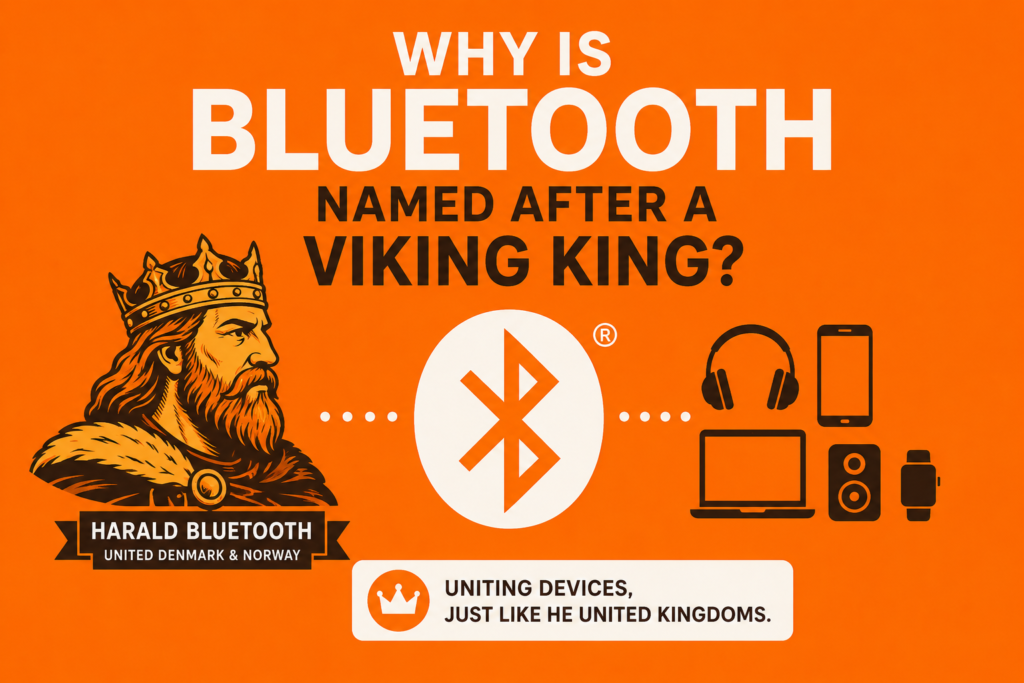
The answer to why is bluetooth named after a viking king begins with Harald “Bluetooth” Gormsson, an ancient ruler famous for uniting Scandinavia. Surprisingly, the creators of Bluetooth technology believed his story perfectly represented their vision for wireless communication.
This article explores the full story behind Bluetooth naming origins, the meaning of the Bluetooth logo, Nordic runes, Viking symbolism, and how one historical king became permanently connected to modern technology.
The Origin of Bluetooth Technology (1994)
To understand why is bluetooth named after a viking king, we first need to understand how Bluetooth technology began.
In 1994, Swedish telecommunications company Ericsson started developing a short-range wireless communication system. Engineers Jaap Haartsen and Sven Mattisson worked on creating a universal standard for wireless device communication.
Their goal was revolutionary:
Allow electronic devices from different companies to connect seamlessly without cables.
This innovation would eventually transform wireless communication worldwide.
If you want to learn more about the inventors behind the technology, exploring who invented bluetooth helps explain the engineering breakthrough that changed modern connectivity forever.
Harald Bluetooth Gormsson and Viking History (900 – 986)
The answer to why is bluetooth named after a viking king centers around Harald “Bluetooth” Gormsson.
Harald Bluetooth was the King of Denmark and Norway during the 10th century. Historians credit him with uniting Scandinavia and bringing parts of Denmark and Norway together under one rule.
This achievement made Harald famous throughout Scandinavian history.
The nickname “Bluetooth” likely came from a dead tooth that appeared dark blue or gray in color. While historians still debate the exact origin, the nickname became permanently attached to the Viking king.
Harald Bluetooth became known for:
- Unification of tribes
- Political diplomacy
- Expanding communication between regions
- Strengthening alliances
Centuries later, these same ideas inspired the creators of Bluetooth technology.
How the Bluetooth Name Was Chosen (1996 – 1997)
During the development process, technology companies needed a temporary codename for the wireless project.
Intel engineer Jim Kardach played a major role in Bluetooth naming origins. While discussing wireless communication projects with engineers from Ericsson, Intel, and Nokia, he suggested the name “Bluetooth.”
Jim Kardach had recently read a book about Viking history and Harald Bluetooth. He realized the king’s story perfectly symbolized the technology’s purpose.
Just as Harald Bluetooth united Scandinavia, Bluetooth technology would unite electronic devices from different industries.
This symbolic naming strategy immediately impressed the development team.
Originally, Bluetooth was only meant to be a temporary codename. However, the name became so popular that it remained permanent.
Today, it is one of the most recognizable names in technology history.
The Symbolic Meaning Behind the Name
The reason why is bluetooth named after a viking king goes deeper than simple branding.
The creators wanted a name representing:
- Connectivity
- Cooperation
- Unification
- Cross-industry collaboration
Bluetooth technology allowed devices from different manufacturers to communicate together. At the time, this idea was revolutionary because most companies used incompatible proprietary systems.
Harald Bluetooth symbolized unity between separate groups, making his name a perfect metaphor for wireless communication technology.
This use of historical metaphors became one of the smartest branding decisions in modern technology.
The name also helped Bluetooth stand out from other technical products with boring scientific titles.
The Bluetooth Logo Origin and Nordic Runes
Another fascinating part of why is bluetooth named after a viking king involves the Bluetooth logo origin.
The famous Bluetooth symbol is not random. It combines two Nordic runes from runic alphabets:
- Hagall rune representing the letter H
- Bjarkan rune representing the letter B
These runic symbols correspond to Harald Bluetooth’s initials.
The two symbols were merged together to create the modern Bluetooth logo.
This clever design connected ancient Viking culture with futuristic wireless technology.
Today, billions of people recognize the Bluetooth logo without realizing it comes from medieval Scandinavian runes.
The Bluetooth logo origin remains one of the most creative examples of symbolic naming in technology history.
Bluetooth History and Global Expansion (1998 – 2005)
The bluetooth history officially accelerated in 1998 when major technology companies formed the Bluetooth Special Interest Group, commonly called SIG.
Founding companies included:
- Ericsson
- Intel
- IBM
- Nokia
- Toshiba
The organization focused on industry standardization and compatibility between wireless devices.
Bluetooth technology rapidly expanded into:
- Mobile phones
- Computers
- Wireless headsets
- Car systems
- Gaming accessories
Consumers quickly embraced wireless communication because it eliminated cables and simplified connectivity.
The success of Bluetooth proved that the Viking-inspired branding strategy worked brilliantly.
Why the Bluetooth Story Became Famous
The story behind Bluetooth became legendary because it combined:
- Scandinavian history
- Wireless innovation
- Ancient symbolism
- Modern engineering
- Tech lore
Most technology names sound technical or corporate. Bluetooth felt different because it had personality, mythology, and historical depth.
People became curious about the unusual name, which helped generate attention and public interest.
This connection between ancient Viking culture and modern wireless communication created one of the greatest origin myths in technology history.
The Bluetooth story also demonstrated how creative branding strategy can help technologies become globally memorable.
What Is Bluetooth and Why Does It Matter?
Many people learning what is bluetooth are surprised to discover the technology’s rich historical background.
Bluetooth is a short-range wireless communication system that allows electronic devices to exchange information using radio frequency signals.
Its importance comes from several advantages:
- Wireless communication
- Low energy usage
- Easy connectivity
- Global compatibility
- Affordable implementation
Bluetooth powers billions of devices today, including:
- Smartphones
- Wireless earbuds
- Smartwatches
- Gaming controllers
- Speakers
- Automotive systems
Without Bluetooth, modern wireless lifestyles would look completely different.
How Bluetooth Works
Understanding how bluetooth works helps explain why the technology became so successful.
Bluetooth devices use low-power radio waves in the 2.4 GHz frequency band to communicate across short distances.
The process generally includes:
- Device discovery
- Secure connection establishment
- Data transfer
- Frequency hopping to reduce interference
Bluetooth systems create temporary wireless networks between nearby devices.
This technology became extremely popular because it offered convenience without requiring internet access or physical cables.
Over time, engineers improved speed, range, security, and efficiency through newer Bluetooth standards.
Evolution of Bluetooth Versions (2000 – Today)
The evolution of Bluetooth technology helped maintain its global popularity.
Modern bluetooth versions introduced major improvements in:
- Speed
- Battery efficiency
- Audio quality
- Range
- Security
Bluetooth 4.0 introduced Bluetooth Low Energy, which transformed wearable technology and IoT devices.
Bluetooth 5.0 greatly expanded wireless range and transfer speeds.
Today, Bluetooth powers entire ecosystems of connected devices across homes, vehicles, offices, and industries.
The technology continues evolving rapidly.
Bluetooth and the Modern Tech Ecosystem
Bluetooth became one of the most important technologies in the global tech ecosystem.
Its flexibility allowed integration into:
- Consumer electronics
- Healthcare systems
- Smart homes
- Industrial equipment
- Automotive technology
- Fitness devices
Billions of Bluetooth-enabled products are produced every year.
Consumers now depend heavily on wireless communication for entertainment, productivity, and daily convenience.
The story behind Bluetooth remains a perfect example of how creative ideas and engineering innovation can shape modern life.
The Future of Bluetooth Technology
The future of bluetooth looks extremely exciting.
Newer Bluetooth systems continue improving:
- Wireless audio quality
- Device synchronization
- Security systems
- Energy efficiency
- Smart connectivity
Emerging industries such as artificial intelligence, robotics, virtual reality, and smart cities will likely rely heavily on Bluetooth communication systems.
The growth of connected technologies also relates closely to the future of software engineering, where seamless device integration is becoming increasingly important.
Bluetooth will likely remain one of the world’s most important wireless technologies for decades to come.
Why the Bluetooth Name Still Matters Today
The reason why is bluetooth named after a viking king still matters because it represents more than a simple branding decision.
It symbolizes:
- Unity
- Communication
- Innovation
- Cross-industry cooperation
- Historical creativity
Very few technologies successfully combine ancient culture with modern engineering so effectively.
Bluetooth achieved this perfectly.
The story also proves that memorable branding can help transform technical products into global cultural icons.
Frequently Asked Questions (FAQs)
Why is Bluetooth named after Harald Bluetooth?
Bluetooth was named after Harald Bluetooth because he united Denmark and Norway, just as Bluetooth technology unites electronic devices.
Who suggested the Bluetooth name?
Intel engineer Jim Kardach proposed the name during discussions between technology companies developing wireless communication standards.
What does the Bluetooth logo mean?
The Bluetooth logo combines two Nordic runes representing Harald Bluetooth’s initials H and B.
Was Bluetooth supposed to be a temporary name?
Yes. Bluetooth was originally intended as a temporary codename before becoming the official product name.
What was Harald Bluetooth famous for?
Harald Bluetooth was famous for uniting Scandinavia and strengthening political alliances during the 10th century.
Why did the Bluetooth name become so successful?
The name stood out because it combined Viking history, symbolism, and memorable branding with modern technology.
Conclusion
The answer to why is bluetooth named after a viking king reveals one of the most fascinating stories in technology history. Harald “Bluetooth” Gormsson, the Viking ruler who united Denmark and Norway, became the perfect symbol for a wireless system designed to unite electronic devices worldwide.
From Bluetooth naming origins to the Bluetooth logo origin using Nordic runes, every part of the branding reflected themes of unity, communication, and connection.
The creativity of Jim Kardach, the Ericsson engineering team, and the Bluetooth developers helped turn a temporary codename into one of the most recognized technology brands in the world.
Today, Bluetooth remains a powerful example of how history, symbolism, and innovation can combine to create something truly unforgettable.