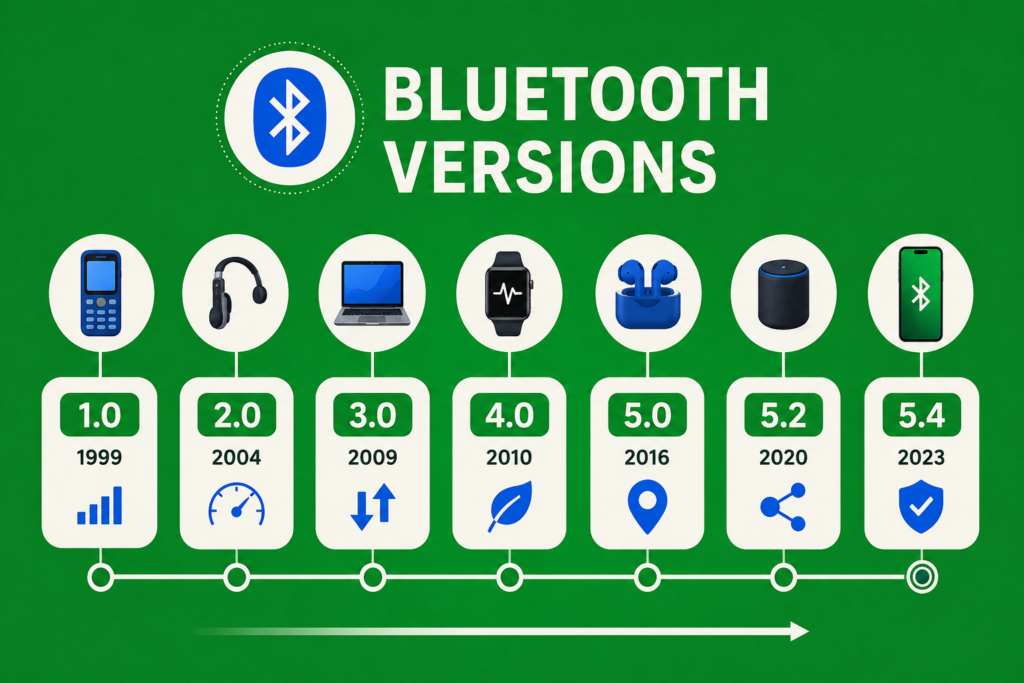
Understanding bluetooth versions is important because Bluetooth technology has changed dramatically since its first release in 1999. Modern Bluetooth systems are faster, more secure, more energy efficient, and far more powerful than early generations.
Today, Bluetooth powers smartphones, earbuds, gaming systems, smartwatches, cars, laptops, and billions of connected devices worldwide. However, many people still do not understand the differences between Bluetooth 1.0, 2.0, 4.0, 5.0, and newer releases like Bluetooth 5.4.
The evolution of bluetooth versions transformed wireless communication from a slow experimental system into one of the most important wireless standards in modern technology.
Every new version introduced important specification updates involving:
- Transfer speed
- Power consumption
- Wireless range
- Security systems
- Audio quality
- Device compatibility
This complete guide explains all major bluetooth versions from 1.0 to 5.4, including the biggest technological advancements and what changed over time.
The Beginning of Bluetooth Technology (1994 – 1999)
Before discussing bluetooth versions, it is important to understand how Bluetooth started.
Bluetooth technology was developed in 1994 by Ericsson engineers who wanted a universal wireless communication system for mobile devices.
The goal was to replace cables with wireless communication using short-range radio signals.
If you want to understand the origins of the technology itself, exploring bluetooth history explains how Bluetooth became a global wireless standard.
Bluetooth officially entered the commercial market in 1999 with Bluetooth 1.0.
Bluetooth 1.0 and 1.0B (1999)
Bluetooth 1.0 was the first public Bluetooth release.
Although revolutionary at the time, it had several major limitations:
- Slow data transfer
- Weak connection stability
- Compatibility problems
- High battery usage
The maximum transfer speed was about 721 kbps, which was extremely limited compared to modern standards.
Bluetooth 1.0 devices also struggled with connection establishment and interoperability between different manufacturers.
Despite these issues, Bluetooth 1.0 introduced the world to wireless personal communication.
This first release laid the foundation for every future Bluetooth improvement.
Bluetooth 1.1 and 1.2 Improvements (2001 – 2003)
Bluetooth 1.1 fixed many early technical problems.
The update improved:
- Signal reliability
- Connection stability
- Error correction
- Device compatibility
Bluetooth 1.2 introduced faster discovery systems and better resistance to signal interference using adaptive frequency hopping.
This helped Bluetooth operate more effectively around WiFi networks and other wireless devices.
These improvements made Bluetooth more practical for consumer electronics.
Bluetooth 2.0 + EDR (2004)
Bluetooth 2.0 EDR was one of the most important upgrades in Bluetooth history.
EDR stands for Enhanced Data Rate.
Bluetooth 2.1 EDR dramatically improved data rate improvements and wireless efficiency.
The maximum speed increased to approximately 3 Mbps, which was much faster than earlier versions.
This release improved:
- Audio streaming
- File sharing
- Wireless accessories
- Battery performance
Bluetooth 2.0 also reduced power consumption significantly, making wireless devices more practical for daily use.
This version helped Bluetooth become mainstream worldwide.
Bluetooth 2.1 + EDR (2007)
Bluetooth 2.1 EDR focused heavily on improving user convenience.
The biggest innovation was Secure Simple Pairing.
This allowed devices to connect more quickly and easily without complicated setup processes.
Bluetooth 2.1 also improved:
- Security systems
- Device discovery
- Energy efficiency
- Wireless reliability
Modern pairing systems used today were heavily influenced by Bluetooth 2.1 EDR.
Many users first experienced truly convenient wireless connectivity during this era.
If you need setup help, learning how to pair bluetooth devices becomes much easier with newer Bluetooth systems.
Bluetooth 3.0 + HS (2009)
Bluetooth 3.0 HS introduced another major leap forward.
HS stands for High Speed.
Bluetooth 3.0 HS used WiFi-assisted communication to achieve transfer speeds up to 24 Mbps for large file transfers.
This was a huge technological advancement compared to older versions.
Bluetooth 3.0 improved:
- File transfer speed
- Media synchronization
- Data transmission efficiency
However, power consumption remained relatively high for some applications.
Still, Bluetooth 3.0 helped expand wireless communication into multimedia and larger data transfer tasks.
Bluetooth 4.0 and Bluetooth Low Energy (2010)
Bluetooth 4.0 changed the entire Bluetooth ecosystem.
This version introduced Bluetooth Low Energy, commonly called BLE.
The difference between traditional Bluetooth and BLE became extremely important.
If you want detailed comparisons, exploring bluetooth classic vs ble helps explain how the technologies differ.
Bluetooth 4.0 focused on ultra-low power communication for:
- Fitness trackers
- Smartwatches
- Medical devices
- Smart sensors
- IoT products
This release dramatically improved energy efficiency and battery life.
BLE devices could now operate for months or years on small batteries.
Bluetooth 4.0 helped launch the wearable technology revolution.
Bluetooth 4.1 and 4.2 Features (2013 – 2014)
Bluetooth 4.1 improved communication between LTE mobile networks and Bluetooth systems.
The update introduced better coexistence with modern wireless technologies.
Bluetooth 4.2 features included:
- Faster data transfer
- Better privacy systems
- Improved Internet connectivity
- Enhanced security
Bluetooth 4.2 also supported IPv6 internet communication, helping Bluetooth devices participate in smart home and IoT ecosystems.
These improvements strengthened Bluetooth’s role in connected devices worldwide.
Bluetooth 5.0 Milestone (2016)
Bluetooth 5.0 milestone represented one of the biggest jumps in Bluetooth history.
Bluetooth 5.0 introduced:
- Much longer range
- Faster transfer speed
- Better broadcast communication
- Improved energy efficiency
Compared to Bluetooth 4.2:
- Range increased up to four times
- Speed doubled
- Broadcast capacity improved dramatically
This made Bluetooth 5.0 ideal for:
- Smart homes
- Wireless audio
- Industrial IoT
- Smart cities
- Large wireless ecosystems
Consumers especially noticed improvements in bluetooth range and wireless stability.
Bluetooth 5.0 became the foundation for most modern wireless devices.
Bluetooth 5.1 and 5.2 Improvements (2019 – 2020)
Bluetooth 5.1 introduced direction finding technology.
This allowed more accurate device positioning and indoor navigation systems.
Bluetooth 5.2 improved wireless audio significantly through LE Audio technology.
This update enhanced:
- Audio quality
- Battery efficiency
- Multi-device audio sharing
Bluetooth audio systems became more powerful and reliable than ever before.
If you enjoy wireless music systems, learning about bluetooth audio codecs explains how sound quality improved over time.
Bluetooth 5.2 also strengthened support for advanced wearable devices and gaming accessories.
Bluetooth 5.3 Enhancements (2021)
Bluetooth 5.3 focused mainly on efficiency and reliability improvements.
Key enhancements included:
- Better channel selection
- Lower battery usage
- Improved interference management
- Faster reconnection systems
These changes improved overall wireless stability for connected devices.
Bluetooth 5.3 especially benefited smart home systems and wearable technologies.
Modern firmware updates also became more efficient with newer Bluetooth architectures.
Bluetooth 5.4 Features (2023)
Bluetooth 5.4 introduced advanced wireless networking improvements.
Major features included:
- Periodic advertising with responses
- Better mesh networking support
- Improved large-scale device communication
- Enhanced energy optimization
Periodic advertising allows devices to communicate more efficiently within large wireless ecosystems.
Bluetooth 5.4 also improved network topology management for smart environments involving many connected devices simultaneously.
This version focuses heavily on future IoT expansion and industrial wireless communication systems.
Bluetooth 5.0 vs 5.4 Comparison
The comparison between Bluetooth 5.0 vs 5.4 shows how rapidly the technology evolved.
Bluetooth 5.0
- Long-range communication
- Faster speed
- Better broadcasting
Bluetooth 5.4
- Smarter networking
- Better IoT optimization
- Improved periodic advertising
- Greater efficiency for connected ecosystems
If you want deeper technical comparisons, exploring bluetooth 5.0 vs 5.3 vs 5.4 provides more detailed insights.
Bluetooth 5.4 represents the most advanced public Bluetooth standard available today.
Version Compatibility and Legacy Support
One major strength of Bluetooth technology is backward compatibility.
Modern Bluetooth devices can usually communicate with older systems, although advanced features may be limited.
Version compatibility helps protect consumers from constantly replacing devices.
Legacy support became one of Bluetooth’s greatest advantages compared to many competing wireless technologies.
This strategy helped Bluetooth maintain massive global adoption across decades.
Bluetooth Security Improvements Across Versions
Bluetooth security improved dramatically over time.
Early Bluetooth versions had weak encryption and limited protection systems.
Modern bluetooth security systems now include:
- Secure pairing
- Encrypted communication
- Authentication systems
- Privacy protection
Every new Bluetooth generation strengthened security standards and wireless safety.
Security continues improving as Bluetooth technology evolves.
Bluetooth and Modern Wireless Technology
Bluetooth became essential to modern wireless communication because it balanced:
- Low power consumption
- Reliable communication
- Affordable implementation
- Global compatibility
Today, Bluetooth supports:
- Smartphones
- Gaming systems
- Smart homes
- Automotive systems
- Health technology
- Industrial automation
Very few wireless standards achieved such widespread success.
The Future of Bluetooth Technology
The future of bluetooth looks incredibly promising.
Future Bluetooth systems will likely focus on:
- Smarter IoT networking
- Artificial intelligence integration
- Better mesh networking
- Improved wireless synchronization
- Ultra-low power communication
The growth of connected ecosystems also relates closely to the future of software engineering, where smart automation and wireless communication continue becoming increasingly important.
Bluetooth will remain a central technology in modern digital infrastructure.
Frequently Asked Questions (FAQs)
What are Bluetooth versions?
Bluetooth versions are different generations of Bluetooth technology that introduced improvements in speed, range, security, and efficiency.
Which Bluetooth version is best?
Bluetooth 5.4 is currently the most advanced public version with improved networking, efficiency, and IoT features.
What changed in Bluetooth 5.0?
Bluetooth 5.0 improved range, speed, energy efficiency, and broadcast communication significantly compared to Bluetooth 4.2.
What is Bluetooth Low Energy?
Bluetooth Low Energy, or BLE, is a low-power Bluetooth system introduced in Bluetooth 4.0 for smart devices and wearable technology.
Are newer Bluetooth versions backward compatible?
Yes. Most modern Bluetooth devices support communication with older versions through backward compatibility systems.
Why are Bluetooth updates important?
Bluetooth updates improve speed, security, battery efficiency, wireless stability, and support for modern connected devices.
Conclusion
The evolution of bluetooth versions transformed Bluetooth from a slow experimental wireless system into one of the world’s most important communication technologies.
From Bluetooth 1.0 to Bluetooth 5.4, every generation introduced major technological advancements involving transfer speed, energy efficiency, range extension, security systems, and network topology improvements.
Technologies such as Bluetooth Low Energy, periodic advertising, mesh networking, and advanced channel selection helped Bluetooth support modern smart devices, wearable technology, industrial automation, and wireless ecosystems worldwide.
As Bluetooth continues evolving, it will remain a powerful foundation for wireless communication and connected technology for many years ahead.