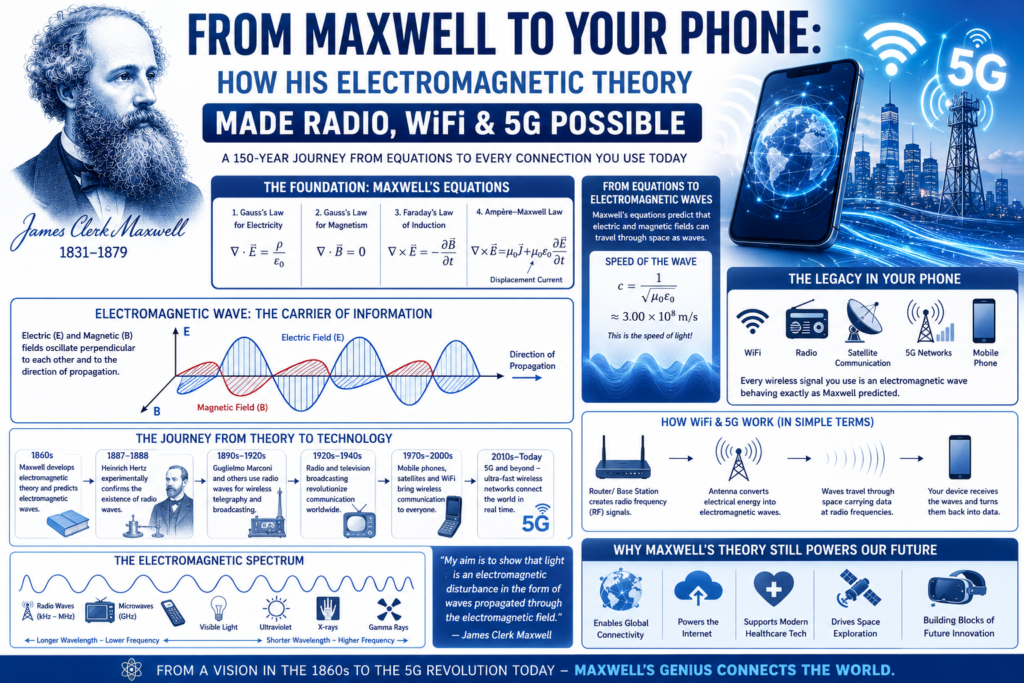
The story of maxwell electromagnetic theory is one of the greatest examples of how a scientific idea can transform civilization. When James Clerk Maxwell published his groundbreaking work in the 1860s, he had no way of knowing that his equations would eventually power smartphones, WiFi networks, radio stations, satellite communication, and 5G technology.
Today, billions of people use devices that rely on maxwell electromagnetic theory every second of every day. Every phone call, text message, WiFi connection, and video stream depends on electromagnetic waves behaving exactly as Maxwell predicted more than 150 years ago.
This remarkable journey from theoretical mathematics to modern telecommunications is one of the most inspiring stories in science and technology.
The World Before Maxwell (1800 – 1860)
Before the development of maxwell electromagnetic theory, scientists knew that electricity and magnetism existed, but they did not fully understand their relationship.
Researchers such as Ørsted, Ampère, and Faraday made important discoveries. They demonstrated that electric currents could create magnetic fields and that changing magnetic fields could produce electricity.
However, these discoveries appeared to be separate phenomena.
The partnership of faraday and maxwell changed everything.
Faraday provided experimental evidence, while Maxwell supplied the mathematical framework that unified the entire field of electromagnetism.
James Clerk Maxwell’s Big Idea (1861 – 1865)
The genius of James Clerk Maxwell was his realization that electricity and magnetism were not separate forces.
Instead, they were different aspects of the same physical phenomenon.
Maxwell developed a mathematical system that explained how electric fields and magnetic fields interact.
The foundation of maxwell electromagnetic theory rests upon four famous equations.
These equations describe:
- Electric fields
- Magnetic fields
- Electric charges
- Electric currents
- Electromagnetic waves
They remain among the most important equations ever written.
Maxwell’s Equations and Wireless Communication
The core of maxwell electromagnetic theory comes from the famous maxwell equations:
∇ · E = ρ/ε₀
∇ · B = 0
∇ × E = − ∂B/∂t
∇ × B = μ₀J + μ₀ε₀(∂E/∂t)
These equations revealed a revolutionary truth.
Changing electric fields create magnetic fields.
Changing magnetic fields create electric fields.
This interaction allows energy to travel through space as electromagnetic waves.
That discovery laid the foundation for wireless communication.
Without Maxwell’s equations, modern telecommunications would not exist.
The Importance of Displacement Current
One of Maxwell’s most brilliant insights involved displacement current.
Before Maxwell, scientists believed magnetic fields could only be created by moving electric charges.
Maxwell recognized a missing piece.
He proposed that changing electric fields could also generate magnetic fields.
Mathematically:
I_d = ε₀(dΦ_E/dt)
Where:
- I_d = Displacement current
- Φ_E = Electric flux
This simple addition completed electromagnetic theory.
More importantly, it made electromagnetic wave propagation mathematically possible.
Many historians consider displacement current one of the most important theoretical discoveries in physics.
The Birth of Electromagnetic Waves
After combining his equations, Maxwell derived the wave equation.
For electric fields:
∇²E = μ₀ε₀ ∂²E/∂t²
For magnetic fields:
∇²B = μ₀ε₀ ∂²B/∂t²
These equations describe waves moving through space.
The wave velocity equals:
c = 1/√(μ₀ε₀)
Substituting known values gives:
c ≈ 3 × 10⁸ m/s
This value matched the measured speed of light.
Maxwell immediately realized something astonishing.
Light itself was an electromagnetic wave.
The concept became known as electromagnetic wave theory.
This discovery transformed science forever.
Heinrich Hertz Proves Maxwell Correct (1887 – 1888)
Although Maxwell predicted electromagnetic waves, experimental proof arrived later.
German physicist Heinrich Hertz conducted famous experiments that generated and detected radio waves.
These Heinrich Hertz experiments confirmed Maxwell’s predictions.
Hertz demonstrated that radio waves behaved exactly like light.
They could:
- Reflect
- Refract
- Interfere
- Diffract
The success of these experiments proved that electromagnetic waves were real.
The age of wireless communication had begun.
The History of Radio Waves (1890 – 1920)
Following Hertz’s success, inventors began exploring practical applications.
The history of radio waves accelerated rapidly.
Inventors discovered that information could be transmitted using electromagnetic signals.
Radio frequency (RF) technology emerged as a powerful communication method.
Signals could travel across oceans without wires.
This breakthrough revolutionized communication.
Radio broadcasting soon became one of humanity’s most important technologies.
Every radio transmission relied directly on maxwell electromagnetic theory.
How Radio Works
Radio communication depends upon electromagnetic radiation.
A transmitter creates oscillating electrical currents.
These currents generate electromagnetic waves.
The frequency of the signal determines the radio channel.
Wave relationship:
c = fλ
Where:
- c = Speed of light
- f = Frequency
- λ = Wavelength
The wave travels through space until it reaches a receiving antenna.
The receiver converts the wave back into sound or data.
This process is a direct application of maxwell electromagnetic theory.
From Radio to Television (1920 – 1960)
The success of radio inspired further innovation.
Engineers learned to transmit images using electromagnetic waves.
Television broadcasting emerged.
Both radio and television rely upon signal propagation through electromagnetic fields.
Maxwell never saw television.
However, every television signal follows the laws he discovered.
The telecommunications history of the twentieth century is fundamentally a story about Maxwell’s equations becoming practical technology.
The Rise of Mobile Communication (1970 – 2000)
The next major revolution involved mobile phones.
Instead of broadcasting information to millions of listeners, cellular networks allowed two way communication between individuals.
Cell towers transmit electromagnetic signals.
Phones receive and send data using carefully managed radio frequencies.
The principles remain identical to those Maxwell described.
Every smartphone depends on maxwell electromagnetic theory to communicate.
Without electromagnetic waves, mobile networks would be impossible.
How WiFi Works Physics
Many people use WiFi daily without understanding the science behind it.
The answer lies in maxwell electromagnetic theory.
WiFi uses microwave frequencies to transmit data wirelessly.
Most WiFi systems operate around:
2.4 GHz
and
5 GHz
Here, GHz means gigahertz or billions of cycles per second.
Data transmission occurs when routers convert digital information into electromagnetic signals.
These signals travel through walls, rooms, and buildings.
Devices receive the waves and reconstruct the original information.
The entire process follows Maxwell’s laws.
Antenna Theory and Wireless Networks
Antenna theory is another direct application of maxwell electromagnetic theory.
Antennas convert electrical energy into electromagnetic waves.
They also convert incoming waves back into electrical signals.
Efficient antenna design requires understanding:
- Wavelength
- Frequency
- Polarization
- Signal propagation
Modern telecommunications engineers still rely on Maxwell’s equations when designing antennas.
Whether for WiFi routers, satellites, or smartphones, the same principles apply.
The Arrival of 5G Technology (2019 – Present)
One of the newest applications of maxwell electromagnetic theory is 5G communication.
5G uses higher frequencies than previous cellular generations.
Many networks operate in:
- Sub 6 GHz bands
- Millimeter wave frequencies
These higher frequencies allow:
- Faster downloads
- Lower latency
- Greater network capacity
The 5G electromagnetic spectrum enables billions of devices to communicate simultaneously.
Despite the advanced technology, the underlying physics remains Maxwell’s electromagnetism.
Satellites and Global Connectivity
Modern communication extends far beyond Earth.
Satellites use electromagnetic waves to transmit information across vast distances.
GPS systems, weather forecasting, television broadcasts, and internet services all depend on satellite communication.
Electromagnetic signals travel between Earth and space according to Maxwell’s equations.
Without maxwell electromagnetic theory, global connectivity would not exist.
James Clerk Maxwell Contributions to Modern Communication
When discussing James Clerk Maxwell Contributions, wireless communication stands among the most important.
His discoveries enabled:
- Radio
- Television
- Radar
- Mobile phones
- WiFi
- Bluetooth
- Satellite communication
- 5G networks
Very few scientists have had such a profound influence on everyday life.
Each time someone sends a text message, streams a video, or joins a WiFi network, they are benefiting from Maxwell’s work.
Maxwell’s Influence on Future Science
The impact of maxwell electromagnetic theory extends beyond communication.
It influenced Albert Einstein and modern physics.
The relationship between einstein hero maxwell and scientific progress is well known.
Einstein often praised Maxwell’s achievements.
The intellectual journey from maxwell to einstein helped shape modern science.
Relativity, quantum mechanics, and telecommunications all owe something to Maxwell’s discoveries.
Why Maxwell’s Theory Still Matters Today
Even in the twenty first century, maxwell electromagnetic theory remains essential.
Researchers use Maxwell’s equations in:
- Artificial intelligence hardware
- Space exploration
- Quantum computing
- Fiber optic communication
- Medical imaging
- Microwave engineering
- Telecommunications infrastructure
His work continues driving innovation around the world.
The technology may change, but the physics remains the same.
Frequently Asked Questions (FAQs)
What is Maxwell electromagnetic theory?
Maxwell electromagnetic theory unifies electricity and magnetism into a single framework and explains electromagnetic waves.
How does WiFi use Maxwell’s theory?
WiFi transmits data using electromagnetic waves that obey Maxwell’s equations.
Why are radio waves important?
Radio waves allow wireless communication, broadcasting, navigation, and internet connectivity.
What role did Heinrich Hertz play?
He experimentally confirmed Maxwell’s prediction of electromagnetic waves during the late nineteenth century.
How is 5G related to Maxwell’s theory?
5G uses high frequency electromagnetic waves that behave according to Maxwell’s equations.
Conclusion
The journey from Maxwell’s equations to modern smartphones is one of the greatest success stories in scientific history. Through maxwell electromagnetic theory, James Clerk Maxwell revealed how electric and magnetic fields interact and travel through space as waves.
Those discoveries eventually made radio, television, WiFi, mobile phones, satellites, and 5G possible. Every wireless signal moving through the air today follows principles Maxwell uncovered more than 150 years ago.
His theories transformed civilization and continue shaping the future. From the first radio transmission to the latest 5G network, Maxwell’s legacy remains everywhere around us, quietly powering the connected world we depend on every day.