
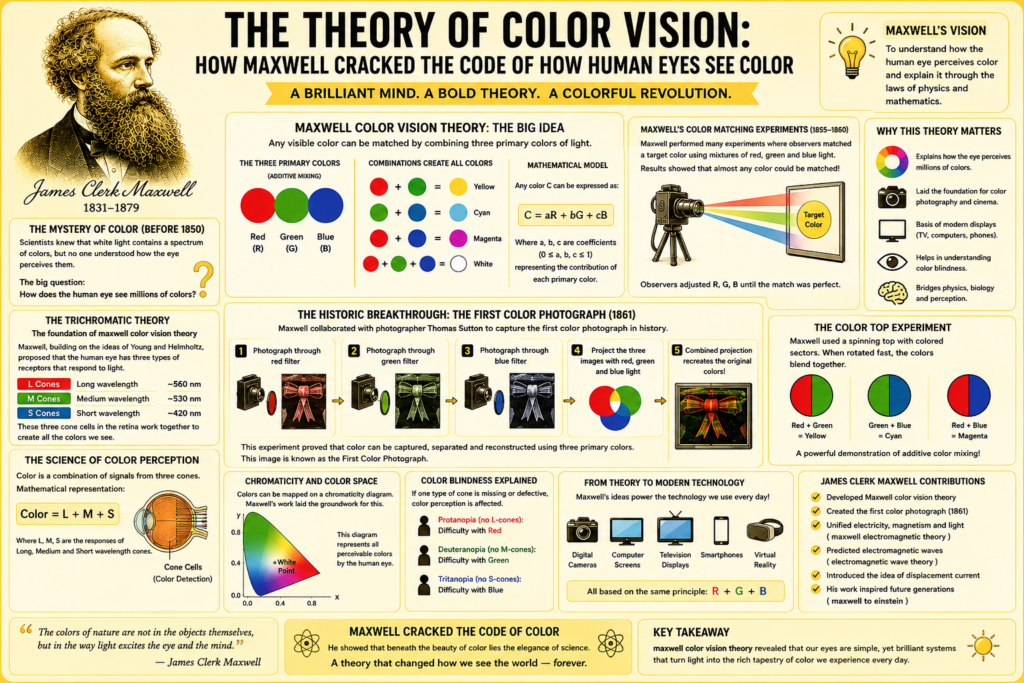
The story of maxwell color vision theory is one of the most fascinating scientific breakthroughs of the nineteenth century. Long before televisions, smartphones, digital cameras, and computer monitors existed, James Clerk Maxwell discovered principles that explain how humans perceive color.
Today, we naturally recognize millions of colors. We distinguish red roses, green forests, blue oceans, and golden sunsets without giving much thought to how our eyes perform this remarkable task. Yet for centuries, scientists struggled to understand the true nature of color perception.
Maxwell changed that.
Using mathematics, experiments, and careful observation, he helped reveal how human vision works and demonstrated that virtually every visible color can be created from combinations of three primary colors. The development of maxwell color vision theory laid the foundation for modern photography, television, computer graphics, and digital displays.
The Mystery of Color Before Maxwell (1700 – 1850)
Before the development of maxwell color vision theory, scientists knew that light contained different colors.
Isaac Newton had already shown that white light could be separated into a spectrum using a prism.
However, one important question remained unanswered:
How do human eyes perceive color?
Was every color detected separately?
Did the eye contain hundreds of color receptors?
Or was some other process responsible?
Scientists lacked a complete explanation.
The solution would emerge through the combined efforts of Thomas Young, Hermann von Helmholtz, and Maxwell.
The Early Trichromatic Theory of Vision
In the early nineteenth century, physicist Thomas Young proposed a revolutionary idea.
Young suggested that the human eye might use only three types of color receptors.
According to this trichromatic theory of vision, every visible color could be produced by combining responses from these three receptors.
Later, German scientist Hermann von Helmholtz expanded the theory.
Maxwell would eventually provide the strongest experimental support.
Together, their work became known as the Young-Helmholtz Maxwell theory.
Maxwell’s Interest in Human Vision
Although most people remember Maxwell for electromagnetism, he was also deeply interested in optics and perception.
James Clerk Maxwell believed that understanding color required both physics and biology.
He studied:
- Light wavelengths
- Human vision
- Color matching
- Optical illusions
- Spectral sensitivity
His goal was to explain how the eye transforms light into color experiences.
This work eventually became known as maxwell color vision theory.
Understanding Human Color Perception
Modern science confirms the central idea behind maxwell color vision theory.
The human retina contains specialized retinal receptors called cone cells.
There are three primary types:
- Long wavelength cones (L)
- Medium wavelength cones (M)
- Short wavelength cones (S)
These receptors respond differently to incoming light.
Mathematically, color perception can be represented as:
Color = L + M + S
Different activation levels produce different colors.
This simple principle explains an enormous range of visual experiences.
Cone Cells and Spectral Sensitivity
Each cone type possesses a different spectral sensitivity.
Approximate peak responses are:
L Cone ≈ 560 nm
M Cone ≈ 530 nm
S Cone ≈ 420 nm
Visible wavelengths extend roughly from:
380 nm ≤ λ ≤ 750 nm
The brain combines signals from these cone cells to create color perception.
The ability of three receptor types to generate millions of colors became one of the greatest insights of maxwell color vision theory.
Maxwell’s Color Matching Experiments (1855 – 1860)
To test his ideas, Maxwell conducted extensive color matching experiments.
Participants viewed colored light and attempted to reproduce it using mixtures of three primary colors.
The results were remarkable.
Observers could match nearly any visible color using suitable combinations of red, green, and blue light.
This provided strong evidence supporting maxwell color vision theory.
The experiments demonstrated that three color channels were sufficient to describe human color perception.
The Mathematics of Color Mixing
One of Maxwell’s greatest contributions was introducing mathematics into color science.
Suppose:
R = Red intensity
G = Green intensity
B = Blue intensity
Then:
Color = R + G + B
Examples:
White = R + G + B
Yellow = R + G
Magenta = R + B
Cyan = G + B
This process is known as additive color mixing.
The mathematical simplicity of these relationships became a cornerstone of maxwell color vision theory.
The Color Top Experiment
Among Maxwell’s most famous demonstrations was the color top experiment.
He created spinning disks containing different colored sectors.
When rotated rapidly, the colors blended together.
For example:
50% Red + 50% Green
appeared yellow.
By carefully adjusting proportions, Maxwell could reproduce a wide range of colors.
The color top experiment provided dramatic visual evidence that color perception results from combining primary color signals.
Color Matching Functions
Maxwell also helped establish the concept of color matching functions.
These functions describe how combinations of primary colors reproduce perceived colors.
Modern color science represents this mathematically as:
C = aR + bG + cB
Where:
- C = Target color
- a, b, c = Weighting coefficients
This approach remains fundamental in modern imaging systems.
Color matching functions became one of the lasting achievements of maxwell color vision theory.
The First Color Photograph (1861)
The most famous demonstration of maxwell color vision theory occurred in 1861.
Maxwell collaborated with photographer Thomas Sutton.
Three photographs of a tartan ribbon were taken through:
- Red filter
- Green filter
- Blue filter
The images were later projected using matching colored light.
When combined, they recreated the original colors.
The result became the first color photograph in history.
This achievement provided spectacular confirmation of Maxwell’s theory.
Why the First Color Photograph Was Important
The success of the first color photograph proved that color information could be separated into three channels and reconstructed accurately.
This achievement demonstrated:
- Human vision is fundamentally trichromatic.
- Color can be represented mathematically.
- RGB principles accurately model perception.
Modern photography still relies on the same concept.
The experiment remains one of the greatest successes of maxwell color vision theory.
Maxwell’s Chromaticity Research
Maxwell’s investigations eventually led toward concepts later represented by the chromaticity diagram.
A chromaticity diagram maps colors according to human perception.
Although modern versions were developed later, Maxwell’s work provided essential foundations.
His studies demonstrated that colors could be described quantitatively rather than purely subjectively.
This transformed color science into a rigorous scientific discipline.
Color Blindness Research
The development of maxwell color vision theory also influenced color blindness research.
If color perception depends upon three receptor types, then deficiencies in one receptor should alter color vision.
Modern science confirms this prediction.
Examples include:
- Protanopia (red deficiency)
- Deuteranopia (green deficiency)
- Tritanopia (blue deficiency)
These conditions arise because one class of cone cells functions abnormally.
Maxwell’s framework helped researchers understand these visual disorders.
Optical Illusions and Color Perception
Another fascinating consequence of maxwell color vision theory involves optical illusions.
The brain does not simply record incoming light.
Instead, it interprets signals from cone cells.
This interpretation process can produce surprising visual effects.
Color contrast illusions demonstrate that perceived colors depend partly on surrounding colors.
These phenomena continue fascinating neuroscientists and psychologists today.
Relationship to Modern Technology
The influence of maxwell color vision theory extends throughout modern technology.
Applications include:
- Digital cameras
- Computer monitors
- Television displays
- Smartphones
- Virtual reality systems
- Graphic design software
Every RGB display uses principles Maxwell helped establish.
Modern imaging technology remains deeply connected to his work.
James Clerk Maxwell Contributions Beyond Electromagnetism
When discussing James Clerk Maxwell Contributions, color vision research deserves far more attention than it usually receives.
His achievements include:
- Electromagnetic theory
- Color vision science
- Color photography
- Statistical mechanics
- Mathematical physics
His ability to combine theory and experimentation made him one of history’s most versatile scientists.
Maxwell’s Influence on Future Science
The impact of maxwell color vision theory extended well beyond photography.
It influenced:
- Neuroscience
- Vision research
- Computer graphics
- Display engineering
- Cognitive psychology
Even today, scientists continue exploring questions first raised by Maxwell’s work.
His influence remains remarkably strong.
Why Maxwell’s Theory Still Matters
More than 150 years later, maxwell color vision theory remains central to our understanding of human vision.
The theory explains:
- How cone cells function
- Why RGB systems work
- How color photography operates
- Why color blindness occurs
- How displays reproduce color
Its predictive power continues validating Maxwell’s genius.
Very few scientific theories have proven so influential across so many disciplines.
The Legacy of Maxwell’s Color Vision Theory
The success of maxwell color vision theory demonstrates the extraordinary value of combining mathematics, experimentation, and imagination.
Maxwell transformed color from a mysterious subjective experience into a measurable scientific phenomenon.
Every photograph, smartphone display, and television screen owes something to his insights.
His work helped humanity understand one of its most remarkable senses.
Frequently Asked Questions (FAQs)
What is Maxwell color vision theory?
Maxwell color vision theory explains that human color perception is based on combinations of three primary color responses corresponding to different cone cells.
How did Maxwell prove his theory?
He conducted color matching experiments and later demonstrated the first color photograph using red, green, and blue filters.
What are cone cells?
Cone cells are retinal receptors responsible for detecting color and enabling detailed visual perception.
Why is RGB important?
RGB systems reproduce colors by combining red, green, and blue light, directly reflecting Maxwell’s theory.
How does color blindness relate to Maxwell’s theory?
Color blindness occurs when one or more cone cell types function abnormally, affecting color perception.
Conclusion
The story of maxwell color vision theory is one of the greatest achievements in the history of vision science. Through experiments, mathematics, and extraordinary insight, James Clerk Maxwell helped explain how human eyes perceive color and demonstrated that three primary color signals could recreate virtually every visible hue.
His work transformed photography, imaging, display technology, and neuroscience. From the first color photograph to modern smartphones and televisions, Maxwell’s discoveries continue shaping everyday life.
More than a century and a half later, his theory remains one of the most elegant and influential explanations of human perception ever developed, proving once again that Maxwell’s genius extended far beyond electromagnetism and into the very way we see the world.