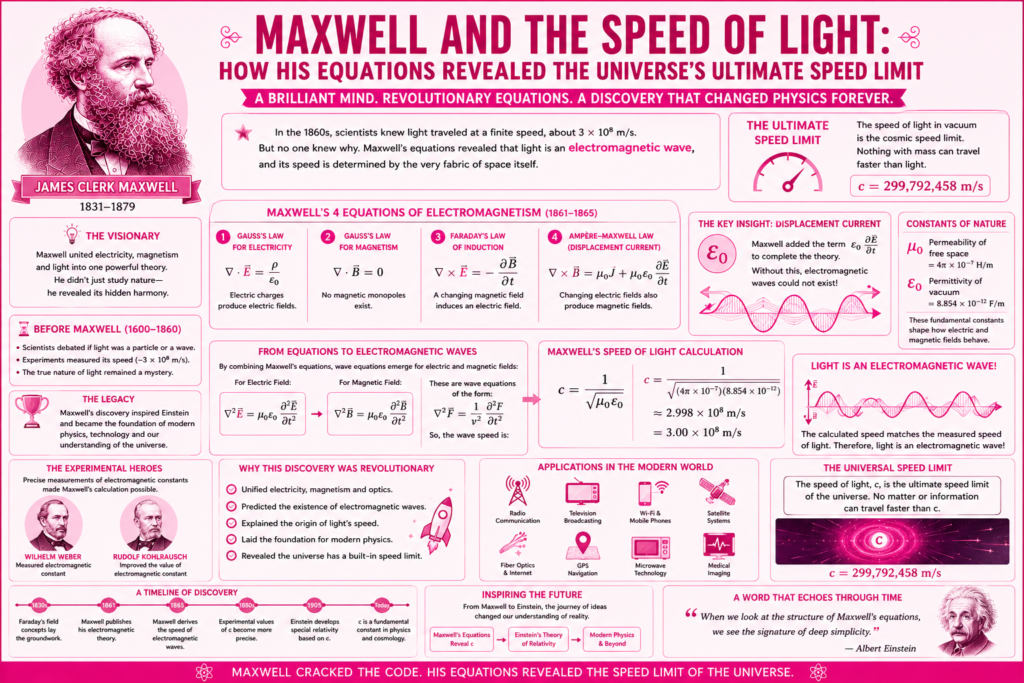
The story of maxwell and speed of light is one of the greatest intellectual achievements in the history of science. Long before modern physics, relativity, and space exploration, James Clerk Maxwell used mathematics to uncover one of nature’s deepest secrets. He discovered that light travels at a specific speed determined by the fundamental properties of the universe itself.
Today, we know that the speed of light is approximately:
c = 299,792,458 m/s
This value is often called the ultimate speed limit of the universe. Nothing carrying information can travel faster.
What makes this discovery extraordinary is that Maxwell did not measure the speed of light directly. Instead, he derived it from equations describing electricity and magnetism. Through pure mathematical reasoning, he revealed that light was actually an electromagnetic wave.
The achievement of maxwell and speed of light transformed physics forever and laid the foundation for Einstein’s theory of relativity.
The Mystery of Light Before Maxwell (1600 – 1860)
Before the work of maxwell and speed of light, scientists debated the true nature of light.
Isaac Newton argued that light consisted of particles.
Other researchers proposed that light behaved as a wave.
Experiments showed evidence supporting both views.
Although scientists could measure the speed of light, they still did not understand what light actually was.
The question remained unanswered for centuries.
Then Maxwell entered the picture.
Early Measurements of Light Speed
Long before Maxwell, several scientists attempted to measure light’s velocity.
Among the most famous were:
- Ole Rømer
- Hippolyte Fizeau
- Léon Foucault
Their experiments demonstrated that light traveled at a finite speed.
By the mid nineteenth century, scientists knew light moved at roughly:
3 × 10⁸ m/s
However, nobody understood why this value existed.
The answer would emerge from maxwell and speed of light.
The Foundation Built by Faraday (1830 – 1860)
Michael Faraday’s discoveries played a crucial role.
The partnership of faraday and maxwell became one of science’s greatest success stories.
Faraday introduced revolutionary concepts:
- Electric fields
- Magnetic fields
- Electromagnetic induction
- Lines of force
Although Faraday lacked advanced mathematical training, he understood that electricity and magnetism were deeply connected.
Maxwell later transformed these ideas into mathematics.
Maxwell’s Electromagnetic Vision (1861 – 1865)
The breakthrough of maxwell and speed of light emerged from what became known as maxwell electromagnetic theory.
Maxwell sought a unified explanation for electricity and magnetism.
His work eventually produced the famous equations:
∇ · E = ρ/ε₀
∇ · B = 0
∇ × E = − ∂B/∂t
∇ × B = μ₀J + μ₀ε₀(∂E/∂t)
These equations transformed physics forever.
They described how electric and magnetic fields interact and evolve through space.
The Importance of Displacement Current
One critical step involved displacement current.
Maxwell realized that changing electric fields could generate magnetic fields.
He introduced:
J_d = ε₀(∂E/∂t)
This mathematical correction completed electromagnetic theory.
Without displacement current, Maxwell could never have discovered the connection between light and electromagnetism.
Many historians consider it the key insight behind maxwell and speed of light.
Deriving the Wave Equation
After combining his equations, Maxwell derived a remarkable result.
For electric fields:
∇²E = μ₀ε₀ ∂²E/∂t²
For magnetic fields:
∇²B = μ₀ε₀ ∂²B/∂t²
These are wave equations.
They describe disturbances propagating through space.
The general wave speed formula is:
v = λf
Where:
- v = Velocity
- λ = Wavelength
- f = Frequency
Maxwell realized that electromagnetic fields behaved exactly like waves.
This was the beginning of the story of maxwell and speed of light.
The Famous Speed Calculation
Maxwell examined the wave equation carefully.
From the mathematics, the wave velocity becomes:
c = 1/√(μ₀ε₀)
This equation is one of the most important formulas in physics.
It connects the speed of light to two fundamental electromagnetic constants.
These are:
μ₀ = Permeability of free space
ε₀ = Permittivity of vacuum
These quantities describe how electric and magnetic fields behave in empty space.
Understanding μ₀ and ε₀
The symbols μ₀ and ε₀ play a central role in maxwell and speed of light.
Permeability of Free Space
μ₀ = 4π × 10⁻⁷ H/m
This constant measures how magnetic fields form in vacuum.
Permittivity of Vacuum
ε₀ = 8.854 × 10⁻¹² F/m
This constant measures how electric fields behave in vacuum.
Together, these values determine the speed of electromagnetic waves.
They are among the most important electrodynamic constants in nature.
Maxwell’s Speed of Light Calculation
Substituting the constants:
c = 1/√[(4π × 10⁻⁷)(8.854 × 10⁻¹²)]
Calculating:
c ≈ 3 × 10⁸ m/s
The result matched the experimentally measured speed of light.
Maxwell was astonished.
This could not be a coincidence.
His equations had revealed the nature of light itself.
The breakthrough of maxwell and speed of light had arrived.
Light Is an Electromagnetic Wave
Maxwell immediately recognized the significance of his calculation.
If electromagnetic waves travel at the speed of light, then light itself must be an electromagnetic wave.
This conclusion changed science forever.
It established electromagnetic wave theory.
For the first time, electricity, magnetism, and optics became part of one unified framework.
Few discoveries in history have been so profound.
Why This Discovery Was Revolutionary
The achievement of maxwell and speed of light solved several major mysteries simultaneously.
It explained:
- What light is
- Why light has a specific speed
- How electricity and magnetism are connected
- Why electromagnetic waves exist
Instead of viewing light as an isolated phenomenon, Maxwell showed it belonged to a larger family of electromagnetic waves.
This family includes:
- Radio waves
- Microwaves
- Infrared radiation
- Visible light
- Ultraviolet radiation
- X rays
- Gamma rays
Weber and Kohlrausch’s Contribution
Before Maxwell’s work, physicists Wilhelm Weber and Rudolf Kohlrausch had measured an important electromagnetic constant.
Their experiments revealed a value remarkably close to the speed of light.
This electromagnetic constant provided additional evidence supporting Maxwell’s conclusions.
The connection strengthened the emerging theory.
The Universe’s Ultimate Speed Limit
The story of maxwell and speed of light eventually led to a deeper realization.
The speed of light is not merely the speed of light.
It is the speed limit of the universe.
No signal can travel faster than c.
This principle became central to modern physics.
Today, the speed limit of the universe governs:
- Relativity
- Particle physics
- Cosmology
- Space exploration
Maxwell’s equations revealed this limit decades before Einstein.
Maxwell to Einstein (1865 – 1905)
The influence of maxwell and speed of light extended directly into the twentieth century.
Albert Einstein greatly admired Maxwell’s work.
The connection known as einstein hero maxwell remains legendary.
Einstein recognized a profound problem.
If Maxwell’s equations always predict the same speed of light, then classical mechanics must be incomplete.
This realization led directly to special relativity.
The journey from maxwell to einstein transformed modern science.
James Clerk Maxwell Contributions to Physics
When discussing James Clerk Maxwell Contributions, the speed of light discovery stands among his greatest achievements.
His accomplishments include:
- Electromagnetic theory
- Prediction of electromagnetic waves
- Speed of light derivation
- Statistical mechanics
- Color vision theory
- Mathematical physics
Few scientists have influenced so many fields simultaneously.
Modern Technology and Maxwell’s Discovery
The discovery of maxwell and speed of light made countless technologies possible.
Applications include:
- Radio communication
- Television broadcasting
- WiFi networks
- Mobile phones
- GPS systems
- Satellites
- Fiber optics
Every electromagnetic technology relies upon Maxwell’s understanding of light and wave propagation.
His equations remain essential today.
Fundamental Constants of Nature
One reason physicists admire maxwell and speed of light is that the speed emerges naturally from fundamental constants of nature.
The value does not depend on human choices.
It is determined by the structure of the universe itself.
This realization changed how scientists view physical laws.
Nature appeared far more interconnected than anyone had imagined.
Why Maxwell’s Discovery Still Matters
More than 150 years later, the achievement of maxwell and speed of light remains one of science’s greatest triumphs.
His equations continue guiding research in:
- Quantum electrodynamics
- Telecommunications
- Astrophysics
- Space science
- Particle physics
The discovery remains a shining example of how mathematics can reveal hidden truths about reality.
Frequently Asked Questions (FAQs)
What did Maxwell discover about the speed of light?
Maxwell discovered that electromagnetic waves travel at the same speed as light, proving that light is an electromagnetic wave.
What is the formula Maxwell used?
The famous formula is:
c = 1/√(μ₀ε₀)
What are μ₀ and ε₀?
They are the permeability of free space and the permittivity of vacuum, fundamental electromagnetic constants.
Why is the speed of light important?
It represents the maximum speed at which information can travel through the universe.
How did Maxwell influence Einstein?
Einstein used Maxwell’s equations as a foundation for developing special relativity.
Conclusion
The story of maxwell and speed of light represents one of humanity’s greatest intellectual achievements. Through mathematics alone, James Clerk Maxwell revealed that light is an electromagnetic wave and uncovered the fundamental speed limit governing the universe.
His calculation connected electricity, magnetism, and optics into a single theory, transforming physics forever. The discovery inspired Einstein, launched modern electromagnetism, and helped create the technological world we inhabit today.
More than a century and a half later, Maxwell’s equations continue guiding science and engineering, proving that a few elegant mathematical relationships can unlock some of the deepest secrets of the cosmos.