The invisible threads of wireless communication hold our modern world together. We stream high-definition movies on the subway, conduct international business meetings from beachside cafes, and manage complex smart home ecosystems without a single physical wire. Yet, this seamless digital universe did not appear overnight. The true journey of wi-fi history: 1997 to today is a breathtaking chronicle of rapid engineering breakthroughs, global collaborations, and staggering technological growth.
Before this revolution, connecting to the internet meant being physically chained to a desk by copper cables or relying on sluggish dial-up tones. The birth of standardized wireless networking changed human civilization forever. By looking deeply into wi-fi history: 1997 to today, we can fully understand how creative engineers transformed an unreliable corporate experiment into a universal human utility.
The Genesis and the Original 802.11 Protocol (1997 – 1999)
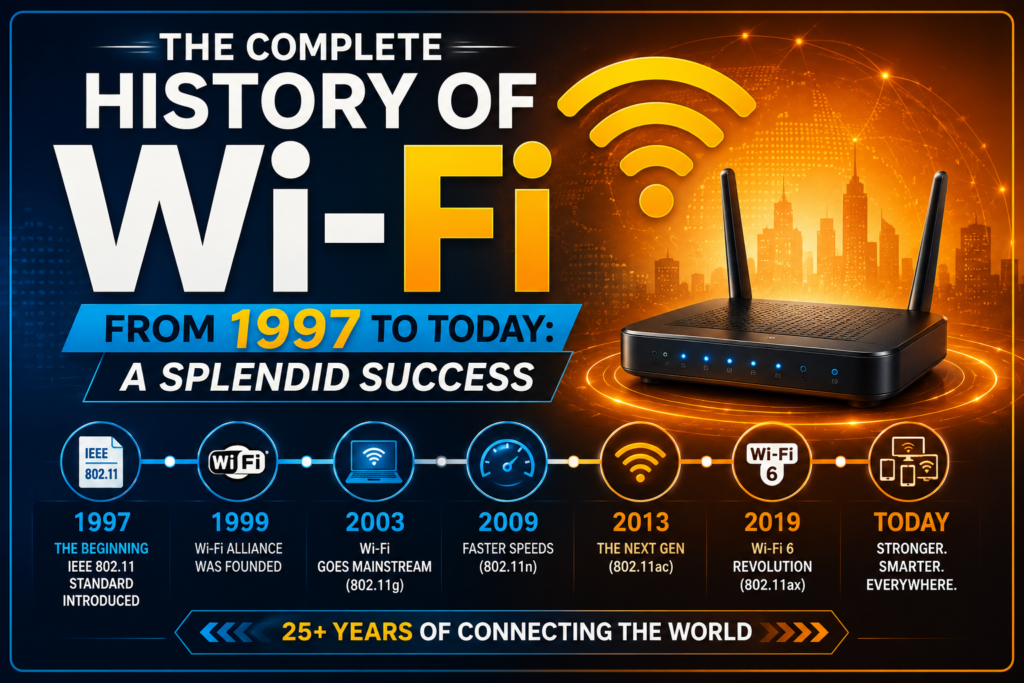
The official timeline of modern wireless networking kicked off in the summer of 1997. Regulatory bodies and international engineering committees finally agreed on a unified technical standard. This baseline protocol was published by the Institute of Electrical and Electronics Engineers (IEEE) and given the unglamorous name of legacy 802.11.
This original system operated on the 2.4 GHz radio spectrum allocation. By today’s standards, the original Wi-Fi speed was agonizingly slow, topping out at a maximum of just 2 megabits per second. Despite the limitations, this technology proved to the tech industry that data packets could travel through the air inside an office environment without dropping signals constantly.
However, tech companies soon realized that the name “IEEE 802.11” was far too complex for ordinary consumers. To fix this marketing challenge, an industry alliance hired a branding firm to invent a catchy name. If you have ever wondered why is it called wi-fi, the answer is surprisingly simple. It was created in 1999 as a memorable marketing play on the audio term “hi-fi” (high fidelity), even though it does not technically stand for wireless fidelity.
The Early Evolution and Mass Market Adoption (1999 – 2003)
With a catchy name and a solid framework established, the evolution of Wi-Fi entered its first major growth spurt at the turn of the millennium. The IEEE committee realized that the original 2 megabits per second speed was too slow to handle the expanding world wide web. This realization led to a split in development, resulting in two distinct standards released nearly simultaneously: 802.11a and 802.11b.
The 802.11b standard quickly became the absolute darling of the consumer market. While 802.11a was technically faster, it used a higher frequency that struggled to penetrate walls. Meanwhile, 802.11b operated on the cheaper, highly accessible 2.4 GHz band and achieved speeds of 11 megabits per second.
[Legacy 802.11] (1997) ──► 2 Mbps (2.4 GHz)
       │
       ├──► [802.11a] (1999) ──► 54 Mbps (5 GHz - Enterprise)
       │
       └──► [802.11b] (1999) ──► 11 Mbps (2.4 GHz - Mass Market)
This era marked the beginning of commercial Wi-Fi history. In 1999, Apple famously integrated this wireless technology into its sleek iBook laptops under the “AirPort” brand name. Suddenly, everyday consumers experienced the sheer magic of browsing websites from their couches. The infrastructure of the internet changed instantly as schools, offices, and tech-savvy households rushed to install wireless access points.
Achieving True Broadband Speeds (2003 – 2009)
As the mid-2000s approached, the internet evolution accelerated. Web pages were no longer just static text and small images; users wanted to download audio files, share large data folders, and stream early web videos. The existing 802.11b networks were buckling under the heavy bandwidth demands.
The engineering solution arrived in 2003 with the introduction of the 802.11g protocol. This milestone combined the best parts of both previous standards. It operated on the highly compatible 2.4 GHz frequency band but boosted maximum raw data transfer speeds up to 54 megabits per second.
To help clarify what this meant for consumers, early computer software began utilizing automation scripts to detect and test signal parameters. The following simple script illustrates how early client chipsets would analyze signal strength to determine if a connection was stable enough to handle the upgraded 54 Mbps bandwidth:
Python
def analyze_signal_strength(dbm_level):
    """Simulates basic wireless client logic from the mid-2000s era."""
    print(f"Current Signal Level: {dbm_level} dBm")

    if dbm_level >= -50:
        return "Excellent Connection: Operating at maximum 54 Mbps protocol speed."
    elif -70 <= dbm_level < -50:
        return "Good Connection: Maintaining stable throughput."
    elif -85 <= dbm_level < -70:
        return "Weak Connection: Dropping to legacy fallback speeds to prevent packet loss."
    else:
        return "No Signal: Packet collision or severe multipath distortion detected."

# Evaluating typical home office environment connection quality
current_environment_metric = -62
connection_status = analyze_signal_strength(current_environment_metric)
print(f"Network Status: {connection_status}")
This protocol was a massive triumph for the growth of wireless technology because it maintained strict backward compatibility. This meant users could buy newer, faster laptops without being forced to throw away their older legacy devices.
Going Dual-Band and the Rise of Smart Devices (2009 – 2014)
By the late 2000s, the wireless landscape changed dramatically due to a single major invention: the modern smartphone. With millions of cellular phones, tablets, and gaming consoles joining home networks simultaneously, the 2.4 GHz radio spectrum became extremely overcrowded.
The industry solved this congestion crisis in 2009 with the release of 802.11n (which was later retroactively labeled Wi-Fi 4). This update represents one of the most critical turning points in wi-fi history: 1997 to today. It introduced true dual-band routing, meaning devices could seamlessly use both the 2.4 GHz and 5 GHz radio frequencies.
Furthermore, 802.11n introduced Multiple Input, Multiple Output (MIMO) technology. Instead of sending data through a single antenna, routers could now use multiple internal antennas to broadcast and receive data simultaneously. This technical evolution pushed theoretical network speeds up to a blistering 600 megabits per second, turning the wireless network history into a narrative of desktop-grade performance without cords.
The Gigabit Era and Ubiquitous Hotspots (2014 – 2019)
As we moved deeper into the 2010s, consumer expectations shifted again. High-definition 4K video streaming, cloud file storage, and intensive online multiplayer gaming required gigabit speeds. The wireless local area network needed to behave exactly like a hardwired fiber-optic cable.
The answer arrived in 2014 with 802.11ac (Wi-Fi 5). This protocol focused almost exclusively on optimizing the 5 GHz band. By using wider channels and advanced beamforming technology, which shoots targeted beams of radio data directly at a specific device rather than broadcasting it uniformly in all directions, Wi-Fi 5 broke the gigabit barrier.
During this era, widespread hotspot deployment transformed cities worldwide. Coffee shops, international airports, public parks, and hotels offered free public access points. However, this massive convenience created a glaring vulnerability. Users needed to learn how these public signals operated to protect their personal identities. Reading comprehensive guides on how wi-fi works became essential for everyday citizens to safeguard their private laptops against hackers lurking on open, unencrypted public networks.
Smart Homes and Extreme Device Density (2019 – 2024)
By the end of the decade, the primary technical issue was no longer raw download speed for a single computer. Instead, the major challenge was handling massive device density. A typical modern smart household now contained dozens of smart TVs, voice assistants, security cameras, refrigerators, and personal phones all competing for the exact same router space.
To solve this crowded environment problem, the IEEE group rolled out 802.11ax, widely marketed as Wi-Fi 6. This update focused heavily on network efficiency rather than just peak speeds. It utilized an enterprise-grade cellular technology called OFDMA (Orthogonal Frequency Division Multiple Access), which effectively divides a single wireless channel into thousands of tiny sub-channels, allowing a router to deliver data to dozens of different smart home devices in a single transmission wave.
Shortly after, regulatory bodies opened up a pristine, completely unoccupied block of radio spectrum: the 6 GHz band. This gave birth to Wi-Fi 6E, creating an expansive superhighway free from the interference of older baby monitors, microwaves, and legacy electronics.
The Modern Frontier of Wireless Connectivity (2024 – 2026)
This brings us directly to the present day, where we are actively witnessing the rollout of Wi-Fi 7 (802.11be). This cutting-edge standard represents the pinnacle of wi-fi history: 1997 to today, bringing unprecedented multi-gigabit speeds directly into our homes and offices.
Wi-Fi 7 introduces a concept called Multi-Link Operation (MLO). In past generations, your phone could only connect to one frequency band at a time (either 2.4 GHz, 5 GHz, or 6 GHz). With MLO, a modern device can connect to multiple frequencies simultaneously. If one frequency experiences sudden interference from a concrete wall, the data instantly and silently shifts over to the other band without a single millisecond of lag.
To fully understand how far the technology has advanced over the past few decades, it is highly instructive to compare the technical specifications of these different eras side-by-side:
| Generation Name | IEEE Technical Standard | Launch Year | Max Theoretical Speed | Key Structural Feature |
| Wi-Fi 1 | 802.11b | 1999 | 11 Mbps | First mass consumer adoption |
| Wi-Fi 3 | 802.11g | 2003 | 54 Mbps | Universal backward compatibility |
| Wi-Fi 4 | 802.11n | 2009 | 600 Mbps | MIMO multiple antennas introduced |
| Wi-Fi 5 | 802.11ac | 2014 | 3.5 Gbps | Dedicated 5 GHz beamforming |
| Wi-Fi 6 / 6E | 802.11ax | 2019 | 9.6 Gbps | OFDMA density handling & 6 GHz |
| Wi-Fi 7 | 802.11be | 2024 | 46 Gbps | Multi-Link Operation (MLO) channels |
This steady rise in overall efficiency has completely reshaped our global economy, turning cloud computing and mobile workforces into a reality.
What Lies Beyond: The Long-Term Horizon
As engineers push past the boundaries of the current standards, the conversation has already shifted toward the next decade of network evolution. The upcoming 802.11bn standard, which will eventually be known as Wi-Fi 8, is actively being designed in laboratory environments.
Instead of chasing faster peak speeds that human eyes can no longer perceive, future wireless developments will focus entirely on reliable reliability, ultra-low latency tracking, and power efficiency for internet-of-things devices. We are moving toward a world where wireless signals can actively map out the physical geometry of a room, helping smart devices navigate environments safely. Examining the future of wi-fi explained by industry experts reveals a fascinating landscape where artificial intelligence will actively manage radio channels in real-time to eliminate dead zones before they happen.
Frequently Asked Questions (FAQs)
What was the maximum speed of the very first Wi-Fi network?
The original legacy 802.11 standard, released in 1997, had a maximum speed of just 2 megabits per second. In real-world applications, the actual speed was often closer to 1 megabit per second or less due to signal interference. This original speed was barely enough to handle basic text emails and simple web pages.
Who is officially credited with creating the core wireless technology?
While many brilliant engineers contributed to the global protocols, the fundamental hardware breakthrough that prevented indoor radio echoes was invented by a team of Australian scientists at the CSIRO, led by John O’Sullivan. Their creative use of mathematical formulas originally designed for radio astronomy became the core foundation of modern wireless internet chipsets.
How does Wi-Fi 7 handle multiple bands differently than older routers?
Older dual-band or tri-band routers forced your device to choose a single frequency band to connect to at any given moment. Wi-Fi 7 uses a groundbreaking technology called Multi-Link Operation (MLO), which allows a compatible device to send and receive data across multiple distinct frequency bands simultaneously, dramatically increasing connection reliability.
Why did the industry change the naming system to simple numbers like Wi-Fi 5 and Wi-Fi 6?
For nearly twenty years, the industry used complicated engineering codes like 802.11g, 802.11n, and 802.11ac. This caused massive confusion for everyday consumers who couldn’t tell which router was newer or faster. In 2018, the Wi-Fi Alliance simplified the system by introducing clean, numerical generations, making it easy to see that a Wi-Fi 6 router is newer and better than a Wi-Fi 5 model.
Conclusion: An Unstoppable Digital Legacy
Reviewing the extraordinary timeline of wi-fi history: 1997 to today shows that wireless technology is one of humanity’s greatest cooperative achievements. In less than three decades, wireless engineers have managed to boost data transmission speeds by a factor of over twenty thousand, turning a niche office novelty into an invisible global foundation.
This incredible transformation reminds us that technological evolution is completely unstoppable when shared global standards are embraced. As we step boldly into an era defined by augmented reality, artificial intelligence, and smart cities, our reliable wireless networks stand ready to carry the load, continuing to reshape how we work, communicate, and understand the universe.