Every single day, billions of people around the globe perform a subconscious ritual. We walk into a coffee shop, an airport terminal, or a friend’s living room and immediately look at our devices to connect to an invisible network. We look for that familiar, universal icon composed of stacked radio waves. Yet, despite our total, absolute dependence on this technology, a massive question remains shrouded in mystery for the average consumer.
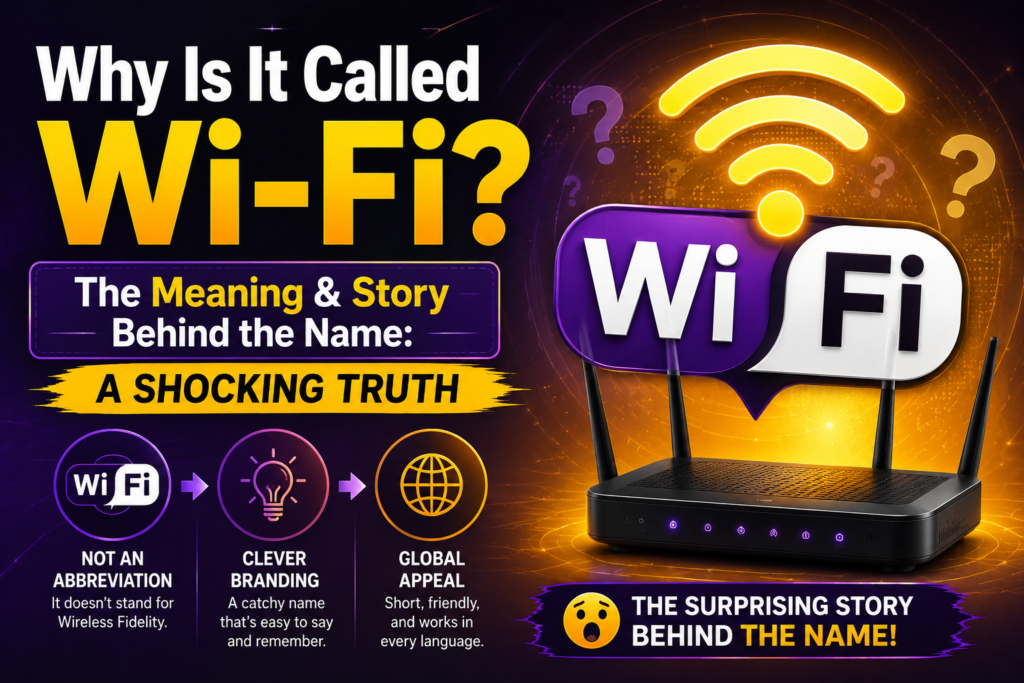
Exactly why is it called wi-fi? If you ask ten different tech enthusiasts this question, nine of them will confidently look you in the eye and tell you that it stands for wireless fidelity. They will explain that it is a direct technical cousin to high fidelity audio systems. However, that confident explanation is a complete and utter illusion. The true tale behind this universal nomenclature has nothing to do with engineering standards, audio fidelity vs Wi-Fi comparisons, or scientific equations. Instead, it is a fascinating, high stakes corporate narrative driven by a world class branding agency, a desperate marketing need, and a persistent misconception that took on a life of its own.
The Complex Tech Background and the Branding Problem (1995 – 1999)
To understand exactly why is it called wi-fi, we have to jump back in a time machine to the late 1990s. Wireless internet technology was actively emerging from engineering laboratories, but it was facing a critical consumer adoption roadblock. The brilliant scientists who developed the underlying hardware had handed the tech over to global regulatory bodies. The Institute of Electrical and Electronics Engineers (IEEE) had assigned a formal name to this new wireless standard: IEEE 802.11b Direct Sequence High Rate.
Take a moment to imagine trying to sell that phrase to an ordinary consumer in a retail store. It was an absolute marketing disaster. No regular person shopping for a home computer system could remember that string of numbers and letters, let alone understand what it meant. The industry desperate for widespread consumer awareness realized that this cold, mechanical phrasing would cripple commercial growth.
A group of visionary tech companies came together in 1999 to form a non profit organization called the Wireless Ethernet Compatibility Alliance (WECA). This group, which would later rename itself the Wi-Fi Alliance branding powerhouse, knew they needed a sleek, approachable, and highly memorable trademark to replace the unpronounceable IEEE string. They needed a clean catchphrase that would look fantastic printed on consumer boxes and router chassis.
Enter Interbrand and the Creation of a Legend (1999)
Realizing that engineers are historically terrible at naming consumer friendly products, WECA hired Interbrand, a legendary creative marketing firm. Interbrand was famous for engineering some of the most iconic brand identities in modern corporate history. The creative experts at Interbrand were tasked with a clear objective: craft a short, punchy term that felt familiar yet cutting edge.
The creative team brainstormed an extensive list of roughly ten separate candidate names. Some of the rejected concepts floating around the conference room included names like WaveLAN, FlankSpeed, DragonFly, and even Hornet. Thankfully, the team at Interbrand recognized that these names either sounded like military operations or cheap comic book characters.
Instead, they designed a beautiful piece of linguistic wordplay. They put forward the word Wi-Fi. It was an instant, unanimous hit. The structural symmetry of the word was visually spectacular, it rolled off the human tongue with zero friction, and it possessed an immediate psychological warmth.
The Birth of the Wireless Fidelity Myth
So, where exactly did the legendary phrase wireless fidelity come from if Interbrand simply invented the word out of thin air? This is the point in why is it called wi-fi history where a brilliant corporate marketing strategy accidentally birthed a permanent global urban legend.
Right after choosing the new trademark, the early alliance members grew incredibly nervous. They worried that everyday consumers would be completely confused by a word that had no literal definition. To ease these corporate anxieties, the alliance agreed to append a small marketing slogan directly beneath the newly designed logo on product packaging. The chosen slogan read: “The Standard for Wireless Fidelity.”
   ┌────────────────────────────────────────┐
   │                 WI-FI                  │  <── Punchy, invented trademark
   ├────────────────────────────────────────┤
   │    The Standard for Wireless Fidelity  │  <── Temporary marketing slogan
   └────────────────────────────────────────┘
This short sentence was a deliberate attempt to give consumers an immediate mental anchor by mimicking the familiar audio industry term hi-fi. However, from a technical perspective, the phrase was absolute nonsense. Wireless technology does not have a fidelity metric in the way an audio amplifier reproduces sound waves.
The inclusion of that brief marketing slogan caused a massive, immediate wave of confusion. Consumers completely skipped past the nuance and assumed that the phrase was a literal definition. They believed that Wi-Fi was an acronym, forever cementing the does Wi-Fi mean wireless fidelity myth into global tech culture. Realizing the slogan was causing a long term misunderstanding, the alliance permanently deleted the phrase from all official promotional materials in late 2000. But by then, the cultural cement had dried completely.
Decoupling the Name from the Underlying Mechanics
While the marketing experts were busy playing with words, engineers were focused on building the actual infrastructure that would back up the flashy new title. The name Wi-Fi is essentially an empty container; a certified stamp of approval ensuring that different electronic devices can talk to each other seamlessly.
To bridge the gap between the catchy name and actual reality, let us look at how devices use these protocols to discover each other. Below is a simple Python simulation demonstrating how a modern device scans for an authorized network name, validating the network before initiating a standard handshake protocol:
Python
def scan_wireless_spectrum():
    """Simulates a device scanning nearby frequencies for valid network tags."""
    available_networks = [
        {"ssid": "Home_Network", "signal_dbm": -45, "certified": True},
        {"ssid": "Unknown_Legacy_Device", "signal_dbm": -82, "certified": False},
        {"ssid": "Coffee_Shop_Free", "signal_dbm": -60, "certified": True}
    ]
    return available_networks

def verify_certification(networks):
    """Simulates checking if a beacon matches established global standards."""
    print("Initiating wireless environment sweep...")
    for net in networks:
        if net["certified"]:
            print(f"  Found Valid Network: [{net['ssid']}] at {net['signal_dbm']} dBm. Certified protocols match.")
        else:
            print(f"  Warning: [{net['ssid']}] lacks official validation. Potential packet collision risk.")

# Execute the simulation framework
detected_beacons = scan_wireless_spectrum()
verify_certification(detected_beacons)
This fundamental verification process highlights what is wi-fi explained in its purest form. The name does not describe a scientific process; it describes a rigorous certification ecosystem that promises absolute interoperability between hardware brands.
The True Power of a Universal Trademark
The decision to hire a specialized branding agency turned out to be an absolute multi billion dollar masterstroke for the global tech sector. By replacing complex engineering jargon with a friendly, accessible word, the alliance removed the psychological barrier to entry for everyday people.
The universal adoption of the term allowed for rapid hotspot deployment across the planet. Restaurants, bookstores, and hotels did not have to explain that they offered high speed local area networks using specific protocols. They simply pasted a small sticker in their front window featuring the newly minted logo.
[IEEE 802.11 Jargon] ──► Confuses Everyday Consumers ──► Halts Market Growth
[Clean Wi-Fi Branding] ──► Reassures Mass Audience   ──► Worldwide Adoption
This brilliant standardization of the nomenclature laid the essential foundation for the explosive expansion of mobile data. It shifted the technology away from specialized corporate server rooms and thrust it directly into our pockets, changing the trajectory of wi-fi history: 1997 to today by turning a piece of niche hardware into a global lifestyle brand.
The Technological Architecture Behind the Catchy Name
Even though the history of the word Wi-Fi is rooted entirely in creative marketing, the engineering hidden beneath the hood is exceptionally precise. Understanding how wi-fi works requires peeling back the branding layer to look at how radio frequencies are split up to send data packets safely through space without crashing into other signals.
When your laptop transmits a file, it relies on a highly sophisticated dance between hardware chipsets and regulatory rules. To see how these protocols have scaled alongside the branding over time, we can look at the historical progression of the standards side by side:
| Era / Generation | Standard Protocol | Frequency Bandwidth | Practical Consumer Impact |
|---|---|---|---|
| Early Era | 802.11b | 2.4 GHz | Replaced physical desktop ethernet cables |
| Mid Era | 802.11n | 2.4 / 5 GHz | Introduced multi antenna MIMO data streams |
| Modern Era | Wi-Fi 6 / 6E | 2.4 / 5 / 6 GHz | Handles massive smart home device density |
| Current Frontier | Wi-Fi 7 | 2.4 / 5 / 6 GHz | Multi Link Operation simultaneous streaming |
This structural progression proves that while the marketing name remained wonderfully simple, the engineering team kept working behind the scenes to scale the capacity up by thousands of times.
Frequently Asked Questions (FAQs)
What does Wi-Fi stand for?
The definitive answer is that Wi-Fi does not stand for anything at all. It is not an acronym, it is not a shortened form of a longer phrase, and it has no hidden scientific meaning. It is an invented word created by a professional branding firm specifically designed to sound catchy and memorable to the general public.
Why did people start saying it means wireless fidelity?
The massive Wi-Fi acronym myth started because the early Wireless Ethernet Compatibility Alliance temporarily used a promotional marketing slogan underneath their logo that read: “The Standard for Wireless Fidelity.” They added this line because they were afraid consumers wouldn’t buy a product with an entirely made up name without some context. The slogan was discontinued quickly, but the myth stayed forever.
Who came up with the actual word Wi-Fi?
The word was invented by a prominent global branding agency named Interbrand. The Wireless Ethernet Compatibility Alliance hired them to create a consumer friendly alternative to the highly complicated engineering name IEEE 802.11b Direct Sequence. Interbrand created the term in 1999, beating out alternative candidate names like WaveLAN and FlankSpeed.
Is Wi-Fi a registered trademark?
Yes, Wi-Fi is an official registered trademark owned exclusively by the Wi-Fi Alliance. Any hardware manufacturer that wants to print the official logo on their retail boxes or market their electronics as wireless certified must submit their devices to rigorous testing labs to ensure compliance with global interoperability standards.
Was the name Wi-Fi ever meant to imply a connection to audio equipment?
The branding experts at Interbrand deliberately engineered the word to rhyme with “hi-fi,” which stands for high fidelity in the premium audio industry. They did this as a clever psychological trick to make the completely new wireless technology instantly feel familiar, high quality, and reliable to consumers who were already comfortable buying hi-fi stereo gear.
Conclusion: The Unmatched Legacy of a Simple Word
When we reflect on the entire journey of why is it called wi-fi, we uncover a profound lesson about the intersection of advanced human engineering and mass consumer psychology. It took brilliant Australian radio astronomers and global engineers to figure out how to fly data packets through the air on invisible radio frequencies. But it took an equally brilliant piece of language design to make humanity fall in love with it.
The word is an absolute triumph of modern design. It gracefully bridged the massive gap between highly abstract computer science and ordinary daily life. The next time you tap that little wave icon on your smartphone or ask a restaurant server for their network password, you can smile knowing the secret truth. You are using a word that means absolutely nothing scientifically, but a word that successfully helped change absolutely everything about how our modern civilization communicates.