Introduction
The microsoft copilot history is the story of a technology giant that had spent years searching for a strategic breakthrough in search and productivity software, and finally found one through the most consequential technology partnership of the decade. When Microsoft began integrating GPT-4 into its products in early 2023, it did not simply add a feature to an existing application. It triggered a complete reimagining of what productivity software could be, and positioned Microsoft as the dominant force in enterprise AI at precisely the moment that every organization in the world was trying to understand how artificial intelligence would change the way people work.
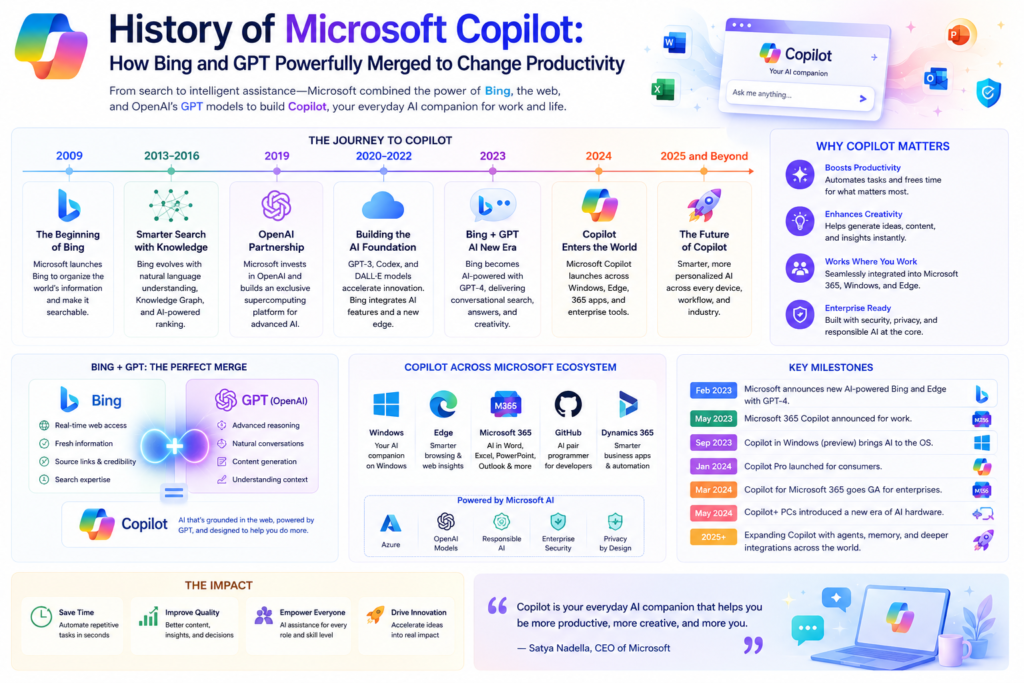
The microsoft copilot history spans a journey from the 2019 investment in OpenAI that looked like a bold bet at the time, through the headline-grabbing Bing Chat launch of February 2023, through the systematic deployment of AI assistance across every major Microsoft product, to the creation of a Copilot brand that now represents one of the most widely used AI platforms on the planet. Understanding the microsoft copilot history means understanding both the strategic vision behind it and the technical execution that turned that vision into products used by hundreds of millions of people every day.
Microsoft’s Early AI Investment and the OpenAI Partnership (2019 – 2022)
The microsoft copilot history did not begin with a product launch or a press conference. It began with a one-billion-dollar check. In July 2019, Microsoft announced a strategic investment in OpenAI, the AI research organization that had been quietly developing the GPT model family. The investment was paired with a commitment to use Microsoft Azure as the exclusive cloud platform for OpenAI’s increasingly compute-intensive model training operations, giving Microsoft both a financial stake and an infrastructure role in the organization that would eventually build ChatGPT.
The openai history from this period shows an organization that had produced GPT-1 and GPT-2 but had not yet released GPT-3 or any consumer-facing product. Microsoft was investing in the team and the research direction rather than in a proven commercial product, which made the investment look prescient in retrospect and somewhat speculative at the time. The partnership gave Microsoft access to OpenAI’s models for integration into its Azure Cognitive Services platform and early developer tools, but the full strategic value of the relationship would not become visible until three years later.
When OpenAI needed additional capital to fund the frontier model training that GPT-3 and subsequent models required, Microsoft extended its commitment significantly. The OpenAI multi-billion dollar partnership was expanded in January 2023 to a reported ten billion dollars over multiple years, announced just weeks before ChatGPT’s explosive growth would validate the investment in the most public way imaginable. This extended partnership gave Microsoft the rights to commercialize OpenAI’s models across its products and cemented Azure as the cloud infrastructure backbone for all of OpenAI’s training and inference operations.
The gpt-4 history shows the model that would become the engine of the microsoft copilot history, and the partnership timing meant that Microsoft had access to GPT-4 capabilities for product integration before any other technology company outside of OpenAI itself.
GitHub Copilot: The First Copilot That Proved the Model (2021 – 2022)
Any honest account of the microsoft copilot history must begin not with Bing Chat but with GitHub Copilot, the AI coding assistant that launched in technical preview in June 2021 and reached general availability in June 2022. GitHub Copilot was the product that first demonstrated, at scale, that AI assistance embedded within professional productivity tools would be adopted enthusiastically and would justify meaningful subscription revenue.
The GitHub Copilot coding tool was built on Codex, an OpenAI model specifically trained on public code repositories, and integrated directly into popular development environments including Visual Studio Code. Developers could write a comment or a function signature and watch Copilot suggest the implementation in real time. They could ask Copilot to explain existing code, suggest fixes for bugs, or translate snippets between programming languages. The AI productivity enhancement was immediate and measurable, with studies finding that developers using GitHub Copilot completed coding tasks twenty-five to fifty percent faster than those working without it.
GitHub Copilot’s success established several principles that would define the entire subsequent microsoft copilot history. It demonstrated that AI assistance should be embedded within the tools users already work in rather than requiring them to switch to a separate application. It demonstrated that a Copilot Pro subscription service model at a meaningful monthly price could find sustainable enterprise adoption. And it demonstrated that the consumer generative assistance model developed for general text generation could be applied productively in specific professional contexts when trained and deployed appropriately.
By the time Microsoft was ready to extend the Copilot concept across its full product portfolio, GitHub Copilot had already proven the thesis with a large developer user base and commercial revenue that validated the approach.
Bing Chat: The AI Search Launch That Shocked Google (February 2023)
The public microsoft copilot history began with a bang in February 2023 when Microsoft launched Bing Chat, a conversational AI search experience built on GPT-4 and powered by what Microsoft called the Prometheus framework integration. Prometheus was Microsoft’s proprietary system for connecting GPT-4 to Bing’s live search index, creating a retrieval-augmented workflow that allowed the model to generate responses grounded in real-time web content rather than relying solely on its training data.
The Bing Chat initial release generated headlines that Bing had not attracted in years. Microsoft had been losing the search market to Google consistently for over a decade, with Bing’s market share stubbornly below ten percent despite billions of dollars of investment. The Bing Chat launch changed the narrative overnight. Suddenly Microsoft had the most technologically advanced search product on the market, and Google was the one scrambling to respond. The semantic indexing engine that Bing had built over years of search technology investment became the retrieval backbone for a conversational AI experience that no competitor could immediately match.
The multi-turn chat interface that Bing Chat offered was genuinely new to search. Instead of reformulating queries and clicking through pages of results, users could have extended conversations about their questions, ask follow-ups, and receive synthesized answers that drew on multiple sources simultaneously. The cross-platform application of this interface across desktop, mobile, and the Edge browser gave Microsoft distribution at scale from day one.
The launch was not without complications. Extended conversations with the Bing Chat system produced some unexpected and occasionally erratic responses in the first days after release, as users discovered edge cases in how the model behaved under pressure. Microsoft addressed these through updated system prompt controls and session length limits, and the rough edges faded as the product matured. The microsoft copilot history records this period as one where the ambition of the deployment outpaced the polish of the product, but where the underlying capability was compelling enough to survive the scrutiny.
Microsoft 365 Copilot: AI Enters Every Office Application (March 2023)
The most strategically significant announcement in the microsoft copilot history came in March 2023 when Microsoft unveiled Microsoft 365 Copilot, a comprehensive AI assistant embedded throughout the entire Microsoft 365 suite. The Microsoft 365 Copilot suite brought GPT-4 capabilities into Word, Excel, PowerPoint, Teams, Outlook, and OneNote simultaneously, representing the most ambitious AI integration into productivity software ever attempted.
In Word, Copilot could draft documents from brief prompts, rewrite existing content in different tones, summarize long reports, and extract key information from uploaded files. In Excel, it could analyze datasets, generate formulas, create charts, and describe data patterns in plain language without requiring users to master Excel’s function syntax. In PowerPoint, it could generate full presentation outlines and slide content from a Word document or a text description. In Teams, it could summarize meeting transcripts, identify action items, and answer questions about discussions that had occurred while a user was unavailable. In Outlook, it could draft email replies, summarize long threads, and flag priority messages.
The contextual software orchestration that made this possible relied on Microsoft Graph, which gave Copilot access to each user’s emails, documents, calendar events, Teams conversations, and collaboration history. Rather than responding with generic AI outputs, Copilot could answer questions like “what did my team decide about the marketing budget last month” by actually reading relevant Teams conversations and documents. This grounding in organizational context separated Microsoft 365 Copilot from any general-purpose AI assistant and made it genuinely useful for professional work in ways that standalone ChatGPT could not match.
The enterprise data protection guardrails that Microsoft built around this integration were essential to commercial adoption. Enterprise customers needed assurance that queries processed through Copilot would not expose proprietary data to OpenAI’s model training, that compliance boundaries would be respected, and that the same security frameworks governing other Microsoft 365 data would apply to Copilot interactions. Microsoft addressed these requirements explicitly and made enterprise data protection a core part of the Microsoft 365 Copilot product positioning.
Microsoft 365 Copilot launched initially at thirty dollars per user per month as an enterprise add-on, a price point that reflected both the genuine productivity value and Microsoft’s confidence that organizations would pay a meaningful premium for AI assistance woven throughout their entire office application ecosystem.
The Copilot Rebranding and Brand Consolidation (November 2023)
A defining moment in the microsoft copilot history came in November 2023 when Microsoft formally consolidated its AI product strategy under the single Copilot brand. The rebranding from Bing to Copilot was announced at Microsoft’s Ignite developer conference alongside a suite of new products and integrations. Bing Chat became Microsoft Copilot. A standalone Copilot application appeared for Windows, iOS, and Android. Copilot became a dedicated button on new Windows 11 keyboards. And the Microsoft 365 AI features continued under the Microsoft 365 Copilot name.
The rebranding was more than cosmetic. Bing as a brand carried decades of association with a search engine that had consistently underperformed against Google. Copilot as a brand was new, neutral, and associated entirely with AI assistance rather than search market share battles. The Windows 11 system-wide integration that accompanied the rebrand put a Copilot access point directly on the taskbar of every updated Windows 11 device, making AI assistance available at the operating system level for the first time in mainstream computing.
The standalone Copilot application became a direct consumer generative assistance product competing with ChatGPT for the free user market, while the Copilot Pro subscription service provided paid tiers with faster responses and deeper Microsoft 365 integration for users who wanted more than the free version offered. This tiered approach allowed Microsoft to compete simultaneously in the consumer market and the enterprise market with a unified brand identity.
GPT-4o Integration and Platform Maturity (2024)
The microsoft copilot history through 2024 was defined by platform maturation and the integration of GPT-4o as the GPT-4o backend infrastructure for Copilot products. GPT-4o, released by OpenAI in May 2024, offered faster response times, lower inference costs, and native multimodal image understanding compared to earlier GPT-4 variants. These improvements translated directly into a better Copilot experience: faster responses in Microsoft 365 applications, improved image analysis in the standalone Copilot application, and more fluid multi-turn chat interface interactions across all products.
The cloud compute scaling required to serve Copilot capabilities at Microsoft’s scale was enormous. Microsoft Azure’s infrastructure had been the platform for OpenAI’s training operations since 2019 and was now also the inference platform for Copilot interactions from hundreds of millions of users across Windows, Office, Edge, and mobile applications. The investments in cloud compute scaling that Microsoft had made over years of Azure development proved essential to Copilot’s ability to serve at this volume without meaningful degradation in response quality or latency.
The user prompt interface improvements across Microsoft 365 Copilot products reflected lessons learned from the first year of deployment. Early users had sometimes struggled to formulate prompts that produced useful results, leading Microsoft to invest in suggested prompt templates, quick actions, and contextual hints that lowered the learning curve for less experienced users. The AI productivity enhancement that power users had realized from day one became more accessible to the broader enterprise population as the product matured.
The retrieval augmented generation rag capabilities embedded in Microsoft 365 Copilot continued to expand, with new connectors allowing Copilot to access data from third-party systems including Salesforce, ServiceNow, and dozens of other enterprise platforms through Microsoft Graph. This extensibility transformed Copilot from a Microsoft-data assistant into a broader enterprise knowledge assistant that could synthesize information from across an organization’s entire technology stack.
Microsoft Copilot’s Competitive Position in Enterprise AI
The Microsoft copilot history has made Microsoft one of the dominant players in enterprise AI, a position that reflects both the depth of the OpenAI partnership and the breadth of Microsoft’s existing enterprise relationships. The combination of Azure cloud infrastructure, Microsoft 365 user base, GitHub developer ecosystem, and exclusive access to GPT-4 class models gives Microsoft a structural advantage in enterprise AI that is extremely difficult for competitors to replicate quickly.
The ai arms race companies landscape shows how Microsoft’s Copilot strategy has forced every major enterprise software company to accelerate its own AI integration. Google responded with Workspace AI features powered by Gemini. Salesforce built Einstein AI into its CRM platform. SAP and ServiceNow integrated AI assistants into their enterprise applications. But the breadth of Microsoft’s product portfolio, covering operating systems, productivity software, developer tools, cloud infrastructure, and search, gives the microsoft copilot history a scope that no single-product competitor can match.
The future of AI in enterprise productivity will be shaped significantly by whether the microsoft copilot history continues at the pace it has maintained since 2023. The question is not whether AI assistance will be central to how organizations work but how quickly AI productivity enhancement translates into measurable business outcomes that justify ongoing investment at scale.
For broader context on how the technology driving Copilot developed, the llm timeline traces the full arc from early language models to the GPT-4 class systems that power the microsoft copilot history today.
FAQs
When did Microsoft Copilot first launch?
The Copilot brand was first used with GitHub Copilot, which launched in technical preview in June 2021 and reached general availability in June 2022. The broader Microsoft Copilot platform, built on Bing Chat and later expanded across Microsoft 365 and Windows, launched in February 2023. Microsoft formally consolidated its AI features under the unified Copilot brand in November 2023, when Bing Chat was renamed Microsoft Copilot.
What powers Microsoft Copilot and how does it work?
Microsoft Copilot is powered by GPT-4 and GPT-4o models from OpenAI, accessed through the multi-billion dollar partnership between Microsoft and OpenAI. In Microsoft 365 applications, Copilot connects to Microsoft Graph, which provides access to each user’s organizational data including emails, documents, and calendar events, allowing it to generate responses grounded in real work context. The Prometheus framework integration connects Copilot in Bing to live web search results for real-time information retrieval.
What is the difference between free Copilot and Copilot Pro?
Free Microsoft Copilot provides access to GPT-4-powered conversation through the web, Windows 11, and mobile applications. Copilot Pro is a paid monthly subscription that provides faster responses during peak times, priority access to the latest model updates, and integration with Microsoft 365 applications including Word, Excel, PowerPoint, Teams, and Outlook. Microsoft 365 Copilot for enterprise users is a separate offering available as an add-on to existing Microsoft 365 subscriptions with additional enterprise data protection features.
How does Microsoft Copilot protect enterprise data?
Microsoft built enterprise data protection guardrails into Microsoft 365 Copilot that ensure organizational data processed through Copilot is not used to train OpenAI’s models, remains subject to the same compliance and security controls as other Microsoft 365 data, and does not cross organizational boundaries. Enterprise customers can audit Copilot interactions, apply data loss prevention policies, and control which users have access to Copilot features through existing Microsoft 365 admin controls.
Is Microsoft Copilot available outside of Microsoft products?
Microsoft Copilot’s core conversational AI features are available through the standalone Copilot application on web, iOS, Android, and Windows. The Microsoft 365 Copilot features are integrated within Microsoft’s productivity applications. GitHub Copilot is available as a plugin for multiple development environments including Visual Studio Code, JetBrains IDEs, and others. Microsoft is also expanding Copilot through an extensibility framework that allows third-party developers to build Copilot plugins and agents for enterprise workflows.
Conclusion
The microsoft copilot history is the story of a strategic vision executed with remarkable speed and scale. From the 2019 investment in OpenAI that most observers treated as a bold gamble, through GitHub Copilot’s proof of concept in developer productivity, through the Bing Chat launch that reset the search competitive landscape, through the Microsoft 365 Copilot suite that brought AI assistance to every major office application, and through the Copilot brand consolidation that made AI a system-wide feature of Windows itself, Microsoft executed one of the most comprehensive technology strategy pivots in the history of enterprise software.
The microsoft copilot history has changed what users expect from productivity software. Documents that write themselves from prompts, spreadsheets that explain their own data, meeting summaries that appear before users have had a chance to review their notes, and search results that answer questions directly rather than returning links are now baseline expectations rather than extraordinary features. Microsoft made this happen faster than almost anyone predicted, and the competitive advantages it built in doing so will shape the enterprise AI landscape for years to come.
Every chapter of the microsoft copilot history has added evidence that Microsoft’s bet on AI as the organizing principle of its entire product portfolio was right. The bet is not finished, and the competition from Google, Salesforce, and dozens of emerging enterprise AI companies will ensure that Microsoft cannot coast. But the ground it has covered from zero enterprise AI capability to the world’s most comprehensive AI productivity platform in just two years is one of the most remarkable strategic achievements in the history of technology.