Introduction
The openai history is one of the most dramatic corporate and scientific stories of the modern era. What began in December 2015 as a non-profit AI research laboratory with an idealistic mission to benefit all of humanity has transformed into one of the most valuable and influential technology companies in the world, now valued at over one hundred billion dollars. Along the way, the openai history has included a landmark partnership with Microsoft, the creation of the most widely used AI product in history, a boardroom crisis that shocked Silicon Valley, and a series of research breakthroughs that permanently changed what people believe machines are capable of.
Understanding the openai history means understanding not just the technical achievements of one organization but the broader forces shaping the development of artificial intelligence today. The decisions OpenAI made about how to structure itself, how to fund its work, when to release its models, and how to balance openness with safety have reverberated across the entire industry and continue to define the landscape of AI development worldwide.
The Founding Vision: A Non-Profit Born From Fear (2015)
The openai history begins with a concern rather than an opportunity. By 2015, several of the most prominent figures in Silicon Valley had become genuinely worried about the trajectory of AI development. Google’s acquisition of DeepMind in 2014 and the accelerating progress of AI research inside large technology corporations raised a specific alarm: what would happen if artificial general intelligence research was controlled by a small number of profit-driven companies with no obligation to share their work or consider broader societal consequences?
The OpenAI founding members who gathered to address this concern included Sam Altman, then president of the startup accelerator Y Combinator; Greg Brockman, a former chief technology officer; Ilya Sutskever, a leading neural network researcher who had been working at Google Brain; Wojciech Zaremba; John Schulman; and Elon Musk, whose involvement would later become one of the most discussed relationships in the openai history.
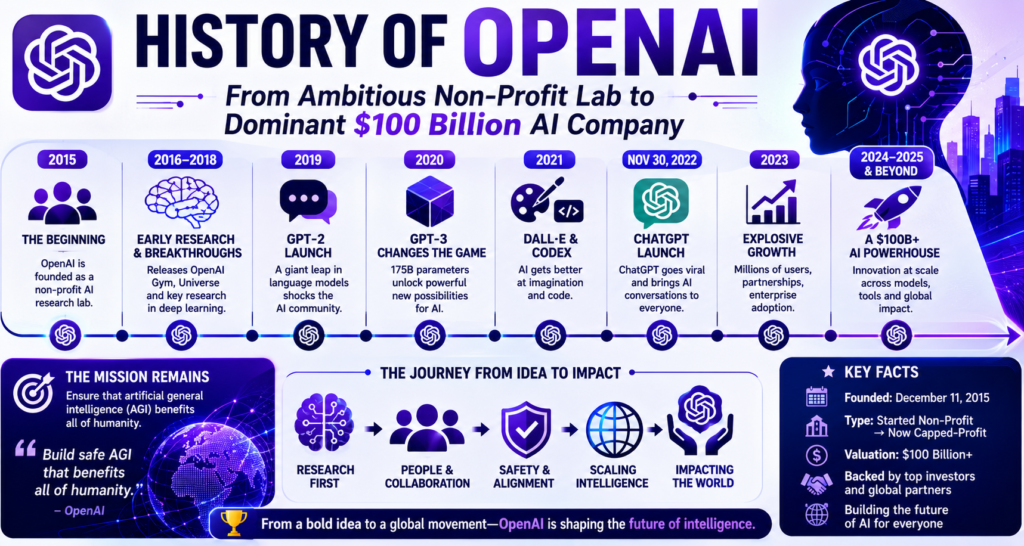
The founding commitment was one billion dollars in pledged contributions, though the actual cash deployed in the early years was substantially less. OpenAI launched as a nonprofit AI research organization with an explicit mission: ensure that artificial general intelligence research would be developed in a way that was safe and that its benefits would be distributed broadly rather than concentrated in the hands of a few powerful entities. This mission placed OpenAI in an unusual position from the very beginning, trying to compete at the frontier of AI research while also committing to openness and public benefit.
The early culture of OpenAI was one of neural network research lab excitement combined with genuine philosophical seriousness about the long-term implications of what the team was working toward. Researchers published their findings openly, experimented across domains from robotics to game playing to language modeling, and operated with a level of transparency that distinguished them sharply from the secretive research operations inside large technology companies.
Early Research and the OpenAI Gym Era (2016 – 2018)
The openai history during its first few years was defined by a broad research agenda rather than a single focused product direction. The organization published influential work on reinforcement learning, releasing the OpenAI Gym toolkit in 2016 as an open-source initiative for developing and benchmarking reinforcement learning algorithms. Researchers at OpenAI demonstrated AI agents that could learn to play video games at superhuman levels and, in a celebrated 2017 demonstration, beat professional human players at the complex strategy game Dota 2 using a system called OpenAI Five.
These early achievements demonstrated that OpenAI could compete at the frontier of AI research. But they also revealed the tension between open-source AI initiatives and the enormous compute infrastructure scaling costs required to do frontier research. Training the systems that achieved these results required massive computational resources that cost far more than the initial philanthropic commitments could sustain indefinitely.
Ilya Sutskever’s OpenAI role as chief scientist was central to the research direction during this period. His deep expertise in neural networks and his conviction about the importance of scale in driving AI capability shaped OpenAI’s early technical choices in ways that would pay off dramatically later. The research team also included John Schulman, who developed Proximal Policy Optimization, the reinforcement learning algorithm that would later become foundational to the RLHF technique used to align ChatGPT.
Elon Musk’s involvement during this period was significant but growing complicated. His public profile gave OpenAI visibility and credibility during its founding years. But tensions developed over strategic direction, and in early 2018 Musk departed from OpenAI’s board, citing potential conflicts of interest with his work at Tesla, which was itself developing AI systems for autonomous vehicles. The openai history records this departure as amicable in public statements, though subsequent years would see Musk become one of OpenAI’s most vocal and contentious critics.
The GPT Breakthrough and the Capped-Profit Pivot (2018 – 2019)
The openai history reached a turning point in 2018 with the publication of GPT-1. The paper demonstrated that pre-training a transformer decoder on large amounts of text and then fine-tuning it for specific tasks could achieve strong performance across a wide range of language benchmarks. This was the beginning of the GPT lineage that would eventually produce ChatGPT, and it set the research direction that would define OpenAI for the next several years.
The gpt models history that followed from this initial paper demonstrated a consistent pattern: each successive model, trained at larger scale on more data, produced qualitatively better outputs. GPT-2 in 2019 was large enough to generate convincingly human-like text, leading OpenAI to stage its release on safety grounds, a decision that generated significant debate about openness vs. caution in AI development.
But the escalating compute costs of frontier research were creating a structural problem. A nonprofit model funded by philanthropy could not sustain the level of investment required to train models at the scale that the scaling laws appeared to demand. The openai history at this point required a fundamental restructuring. In 2019, OpenAI announced the creation of a capped-profit subsidiary, a hybrid structure designed to allow OpenAI to attract venture capital tech funding and employee equity while limiting returns to investors to a maximum of one hundred times their investment and maintaining the nonprofit’s control over the mission.
The commercialization of research that this structure enabled was essential for what came next. The OpenAI transition to capped-profit was controversial within the AI research community, with critics arguing it compromised the organization’s non-profit origins and original commitment to openness. OpenAI defended the move as the only realistic way to fund the scale of compute infrastructure that frontier AI research required.
The Microsoft Partnership and GPT-3 (2019 – 2020)
The most consequential business relationship in the openai history began in July 2019 when Microsoft announced a one-billion-dollar investment in OpenAI and a partnership to develop and commercialize AI technologies. This OpenAI Microsoft partnership history represented a strategic alignment between OpenAI’s research capability and Microsoft’s cloud infrastructure, enterprise relationships, and distribution reach.
The partnership gave OpenAI access to Microsoft Azure’s compute infrastructure at a scale that would have been unaffordable through conventional procurement, while giving Microsoft exclusive access to commercialize OpenAI’s technology in certain categories. For a company whose Bing search engine had been struggling to gain ground against Google for years, the partnership represented a potential strategic breakthrough in the intensifying competition between major technology platforms.
GPT-3 arrived in May 2020 with 175 billion parameters and demonstrated capabilities that stunned the research community. The chatgpt history traces how this model eventually became the foundation for ChatGPT, but the openai history at this moment is also the story of a strategic decision to commercialize GPT-3 through a controlled API rather than releasing it openly. This approach, which generated revenue while maintaining control over the most powerful language model publicly available, was a defining choice that shaped OpenAI’s commercial trajectory.
DALL-E, Codex, and Multimodal Expansion (2021 – 2022)
The openai history between GPT-3 and ChatGPT was not standing still. In January 2021, OpenAI released DALL-E, a model capable of generating images from text descriptions. The DALL-E release history represents OpenAI’s first major expansion beyond language into multimodal AI territory, and it demonstrated that the same transformer-based pre-training approach that worked for text could be adapted to generate images with remarkable creativity and accuracy.
Codex, released in 2021, was a GPT-3 variant fine-tuned specifically on code from public repositories. It became the underlying model for GitHub Copilot, a coding assistant developed through Microsoft’s partnership with OpenAI. GitHub Copilot was one of the first widely deployed commercial applications of large language model technology, introducing millions of software developers to AI-assisted coding and generating substantial revenue for both OpenAI and Microsoft.
InstructGPT, published in January 2022, applied reinforcement learning from human feedback to align a GPT-3 model with human preferences. This was the technical breakthrough that made conversational AI assistants genuinely useful rather than just technically impressive, and it set the stage for the product launch that would change everything.
ChatGPT and the $10 Billion Era (2022 – 2023)
The openai history reached its most consequential moment on November 30, 2022 when ChatGPT launched as a free research preview. Built on GPT-3.5 with RLHF alignment, it became the fastest-growing consumer application in history, reaching 100 million users in two months. For a detailed account of this period, the chatgpt growth 100 million users story captures just how dramatically the launch transformed public awareness of AI.
Microsoft’s response to ChatGPT’s success was rapid and significant. In January 2023, the company announced a multi-year investment reported to be approximately ten billion dollars, extending the original 2019 partnership substantially. Microsoft began integrating GPT-4 into Bing, Office, and a suite of Copilot products across its enterprise software ecosystem. The OpenAI Microsoft partnership history had evolved from a research investment into a full-scale commercial alliance that gave both organizations significant competitive advantages in the accelerating AI arms race.
GPT-4 arrived in March 2023 with meaningfully improved reasoning, multimodal image understanding, and stronger performance across professional benchmarks. The gpt-4 history reflects a model that pushed further on every dimension that GPT-3 had established, while the commercial and competitive pressure surrounding its release reflected how dramatically the landscape had shifted from the quiet research environment of OpenAI’s early years.
The Board Crisis and Corporate Turbulence (November 2023)
The most dramatic episode in the openai history came in November 2023 when OpenAI’s board of directors suddenly and without public explanation fired Sam Altman as chief executive officer. The firing sent shockwaves through Silicon Valley tech startups and the broader technology industry. Within days, the situation had escalated into a full corporate crisis, with the vast majority of OpenAI’s employees signing an open letter threatening to resign and follow Altman to Microsoft if he was not reinstated.
The OpenAI board controversy 2023 was extraordinary not just for its speed but for what it revealed about the tensions built into OpenAI’s unusual corporate structure. The nonprofit board, which retained ultimate governance authority over the organization despite the capped-profit structure, had taken action that the commercial entity’s investors and employees overwhelmingly rejected. The episode exposed deep questions about tech board governance at AI companies, the relationship between safety-focused research governance and commercial imperatives, and the concentration of power in the hands of a small group of board members.
Within five days, Sam Altman was reinstated as chief executive. Several board members resigned and were replaced. The episode left lasting questions about OpenAI’s governance structure and the tensions between its nonprofit mission and its commercial reality. It also demonstrated how essential Sam Altman’s Sam Altman leadership history had become to investor and employee confidence in the organization.
OpenAI’s Research Legacy and What Comes Next
The openai history as an intellectual record is genuinely remarkable regardless of the corporate drama. The organization has published some of the most influential papers in the history of AI research, including the papers that introduced GPT-1 through GPT-4, the InstructGPT alignment paper, the DALL-E and CLIP papers, and the scaling laws paper that gave the field a quantitative framework for predicting how models would improve with scale.
The OpenAI research papers timeline shows an organization that moved from broad reinforcement learning research to a laser focus on large language models and then to multimodal systems, always chasing the frontier of what was possible with current compute infrastructure scaling and the best available training techniques.
The what is rlhf technique that OpenAI developed and published through InstructGPT has become standard practice across the entire industry. Every major AI lab now uses some variant of reinforcement learning from human feedback or a successor technique to align their language models. This is perhaps the most important contribution of the openai history to the broader field: not just the models themselves but the alignment methodology that makes those models deployable.
The future of AI will continue to be shaped significantly by OpenAI, but also by the competitors that OpenAI’s success has called into existence. Anthropic, founded by former OpenAI researchers, is pursuing safety-focused AI development. Google has massively accelerated its own AI research in response to ChatGPT. Meta has released powerful open-weight models that challenge the closed model approach OpenAI has pursued. The openai history is therefore also the history of the AI industry it created.
Frequently Asked Questions (FAQs)
When was OpenAI founded and who founded it?
OpenAI was founded in December 2015 by a group that included Sam Altman, Greg Brockman, Ilya Sutskever, Wojciech Zaremba, John Schulman, and Elon Musk, among others. It launched as a nonprofit AI research organization with one billion dollars in pledged funding and a mission to ensure that artificial general intelligence would benefit all of humanity.
Why did OpenAI change from a non-profit to a for-profit structure?
OpenAI created a capped-profit subsidiary in 2019 because the cost of frontier AI research, particularly the compute required to train large language models, exceeded what philanthropic funding could sustain. The capped-profit structure allowed OpenAI to attract venture capital investment and offer employee equity while theoretically maintaining the nonprofit’s mission-driven governance through its majority ownership of the commercial entity.
What is the relationship between OpenAI and Microsoft?
Microsoft first invested one billion dollars in OpenAI in 2019 and extended that investment to approximately ten billion dollars in 2023. In exchange, Microsoft gained exclusive rights to commercialize OpenAI’s technology in certain categories and access to OpenAI’s models for integration into its products. This partnership produced GitHub Copilot, Bing Chat, and Microsoft Copilot, among other products.
What happened during the OpenAI board crisis in 2023?
In November 2023, OpenAI’s board of directors fired CEO Sam Altman without public explanation. The move triggered an employee revolt, with most of OpenAI’s staff threatening to resign. Microsoft offered Altman a position and signaled it would accommodate OpenAI researchers who followed him. Within five days, Altman was reinstated as CEO. Several board members resigned and the board was restructured.
What are OpenAI’s most important research contributions?
OpenAI’s most influential research contributions include the GPT series of language models, the DALL-E image generation models, the Codex code generation model, the InstructGPT alignment methodology using RLHF, the CLIP vision-language model, and the scaling laws paper that described how AI model performance improves predictably with increased compute, data, and model size.
Conclusion
The openai history is a story about what happens when an ambitious mission collides with the realities of frontier research costs, competitive pressure, and corporate governance in an era of rapidly escalating AI capability. From its idealistic beginnings as a nonprofit trying to ensure AI would benefit humanity, through its transformation into a capped-profit company backed by billions in Microsoft investment, to the boardroom crisis that tested its stability and the ChatGPT launch that changed the world, openai history has been anything but predictable.
What remains consistent throughout the openai history is the organization’s technical ambition and its central role in defining what frontier AI looks like at any given moment. The models OpenAI has built, the alignment techniques it has developed, and the products it has launched have set benchmarks that every other organization in the field measures itself against. Whatever the next chapter brings, the openai history will remain essential reading for anyone seeking to understand how artificial intelligence became the defining technology of the twenty-first century.