Introduction
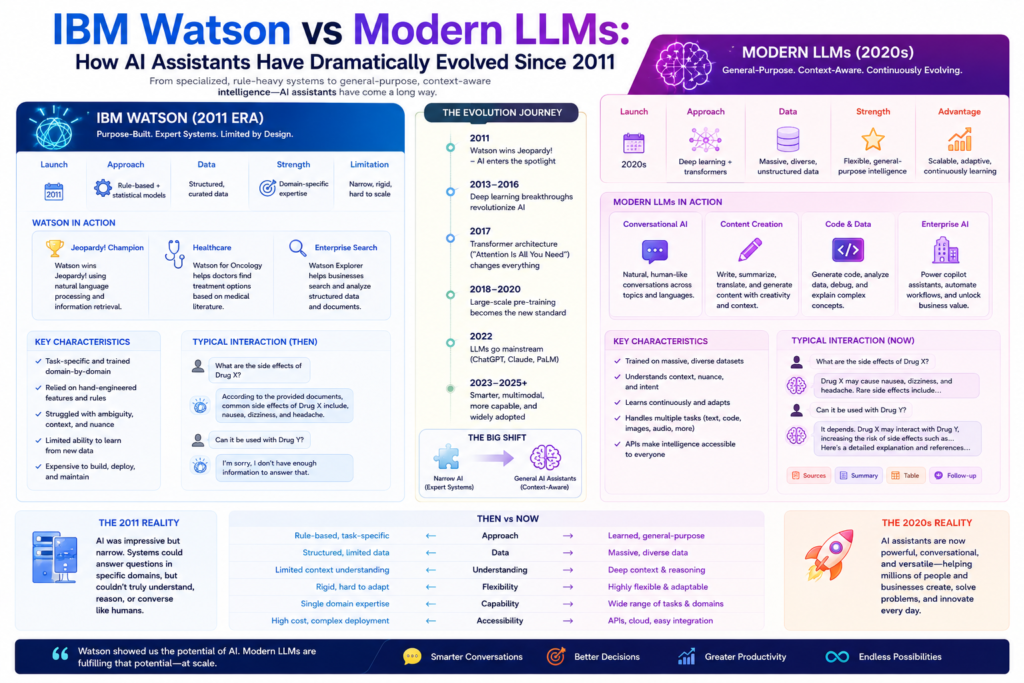
The ibm watson vs llms debate is one of the most illuminating comparisons in the entire history of artificial intelligence. It is a story about two very different visions of what intelligent machines should be, how they should be built, and what problems they should solve. IBM Watson arrived in 2011 as a triumph of rule-based reasoning, information retrieval, and statistical natural language processing, winning Jeopardy! and promising to transform medicine, finance, and business. Modern large language models arrived a decade later with a fundamentally different approach and, for many use cases, dramatically superior results.
Understanding ibm watson vs llms is not simply about declaring a winner. It is about understanding how the philosophy of AI changed, why the transformer architecture displaced the approaches IBM had pioneered, and what Watson’s genuine strengths and documented failures teach us about the limits of both paradigms. The ibm watson vs llms story is ultimately about the evolution of the field and what the shift from structured, curated, expert-guided AI to large-scale self-supervised generative AI means for enterprises, developers, and anyone who wants to understand where AI is heading next.
What IBM Watson Was and How It Was Built (2011 – 2013)
To properly evaluate ibm watson vs llms, you first need to understand what Watson actually was. Watson was not a single product but a system, an ensemble of techniques working together to answer natural language questions by searching through enormous amounts of structured and unstructured data. When Watson competed on Jeopardy! in February 2011 and defeated champions Ken Jennings and Brad Rutter, it demonstrated something genuinely impressive: a machine that could understand the wordplay, cultural references, and indirect phrasing that makes Jeopardy! questions difficult even for highly educated humans.
Watson’s architecture was built on a technique called DeepQA, which combined hundreds of algorithms including information retrieval, knowledge representation, machine learning, and natural language processing to generate candidate answers, score them, and rank them by confidence. It was trained on specific curated datasets including encyclopedias, databases, dictionaries, and domain-specific content. It was rule-based and expert-guided in ways that required significant human curation to set up and maintain.
The history of natural language processing during this era shows how far ahead of its time Watson appeared in 2011. The dominant paradigm in enterprise AI was structured data processing and expert systems. Watson’s ability to handle unstructured natural language at speed was remarkable for the period, and it represented IBM’s most ambitious attempt to prove that machines could engage with the complexity of human language at scale.
The key characteristics that defined Watson in its original form were also the seeds of its later limitations compared to modern large language models. It required extensive human curation of the data it operated on. It needed specific configurations for each domain or use case. It was based on statistical retrieval and scoring rather than on learning generalizable representations from raw text. And it did not generate language. It selected and ranked existing answers rather than producing novel text.
Watson’s Enterprise Ambitions and Documented Struggles (2013 – 2020)
The ibm watson vs llms comparison requires honest engagement with what happened after the Jeopardy! victory. IBM made extremely bold claims about Watson’s potential to transform healthcare, law, finance, and education. Watson for Oncology, a product developed with Memorial Sloan Kettering Cancer Center, was marketed as capable of recommending cancer treatment plans that matched those of expert oncologists. Watson for Discovery promised to transform how legal and research professionals found information. Watson Assistant promised to transform customer service through conversational AI.
The reality of these deployments proved far more complicated than the marketing suggested. Watson for Oncology received significant criticism from oncologists who examined its recommendations and found them sometimes unsafe and often out of date. The fundamental issue was that Watson’s AI tools comparison disadvantage became clear: the system required constant human curation of its training data, and keeping that curation accurate and current in a rapidly evolving medical field proved extremely difficult and expensive. MD Anderson Cancer Center spent approximately sixty million dollars on a Watson-based project that was ultimately cancelled before reaching clinical use.
The Watson NLP vs LLM gap was becoming visible even before large language models existed in their current form. Watson’s approaches to natural language understanding were sophisticated for their era but relied on hand-crafted features, curated ontologies, and expert-defined rules in ways that limited their generalizability. Building a Watson deployment for healthcare oncology required enormous domain expertise to create and validate the knowledge base. Building one for legal research required a completely different knowledge base built with completely different expertise. Each new domain required starting the curation process largely from scratch.
The IBM Watson vs ChatGPT distinction that users would later make explicit was foreshadowed by these enterprise deployment difficulties. Watson was not a system that could generalize from one domain to another. It was a highly capable but highly constrained platform that delivered real value in specific configurations but struggled to deliver the transformative broad impact that IBM’s marketing had promised.
The Transformer Revolution and What It Changed (2017 – 2019)
The ibm watson vs llms story pivots decisively with the emergence of transformer architecture in 2017 and the subsequent development of BERT, GPT, and their successors. Understanding why this shift was so consequential requires understanding what transformers did differently from the approaches that Watson used.
The transformer architecture history shows how self-attention mechanisms replaced the complex pipeline architectures that characterized systems like Watson. Instead of requiring humans to specify how language features should be extracted, categorized, and scored, transformer-based models learned these representations directly from raw text through self-supervised learning on enormous corpora. The deep learning systems that emerged from this approach did not need curated domain-specific training data to get started. They pre-trained on the raw diversity of human language and then transferred that knowledge to specific tasks.
This is the fundamental difference when evaluating ibm watson vs llms as competing philosophies. Watson’s cognitive AI vs LLM contrast is essentially the difference between machine intelligence built on human-curated knowledge and machine intelligence built on patterns extracted from raw language at scale. Watson needed humans to tell it what mattered. Large language models discovered what mattered by being trained to predict text across billions of examples.
The neural language models that emerged from transformer-based pre-training could generalize in ways that Watson could not. A BERT model pre-trained on Wikipedia and books could be fine-tuned to perform legal document analysis, medical question answering, customer service dialogue, and code generation with relatively small amounts of task-specific data. Watson required separate, extensive expert curation for each of these domains. The IBM Watson alternatives that developers and enterprises began exploring after ChatGPT demonstrated what modern large language models could do were not replacing Watson feature by feature. They were replacing the entire paradigm with something fundamentally more flexible.
The IBM Watson Machine Learning Platform Response (2020 – 2023)
IBM did not stand still as the transformer revolution unfolded. The ibm watson vs llms story is more nuanced than a simple narrative of displacement because IBM actively worked to incorporate modern deep learning techniques into its Watson platform. Watson NLP, Watson Discovery, and Watson Assistant were all updated to incorporate transformer-based language understanding, and IBM launched its watsonx platform in 2023 as a comprehensive enterprise AI foundation model platform.
The Watson machine learning platform evolved significantly through this period. IBM integrated large language model capabilities including models from its own research, including foundation models like Granite, as well as partnerships with open-source model providers, into watsonx. The platform positioned itself explicitly as an enterprise-grade alternative to raw API access to models like GPT-4, emphasizing governance, explainability, data lineage, and compliance features that IBM argued were essential for regulated industries like healthcare, finance, and government.
The enterprise AI comparison that IBM made between its watsonx platform and consumer-oriented generative AI platforms centered on these governance and trust features. IBM argued that enterprises deploying AI for consequential decisions needed AI automation tools that could explain their outputs, maintain audit trails, enforce data policies, and comply with regulatory requirements in ways that consumer LLM APIs were not designed to support. This argument had genuine merit for certain categories of enterprise deployment, particularly in highly regulated industries.
The LLMs vs traditional AI framing that IBM adopted was strategic: rather than positioning Watson as a direct competitor to ChatGPT for general use cases, IBM positioned watsonx as the responsible choice for enterprises that needed AI embedded in business processes with appropriate governance. This was a defensible position, though it also represented a significant retreat from the broader ambitions that had characterized Watson’s original marketing.
Head-to-Head: Where Watson Still Leads and Where LLMs Win
The ibm watson vs llms comparison is most useful when applied to specific use case categories rather than treated as a global verdict. Each approach has genuine strengths that the other lacks, and the right tool depends critically on what problem you are trying to solve.
Watson and the watsonx platform retain meaningful advantages in certain enterprise scenarios. For organizations that need explainable AI outputs where the model can trace its reasoning to specific sources and data points, Watson’s structured approaches provide more transparency than most generative AI models. For highly regulated industries where data governance, audit trails, and compliance with specific regulatory frameworks are non-negotiable, IBM’s enterprise-focused platform offers features that general-purpose LLM APIs do not match out of the box. And for organizations with proprietary structured data that needs to be integrated into AI workflows without exposing it to third-party model providers, Watson’s on-premises and private cloud deployment options provide control that consumer AI platforms cannot.
Modern large language models and the generative AI platforms built on them have decisive advantages in other scenarios. Natural language generation, text summarization, code generation, conversational AI systems, and creative applications all favor LLM approaches because these models produce novel, contextually appropriate language rather than retrieving and ranking existing text. The gpt models history shows how dramatically capability in these areas has advanced, and how far beyond Watson’s original design the current generation of models operates.
For knowledge workers who need an AI assistant that can engage flexibly across many domains without extensive prior configuration, modern foundation models are dramatically more practical than Watson-style systems. The in-context learning capabilities of models like GPT-4 and Claude allow users to give instructions and examples in plain language and receive useful results without any configuration, expert curation, or model fine-tuning. Watson required all of these before it could deliver meaningful results in a new domain.
The IBM Watson Assistant vs LLM comparison in customer service contexts illustrates this well. Watson Assistant could be configured with specific intents, entities, and dialogue flows to handle a defined set of customer queries reliably and predictably. A modern LLM-based conversational AI system can handle a much wider range of queries more naturally, but with less predictable behavior in edge cases. Each approach suits different organizational risk tolerances and use case requirements.
The Large Language Model Comparison in Enterprise Adoption
The broader enterprise AI comparison between Watson-era approaches and modern LLM approaches has produced clear patterns in enterprise adoption since 2023. Organizations that had built Watson deployments found themselves reevaluating their AI strategies as GPT-4-class models became available through commercial APIs. The question was not simply which technology was better in the abstract but which combination of capability, cost, governance, and integration would serve specific business requirements.
The chatgpt history shows how ChatGPT’s launch created immediate pressure on enterprise AI vendors including IBM to demonstrate why their platforms remained relevant in a world where extraordinarily capable AI was available through a simple API. IBM’s response through the watsonx platform was substantive but required significant repositioning from the ambitious transformation narrative of Watson’s early years.
Predictive analytics AI remained an area where IBM’s traditional strengths in structured data analysis and business intelligence complemented rather than competed with LLM capabilities. Foundation models are not primarily tools for predictive analytics over structured tabular data. Watson and IBM’s broader data and analytics portfolio retained real value in this domain even as the natural language processing and generation use cases shifted toward LLM approaches.
The llm timeline places the ibm watson vs llms story within a broader arc that shows how quickly the field moved from Watson’s curated, structured approach to the massive scale pre-training paradigm that now dominates. The speed of that transition was remarkable, and IBM’s response, while genuine and substantive, could not fully match the pace of capability development happening at OpenAI, Google, and Anthropic.
The future of AI in enterprise deployments will likely see continued convergence between the governance and explainability features that IBM has championed and the generative capability that modern LLMs provide. IBM’s watsonx platform is moving in this direction, and the market pressure from enterprises that need both capability and governance will continue to drive development across the industry.
FAQs
What was IBM Watson and what made it famous?
IBM Watson was an AI system developed by IBM that became famous by defeating human champions on the quiz show Jeopardy! in February 2011. It used a combination of natural language processing, information retrieval, knowledge representation, and machine learning algorithms to answer questions. Watson demonstrated that machines could handle the wordplay and indirect phrasing of Jeopardy! questions, which was a significant milestone for AI at the time.
How is IBM Watson different from ChatGPT and modern LLMs?
IBM Watson was built on curated knowledge bases and statistical retrieval systems that required extensive human configuration for each deployment domain. Modern LLMs like ChatGPT are trained on massive amounts of raw text through self-supervised learning and can generalize across domains without domain-specific curation. Watson selected and ranked existing answers. LLMs generate new text. Watson needed expert setup. LLMs work from general instructions. Watson excelled at structured retrieval. LLMs excel at flexible generation.
Why did IBM Watson fail to deliver on its healthcare promises?
Watson for Oncology and other healthcare applications struggled because maintaining accurate, current, expert-validated knowledge bases proved far more difficult and expensive than anticipated. The system required constant human curation from domain experts, and keeping that curation current in rapidly evolving medical fields was unsustainable at scale. Some Watson recommendations were found to be unsafe or outdated by clinicians who reviewed them, leading to project cancellations including a high-profile termination at MD Anderson Cancer Center.
Is IBM Watson still relevant in the age of LLMs?
Yes, IBM Watson and the broader watsonx platform remain relevant for specific enterprise use cases where explainability, data governance, regulatory compliance, and on-premises deployment are important requirements. IBM has incorporated large language model capabilities into its platform, including its own Granite foundation models, and positions watsonx as an enterprise-grade AI platform with governance features that general-purpose LLM APIs do not match. Watson’s relevance has narrowed but not disappeared.
Which is better for enterprise use: Watson or modern LLMs?
The answer depends entirely on the specific use case and organizational requirements. Modern LLMs are better for flexible natural language generation, broad domain coverage, conversational AI, code generation, and use cases where users need to interact in natural language without extensive prior configuration. Watson and the watsonx platform offer advantages in highly regulated industries, use cases requiring explainability and audit trails, structured data integration, and environments where data governance and compliance are non-negotiable priorities. Many enterprises use both in different parts of their operations.
Conclusion
The ibm watson vs llms comparison is not a story with a simple winner. It is a story about the evolution of AI paradigms, about what happens when a fundamentally new approach demonstrates capabilities that the previous approach cannot match, and about how established organizations respond when the foundations of their technology strategy shift beneath them.
IBM Watson vs LLMs illuminates the gap between curated, structured, expert-guided AI and self-supervised learning at massive scale. Watson was extraordinary for its time, and the Jeopardy! victory genuinely advanced what people believed machines could do. But the transformer revolution and the development of foundation models created a new paradigm where the ibm watson vs llms distinction became less about one being wrong and more about each being designed for fundamentally different assumptions about how AI should acquire and apply knowledge.
The ibm watson vs llms conversation will continue as both approaches evolve. IBM is incorporating modern LLM capabilities into its platform. LLM providers are developing better governance and enterprise integration features. The future of enterprise AI will be shaped by whoever best combines the generative capability that modern foundation models provide with the trust, transparency, and governance that enterprise deployments require. That is a race in which Watson’s history offers valuable lessons about both what is possible and what is hard.