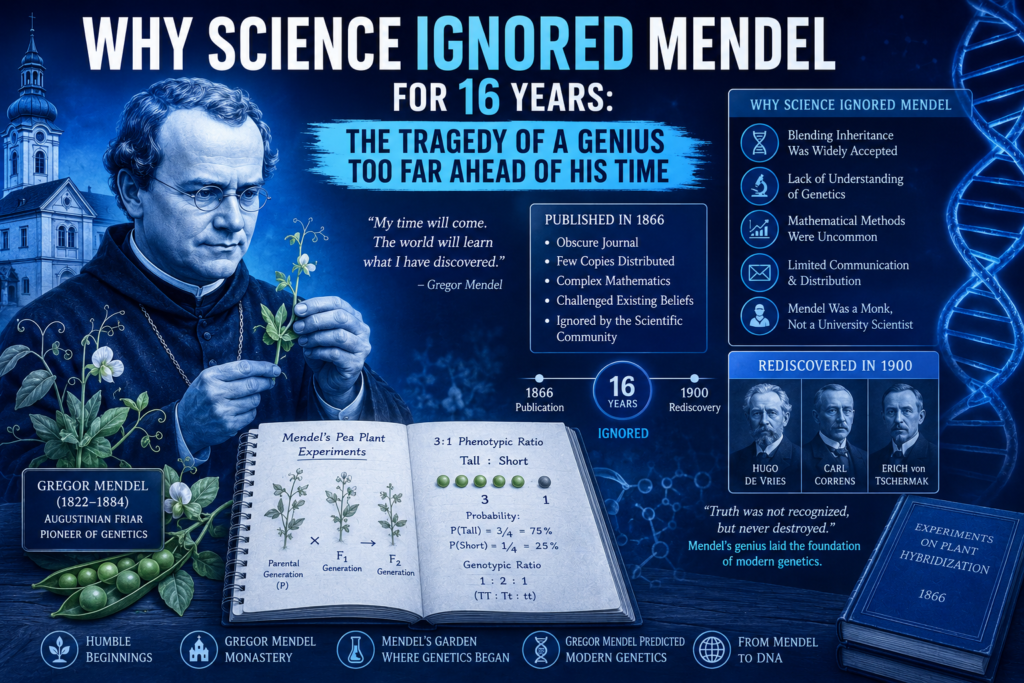
The story of why science ignored mendel is one of the most fascinating and heartbreaking episodes in scientific history. Today, Gregor Mendel is celebrated as the father of genetics. His discoveries form the foundation of modern biology, medicine, agriculture, and genetic engineering. Yet when he published his revolutionary findings in 1866, almost nobody paid attention.
The mystery of why science ignored mendel continues to intrigue historians. How could one of the most important scientific papers ever written remain largely unnoticed? Why did the scientific community fail to recognize evidence that would eventually transform biology forever?
The answer involves a combination of scientific biases, communication failures, intellectual limitations, and the unfortunate reality that Mendel’s ideas were simply too advanced for his era. The tragedy of why science ignored mendel demonstrates that even groundbreaking discoveries can be overlooked when the world is not ready to understand them.
Gregor Mendel and His Revolutionary Discovery (1856 – 1866)
Gregor Mendel spent years studying inheritance through carefully controlled pea plant experiments. Working within a monastery in Brno, he crossed different varieties of peas and recorded the outcomes with extraordinary precision.
Unlike many scientists of his time, Mendel relied heavily on mathematics. He counted thousands of plants and analyzed numerical patterns that emerged across generations.
His observations led him to formulate principles that later became the foundation of genetics.
The importance of why science ignored mendel becomes clear when we understand how revolutionary these discoveries actually were.
The Scientific World Before Mendel
To understand why science ignored mendel, we must first understand the scientific environment of the nineteenth century.
Biology during this period was largely descriptive.
Scientists focused on:
- Classifying species
- Observing plants and animals
- Recording physical characteristics
- Describing natural phenomena
Quantitative biology was still uncommon.
Most biologists preferred qualitative vs quantitative biology approaches. They trusted observation more than mathematical analysis.
As a result, Mendel’s statistical methods seemed unusual and unfamiliar.
This mathematical biology skepticism would become one of the major reasons his work was overlooked.
Mendel’s Groundbreaking Paper (1866)
In 1866, Mendel published his famous paper:
“Versuche über Pflanzen-Hybriden” (Experiments on Plant Hybridization)
The distribution of Versuche über Pflanzen-Hybriden was extremely limited.
Only a small number of copies reached scientific institutions.
Today, historians studying why science ignored mendel often point to this obscure journal publication as a critical factor.
The paper appeared in the Proceedings of the Natural History Society of Brno rather than a widely read scientific journal.
As a result, many leading scientists never even saw it.
The Mathematics That Confused Biologists
One major reason why science ignored mendel was the mathematical nature of his work.
Consider one of his simplest experiments:
Tall Plant (TT) × Short Plant (tt)
First Generation:
TT × tt
Result:
All offspring = Tt
100% Tall
Second Generation:
Tt × Tt
Possible outcomes:
TT, Tt, Tt, tt
Genotypic Ratio:
1 : 2 : 1
Phenotypic Ratio:
3 : 1
Probability:
P(Tall) = 3/4 = 75%
P(Short) = 1/4 = 25%
These numerical relationships later became central to genetics.
However, many nineteenth century biologists were uncomfortable with probability and statistical reasoning.
The scientific community simply was not accustomed to seeing mathematics used to explain biological inheritance.
The Problem of Blending Inheritance Dogma
Another key factor in why science ignored mendel was the widespread acceptance of blending inheritance dogma.
Most scientists believed offspring inherited traits through blending.
According to this idea:
Red trait + White trait = Pink trait
Characteristics were thought to merge permanently.
Mendel’s observations directly contradicted this belief.
His research suggested hereditary factors remained separate and could reappear unchanged in future generations.
This conceptual leap challenged established thinking.
Many scientists found it difficult to accept.
Cell Theory Limitations and Microscopy Constraints
Modern genetics makes sense because we understand chromosomes and DNA.
Mendel did not.
Neither did his contemporaries.
The cell theory limitations of the nineteenth century made it difficult to explain inheritance mechanisms.
Scientists had no evidence for:
- Genes
- Chromosomes
- DNA
- Molecular heredity
Microscopy constraints prevented researchers from observing structures involved in inheritance.
As a result, Mendel’s conclusions seemed abstract and unsupported.
One reason why science ignored mendel was that his theory lacked a visible biological mechanism.
A Discovery Ahead of Its Time
Historians often describe Mendel’s work as ahead-of-its-time science.
His findings anticipated developments that would not occur until decades later.
This created a serious problem.
Scientific ideas are usually accepted when they fit existing knowledge.
Mendel’s discoveries did not.
Instead, they demanded a paradigmatic shift in biological thinking.
Such transformations rarely occur quickly.
The challenge of why science ignored mendel illustrates how difficult it can be for science to adopt revolutionary ideas.
Lack of Academic Credentials
Another factor contributing to why science ignored mendel was his professional status.
Mendel was not employed by a famous university.
He was a monk.
Many leading researchers viewed him as an outsider.
The lack of academic credentials associated with his position reduced the visibility of his work.
Although unfair, scientific reputation often influences whether discoveries receive attention.
His monastery background caused some researchers to underestimate the significance of his findings.
Lack of Professional Network
Modern scientists share discoveries through conferences, journals, universities, and international collaborations.
Mendel had a much smaller audience.
The lack of professional network limited the reach of his work.
While he corresponded with a few scientists, he lacked strong connections to Europe’s most influential biological researchers.
This isolation contributed significantly to why science ignored mendel.
Even groundbreaking discoveries require effective communication.
Why Mendel’s Ideas Were Difficult to Understand
The tragedy of why science ignored mendel was not simply that scientists rejected his work.
Many failed to understand it.
His concepts involved abstract hereditary factors.
He argued that inheritance followed mathematical patterns rather than visual blending.
For researchers accustomed to descriptive biology, this framework seemed strange.
The gap between Mendel’s thinking and contemporary biology was enormous.
His work required a new way of viewing life itself.
Mendel’s Later Years (1868 – 1884)
In 1868, Mendel became abbot of his monastery.
Administrative responsibilities consumed much of his time.
As years passed, he conducted fewer scientific investigations.
Unfortunately, he never witnessed widespread recognition of his discoveries.
The story of why science ignored mendel becomes even more tragic when we remember that he died in 1884 without knowing the true significance of his work.
His greatest achievement remained largely unnoticed.
Historical Peer Review Failures
Many historians view the case as one of history’s greatest historical peer review failures.
The paper was available.
The data were accurate.
The conclusions were correct.
Yet the scientific community failed to appreciate its importance.
This example continues to be cited when discussing scientific community oversights and premature scientific discoveries.
The failure was not Mendel’s.
The failure belonged to the scientific world that overlooked him.
The Rediscovery of Mendel’s Laws (1900 – 1905)
Everything changed in 1900.
Three scientists independently arrived at conclusions similar to Mendel’s:
- Hugo de Vries Carl Correns
- Erich von Tschermak
While conducting their own experiments, they encountered Mendel’s earlier work.
They quickly realized that Mendel had already solved the problem decades before.
The Rediscovery of Mendel’s laws triggered what historians now call the 1900 genetic revolution.
The answer to why science ignored mendel finally began to change.
Scientists started recognizing the brilliance of his discoveries.
Gregor Mendel Predicted Modern Genetics
The statement that Gregor Mendel predicted modern genetics is remarkably accurate.
Mendel never saw chromosomes.
He never understood DNA.
Yet his mathematical models accurately described inheritance patterns.
His research correctly predicted:
- Genetic segregation
- Dominance relationships
- Recessive inheritance
- Independent transmission of traits
Modern genetics repeatedly confirmed his conclusions.
The irony of why science ignored mendel is that history eventually proved he was right all along.
The Path From Mendel to DNA
One of the greatest scientific journeys in history is from mendel to DNA.
Mendel identified inheritance patterns.
Scientists later discovered chromosomes.
Researchers eventually uncovered DNA.
Each major advance built upon foundations established by Mendel.
Without his work, modern genetics would likely have progressed much more slowly.
The legacy of why science ignored mendel reminds us how easily scientific progress can be delayed.
Mendel and Darwin: A Missed Opportunity
An interesting historical connection involves mendel and darwin.
Both men investigated fundamental questions about heredity.
Darwin explained natural selection.
Mendel explained inheritance.
Had their ideas been successfully combined during their lifetimes, biology might have advanced decades earlier.
Instead, the scientific world failed to connect these complementary discoveries.
This missed opportunity remains one of the most fascinating aspects of nineteenth century science.
Posthumous Vindication and Scientific Recognition
Eventually, Mendel received the recognition he deserved.
His discoveries became the basis for:
- Classical genetics
- Molecular genetics
- Genomics
- Biotechnology
- Gene therapy
This posthumous vindication transformed his reputation from obscure monk to scientific giant.
Today, every genetics textbook reflects principles he discovered.
The tragedy of why science ignored mendel ultimately became a story of triumph.
Truth prevailed, even if it arrived too late for Mendel himself.
Lessons for Modern Science
The story of why science ignored mendel offers valuable lessons.
Scientists must remain open to unconventional ideas.
Revolutionary discoveries often emerge from unexpected places.
Innovative research can appear strange before it becomes accepted.
History shows that consensus is not always correct.
Mendel’s experience reminds us that evidence matters more than reputation, status, or popularity.
His work stands as one of the greatest examples of intellectual courage in scientific history.
FAQs
Why did scientists ignore Mendel’s work?
Scientists largely ignored his work because it was highly mathematical, published in an obscure journal, and conflicted with accepted theories of inheritance.
How long was Mendel’s work ignored?
His discoveries remained largely unnoticed for approximately 34 years until their rediscovery in 1900.
What was the biggest obstacle to accepting Mendel’s ideas?
The biggest obstacle was the widespread belief in blending inheritance and the lack of understanding of genes and chromosomes.
Who rediscovered Mendel’s research?
Hugo de Vries, Carl Correns, and Erich von Tschermak independently rediscovered Mendel’s principles around 1900.
Why is Mendel considered ahead of his time?
His theories accurately described inheritance decades before scientists discovered chromosomes and DNA.
How did Mendel influence modern genetics?
His research established the fundamental principles that became the basis of modern genetic science.
Conclusion
The story of why science ignored mendel remains one of the most powerful lessons in scientific history. Gregor Mendel produced evidence that fundamentally transformed biology, yet his contemporaries failed to recognize its significance. Mathematical biology skepticism, limited communication networks, scientific biases, and technological limitations all contributed to the neglect of his work.
Despite this tragic delay, Mendel’s discoveries eventually reshaped our understanding of life itself. His principles became the foundation of genetics, proving that great ideas can survive even when initially ignored. The story is both a warning and an inspiration: scientific truth may sometimes be overlooked, but genuine discoveries ultimately find their place in history.