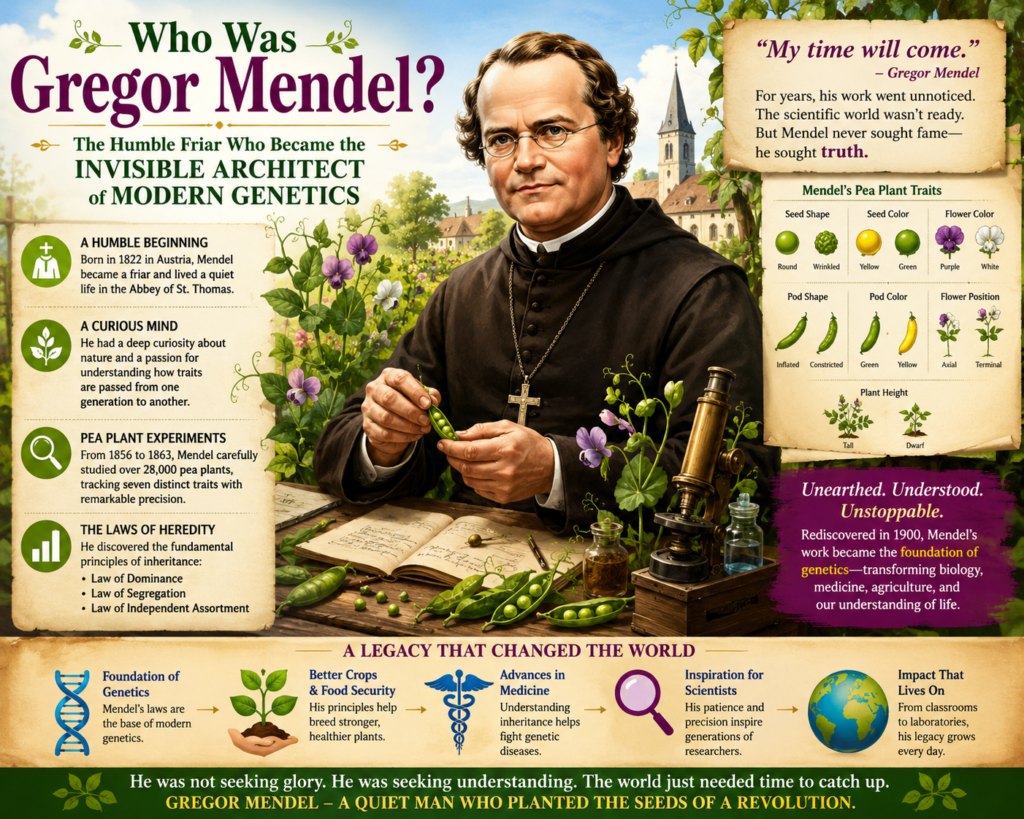
Every cornerstone of modern biological science traces its roots back to a quiet, sunlit monastery garden in Brno. Inside those stone walls, a patient monk methodically unraveled the deepest secrets of life. Today, the world honors him as the father of modern genetics, a visionary thinker who saw mathematical patterns where others only saw random variation. Yet, during his lifetime, his radical discoveries were met with complete silence. He lived as an obscure teacher and administrator, completely unaware that his careful notes would one day transform medicine, agriculture, and biotechnology forever.
To understand the magnitude of his triumph, one must look past the textbook diagrams and enter the world of a man who blended meticulous physics with hands-on botany. He was not a lonely amateur playing with plants, but a highly educated, deeply disciplined investigator. His journey from a poverty-stricken farm boy to a scientific titan is a story of resilience, brilliant insight, and an unwavering commitment to the scientific method.
The Early Life and Education of a Brilliant Mind (1822 – 1843)
Born on July 22, 1822, in the small village of Heinzendorf, then part of the Austrian Empire, Johann Mendel grew up with a deep connection to the land. His family struggled with poverty, working hard on their farm to make a living. From an early age, young Johann showed an exceptional aptitude for learning, particularly in the natural sciences. His local village schoolmaster noticed his quick mind and recommended that he continue his education, a path that placed immense financial strain on his family.
He attended the Philosophical Institute of the University of Olomouc, where he excelled in physics and mathematics. However, the crushing weight of financial hardship and frequent bouts of illness threatened to cut his academic journey short. Realizing that he could not afford to continue his studies independently, a dedicated professor suggested he join the Augustinian Order. In 1843, he entered St. Thomas’s Abbey in Brno, Moravia, taking the name Gregor. This decision was not merely spiritual; it was a practical choice that gave him access to a vibrant community of intellectuals, an extensive library, and the financial stability required to pursue research.
Scientific Awakening at the University of Vienna (1851 – 1853)
The monastery was far from isolated from the scientific world. In fact, it was a hub of intellectual life, deeply tied to the local agricultural society. Recognizing his talent, the Abbot sent Mendel to the University of Vienna to deepen his scientific training. This period proved to be the true turning point in his life, shaping the exact methods he would later use to transform biology.
At the university, he studied physics under Christian Doppler, the famous physicist who discovered the Doppler effect. From Doppler, he learned the absolute necessity of using mathematics and statistical analysis to explain physical phenomena. He also studied botany under Franz Unger, who introduced him to the latest ideas regarding plant cells and hybridization. Unger openly challenged the traditional view that species were completely fixed, suggesting that plants changed over time through variation. Armed with a rare combination of physical precision and botanical curiosity, the young friar returned to Brno ready to design an experiment that would change science forever.
Cultivating Truth in the Monastery Garden (1854 – 1863)
Upon returning to the abbey, he turned his attention to the quiet plots of land known as mendel’s garden. Between 1856 and 1863, this small space became the testing ground for an epic scientific investigation. At the time, 19th-century biologists widely accepted the blending theory of inheritance, which claimed that offspring traits were a simple, smooth mix of parental features, much like mixing red and blue paint to get purple. He suspected this theory was fundamentally flawed.
To test his ideas, he needed a model organism that was easy to grow, produced offspring quickly, and possessed clear, distinct variations. He chose the common pea plant, Pisum sativum. This choice was a masterclass in experimental design. Pea plants could easily self-pollinate or be cross-pollinated by hand, allowing him to maintain absolute control over the parentage of every single generation. Over eight years, he carefully raised and tracked over 28,000 pea plants, cataloging seven distinct, easily identifiable traits, including plant height, seed shape, and flower color.
The Masterpiece of Pea Plant Experiments
The heart of his success lay in his brilliant decision to focus on one single trait at a time, creating what scientists call a monohybrid cross. He began by breeding pure-breeding lines, ensuring that tall plants always produced tall offspring, and short plants always produced short offspring. Once these lines were stabilized, he crossed a pure tall plant with a pure short plant.
According to the popular blending theory of his era, the resulting generation should have been medium-sized. Instead, the results were shocking. Every single plant in this first filial generation grew completely tall. The short trait seemed to have vanished into thin air. He did not stop there. He allowed these new tall plants to self-pollinate, creating the second filial generation.
When he looked at the next generation, the short trait reappeared out of nowhere. Out of 1,064 plants in this generation, 787 were tall and 277 were short. This clear, repeatable pattern proved that traits do not blend like liquids. Instead, they are passed down as distinct, unchanging particles that remain independent across generations. He proved that the father of modern genetics had unlocked a universal rule of inheritance.
The Precise Mathematics of Heredity
To make sense of his massive mountain of experimental data, he turned to the statistical training he received in Vienna. When he analyzed the numbers from his second generation, he discovered a striking mathematical relationship that appeared across all seven traits he tracked.
The ratio of the visible trait to the hidden trait was always approximately 3:1. For example, when studying seed shape, he counted 5,474 round seeds and 1,850 wrinkled seeds, which simplifies directly to a ratio of 2.96:1. For yellow versus green seeds, he counted 6,022 yellow and 2,001 green, yielding a ratio of 3.01:1.
To explain this mathematical consistency, he developed a brilliant algebraic model. He proposed that each plant contains two hereditary units for a trait, one inherited from each parent. Let A represent the dominant unit (such as tallness) and a represent the recessive unit (such as shortness). When the first generation of hybrids self-pollinates, the combination of these hereditary units can be mathematically expressed through a simple polynomial expansion:
(A+a)(A+a)=A2+2Aa+a2
This algebraic expression reveals the true genetic breakdown hidden beneath the surface:
- 1 part pure dominant (AA): Visually tall
- 2 parts hybrid (Aa): Visually tall, but carrying the hidden recessive unit
- 1 part pure recessive (aa): Visually short
This elegant formula shows exactly why the physical appearance results in a 3:1 ratio, while the underlying genetic reality is a perfectly balanced 1:2:1 distribution. It was an astonishing achievement, marking the first time in human history that the chaotic world of biology was tamed by precise mathematical laws.
                  Parent 1 (Aa)
                  +-----+-----+
                  |  A  |  a  |
            +-----+-----+-----+
            |  A  | AA  | Aa  |
  Parent 2  +-----+-----+-----+
    (Aa)    |  a  | Aa  | aa  |
            +-----+-----+-----+
Formulating the Timeless Laws of Inheritance
His rigorous work with the mathematics of heredity led him to formulate three fundamental principles that serve as the foundation of biological inheritance history. These principles explained how traits could hide for a generation and return later with flawless mathematical predictability.
The Law of Dominance
This principle states that in a hybrid individual, one hereditary unit can completely mask or hide the expression of another. The trait that shows up is the dominant trait, while the hidden one is the recessive trait. This explained why the first generation of his cross looked identical to only one of the parents.
The Law of Segregation
This law states that during the formation of reproductive cells, the two hereditary units possessed by a parent separate completely from one another. Each reproductive cell receives only one unit. This clean separation ensures that the units remain pure and unblended, allowing the recessive trait to reappear perfectly intact in later generations.
The Law of Independent Assortment
To test how different traits interacted, he conducted a dihybrid cross, tracking two characteristics at the same time, such as seed shape and seed color. He discovered that the inheritance of one trait has absolutely no influence on the inheritance of another. The units for seed color separate entirely independently from the units for seed shape, resulting in a predictable phenotypic ratio of 9:3:3:1.
Why the 19th-Century Scientific Community Ignored a Genius
In 1865, Johann Gregor Mendel proudly presented his groundbreaking paper, Versuche über Pflanzen-Hybriden (Experiments on Plant Hybridization), to the Natural History Society of Brünn. It was published the following year. He had found the foundational rules of biology, yet the scientific world responded with complete indifference. His work was cited only a handful of times over the next few decades, falling into deep obscurity.
Several factors caused this tragic scientific isolation. First, he was a modest monk working in Moravia, far removed from the major scientific capitals of Europe like London, Paris, or Berlin. Second, his heavy reliance on mathematics and probability theory was completely foreign to 19th-century biologists, who were used to descriptive, non-mathematical science.
Furthermore, he attempted to share his findings with Carl Nageli, a prominent Swiss botanist of the time. Nageli failed to grasp the genius of the work, viewing it as an interesting but localized anomaly. He dismissed the findings and encouraged the friar to test his theories on hawkweed plants. Unbeknownst to either man, hawkweed reproduces asexually through a process that bypasses normal fertilization, making it impossible to replicate the results found in peas. This frustrating setback shook the humble monk’s confidence and slowed his botanical research.
       Mendel's Breakthrough (1865)
                    │
                    ▼
     [ Years of Absolute Silence ]  ◄── Due to geographic isolation
                    │                      and radical use of math
                    ▼
       Rediscovery of Work (1900)
From Scientific Isolation to Posthumous Glory (1868 – 1900)
In 1868, his scientific journey came to an end when he was elected Abbot of St. Thomas’s Abbey. The heavy burden of administrative duties, combined with a long, exhausting legal tax dispute with the local government, consumed his time and energy. He shifted his focus to meteorology and bee breeding, but he never completely abandoned his scientific mindset.
He passed away on January 6, 1884, at the age of 61. He was deeply mourned by the local community for his kindness, generosity, and administrative leadership, but his world-changing scientific work remained completely unrecognized. He died in obscurity, never knowing if his years of tedious work in the garden mattered. Yet, he remained strangely confident. He reportedly told his friends, “My time will surely come.”
That prophecy came true in the spring of 1900. Three independent European scientists—Hugo de Vries, Carl Correns, and Erich von Tschermak—all ran across his original paper while conducting their own plant breeding experiments. Each scientist realized that the modest Augustinian friar science had scooped them by more than three decades. The scientific world was finally ready to listen, and his work was rapidly elevated from obscurity to fame.
Frequently Asked Questions (FAQs)
Why did Gregor Mendel choose pea plants for his experiments?
He selected pea plants because they possess distinct, easily observable traits that do not have intermediate forms. They also have a short life cycle, produce large numbers of offspring, and their reproduction can be controlled easily through artificial pollination or self-pollination.
What is the difference between a monohybrid cross and a dihybrid cross?
A monohybrid cross involves tracking the inheritance of a single trait, such as plant height, across generations. A dihybrid cross tracks the inheritance of two traits simultaneously, such as seed shape and seed color, to determine if they influence each other.
Why was Mendel’s work ignored for over thirty-five years?
His work was ignored because he used complex mathematical analysis in a field that was purely descriptive at the time. Additionally, he lived far from major scientific centers, and influential scientists of his era failed to understand his results.
Did Gregor Mendel know about DNA or chromosomes?
No, he had no knowledge of DNA, genes, or chromosomes. He used the term “hereditary factors” or “units” to describe the physical entities passed down from parents to offspring. The actual physical connection between his laws and DNA was established decades after his death.
The Immortal Legacy of the Father of Modern Genetics
The rediscovery of his work in 1900 sparked a massive revolution in biology. In the decades that followed, scientists connected his mathematical laws to the physical behavior of chromosomes inside cells. This powerful combination laid the groundwork for the Modern Synthesis, beautifully merging the concept of natural selection with Mendelian inheritance basics. The mysterious “hereditary units” he carefully tracked in his garden plots are what we now call genes.
Today, every major advancement in modern biology—from mapping the human genome and editing genes to developing life-saving personalized medicines and engineering resilient crops—rests firmly on the foundation laid by a quiet friar in a monastery garden. He proved that the chaotic, beautiful diversity of life is guided by elegant mathematical order. Against all odds, Gregor Mendel predicted modern genetics through patient observation, unyielding discipline, and absolute creative genius, leaving behind a triumphant legacy that will inspire humanity for generations to come.