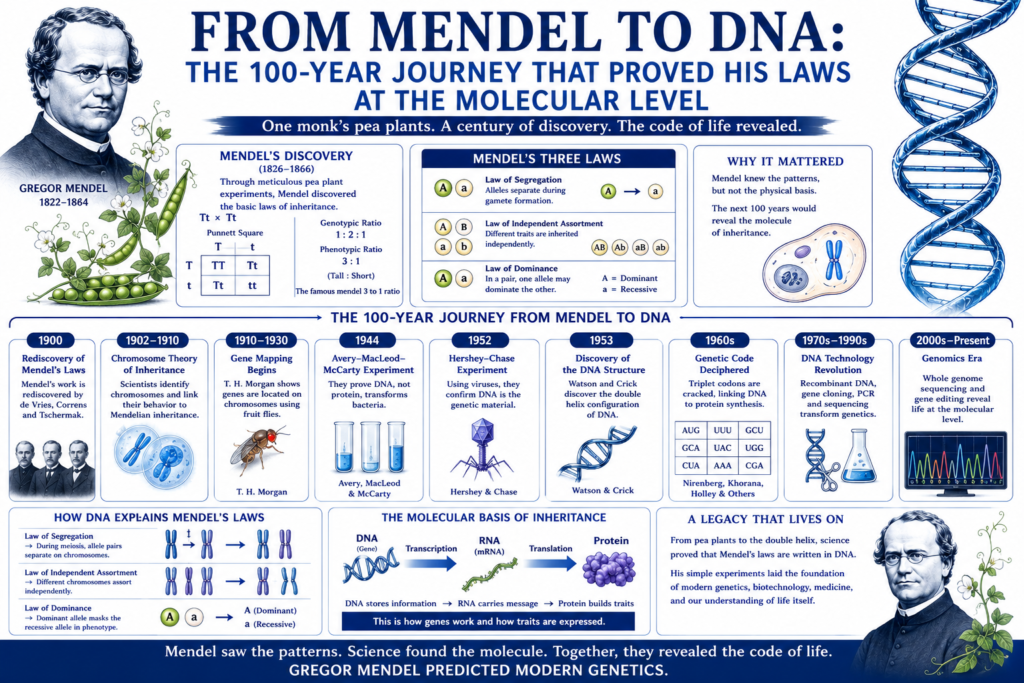
The story of from mendel to DNA is one of the most extraordinary scientific journeys ever undertaken. When Gregor Mendel published his experiments on pea plants in 1866, he had no idea that future generations of scientists would spend nearly a century uncovering the physical and chemical foundations of his inheritance laws. Mendel understood how traits were passed from one generation to another, but he did not know what carried that information or where hereditary factors existed within living cells.
The remarkable journey of from mendel to DNA transformed biology forever. It connected Mendel’s mathematical observations with chromosomes, genes, and eventually DNA itself. This scientific adventure revealed the molecular basis of inheritance and proved that Mendel’s ideas were astonishingly accurate.
Today, every aspect of modern genetics, biotechnology, medicine, and genomics rests upon discoveries made during the historic path of from mendel to DNA.
Mendel’s Original Discovery (1856 – 1866)
The story of from mendel to DNA begins with Gregor Mendel and his famous pea plant experiments.
Mendel carefully crossed plants with contrasting traits:
Tall Plant (TT) × Short Plant (tt)
First Generation:
TT × tt
Result:
All offspring = Tt
100% Tall
Second Generation:
Tt × Tt
Possible combinations:
TT, Tt, Tt, tt
Genotypic Ratio:
1 : 2 : 1
Phenotypic Ratio:
3 : 1
Probability:
P(Tall) = 3/4 = 75%
P(Short) = 1/4 = 25%
These numerical patterns became the foundation of the mathematics of heredity.
Although Mendel correctly described inheritance, he did not know the molecular structures responsible for transmitting traits.
Why Mendel’s Laws Needed Physical Evidence
One challenge in the story of from mendel to DNA was that Mendel’s hereditary factors were invisible.
Scientists accepted that traits were inherited, but many questioned:
- Where are hereditary factors located?
- What are they made of?
- How do they move between generations?
Without answers, Mendel’s discoveries remained incomplete.
Researchers needed physical evidence to identify the actual carriers of inheritance.
Rediscovery of Mendel’s Work (1900 – 1910)
The next major chapter in from mendel to DNA occurred in 1900.
Scientists independently rediscovered Mendel’s experiments and recognized their importance.
The scientific world suddenly realized that inheritance followed predictable mathematical rules.
The famous three laws of inheritance became central to biological research.
Researchers now sought the biological structures responsible for these patterns.
This effort launched the modern history of molecular genetics.
Chromosomes Enter the Picture (1902 – 1915)
A major breakthrough in from mendel to DNA occurred when scientists began studying chromosomes.
Chromosomes became visible through improved microscopy techniques.
Researchers noticed striking similarities between chromosome behavior and Mendel’s inheritance patterns.
During meiosis:
Chromosome Pair → Separate Chromosomes
Similarly:
Allele Pair → Separate Alleles
This relationship supported the chromosomal theory of inheritance.
Scientists realized that Mendel’s hereditary factors were probably located on chromosomes.
The localization of hereditary units had finally begun.
The Chromosomal Theory of Inheritance
The chromosomal theory of inheritance connected Mendelian genetics with cell biology.
Scientists observed:
- Chromosomes occur in pairs.
- Chromosomes separate during reproduction.
- Offspring inherit chromosomes from both parents.
These observations closely matched the law of segregation.
Example:
Aa → A + a
Likewise:
Chromosome Pair → Chromosome A + Chromosome a
The relationship strengthened the growing evidence supporting from mendel to DNA.
Thomas Hunt Morgan and Gene Mapping (1910 – 1930)
One of the most important contributors to from mendel to DNA was Thomas Hunt Morgan.
Using fruit flies, Morgan demonstrated that genes exist on chromosomes.
His experiments showed that inheritance patterns could be traced to specific chromosome locations.
Scientists were now mapping factors to genes.
This achievement transformed genetics from an abstract theory into a physical science.
Gene mapping provided strong evidence that Mendel’s hereditary units were real biological entities.
The Chemical Mystery Remains
Although chromosomes appeared important, researchers still faced a critical question.
What chemical substance carried hereditary information?
Chromosomes contain:
- Proteins
- Nucleic acids
Most scientists initially believed proteins were responsible because proteins appeared more complex.
The mystery remained unresolved.
The journey of from mendel to DNA still had a long way to go.
Avery-MacLeod-McCarty Experiment (1944)
One of the most significant moments in from mendel to dna came through the Avery-MacLeod-McCarty experiment.
Researchers studied bacteria and demonstrated that DNA could transfer hereditary characteristics.
They systematically removed:
- Proteins
- Lipids
- Carbohydrates
Inheritance still occurred.
However, when DNA was destroyed, genetic transformation stopped.
This evidence strongly suggested that DNA carried hereditary information.
The Avery-MacLeod-McCarty experiment marked a turning point in genetics.
Hershey-Chase Experiment (1952)
Further proof arrived through the Hershey-Chase experiment.
Scientists used viruses to determine whether DNA or protein carried genetic information.
Radioactive labeling allowed them to track both substances.
Results:
DNA entered bacterial cells.
Protein remained outside.
Conclusion:
DNA carries hereditary information.
This discovery represented another crucial step in from mendel to DNA.
The chemical blueprint of life was finally becoming clear.
Understanding Deoxyribonucleic Acid
Scientists now focused on deoxyribonucleic acid, commonly known as DNA.
DNA consists of repeating nucleotide units.
Each nucleotide contains:
- Sugar
- Phosphate
- Nitrogen base
The four bases are:
- Adenine (A)
- Thymine (T)
- Cytosine (C)
- Guanine (G)
Researchers suspected these components formed the molecular basis of inheritance.
The next challenge was determining DNA’s structure.
Watson and Crick Mendelian Validation (1953)
Perhaps the most famous moment in from mendel to DNA occurred in 1953.
James Watson and Francis Crick proposed the double helix configuration.
Their model explained:
- DNA replication
- Information storage
- Inheritance transmission
The double helix discovery connection immediately transformed genetics.
Base pairing followed simple rules:
A = T
C = G
Mathematically:
If A = 30%
Then T = 30%
Remaining:
C + G = 40%
Thus:
C = 20%
G = 20%
This elegant structure provided structural validation for Mendel’s inheritance principles.
How DNA Explained Mendel’s Laws
The discovery of DNA finally clarified Mendel’s observations.
The story of from mendel to DNA reached a new level.
Genes were identified as DNA segments.
Chromosomes carried genes.
DNA replication preserved genetic information.
Inheritance patterns now had a molecular explanation.
Mendel’s laws suddenly made perfect biological sense.
The Molecular Basis of Inheritance
The molecular basis of inheritance became clear through DNA research.
During cell division:
DNA Replication:
1 DNA Molecule → 2 DNA Molecules
This process ensures accurate information transfer.
Inheritance is no longer an abstract concept.
It is a molecular process involving DNA molecules, chromosomes, and cellular machinery.
This discovery completed the central journey of from mendel to DNA.
Gene Expression Mechanisms
Scientists eventually learned that genes influence traits through gene expression mechanisms.
DNA does not directly create characteristics.
Instead:
DNA → RNA → Protein
This process is known as transcription and translation.
For example:
Gene Sequence → Messenger RNA → Protein
Proteins influence:
- Eye color
- Height
- Metabolism
- Growth
The connection between genes and traits became fully understood.
Understanding Inheritance at the Atomic Scale
One remarkable achievement of from mendel to DNA was understanding inheritance at the atomic scale.
Scientists could now analyze:
- Molecular localization
- Atomic interactions
- Chemical structures
- Genetic sequences
Inheritance was no longer merely observable through breeding experiments.
It could be studied molecule by molecule.
This advancement launched the twentieth-century genetic revolution.
Chromatin Structure and Genetic Regulation
Researchers discovered that DNA is packaged into chromatin structure.
DNA wraps around proteins called histones.
This packaging regulates gene activity.
Different chromatin arrangements influence:
- Gene activation
- Gene suppression
- Cellular specialization
The complexity of inheritance became even more impressive.
Yet all these discoveries continued supporting Mendel’s original principles.
Meiotic Spindle Fibers and Segregation
Scientists also uncovered the role of meiotic spindle fibers.
These structures help separate chromosomes during meiosis.
The process mirrors Mendel’s predictions.
For example:
Aa
During meiosis:
A → Gamete 1
a → Gamete 2
The physical mechanism behind the law of segregation was finally visible.
The journey of from mendel to DNA had transformed theoretical predictions into observable biological events.
Gregor Mendel Predicted Modern Genetics
Looking back, it is remarkable how accurately Mendel understood inheritance.
The statement Gregor Mendel predicted modern genetics is entirely justified.
Without seeing chromosomes, DNA, or genes, he correctly identified fundamental hereditary patterns.
Modern molecular biology repeatedly confirms his conclusions.
Few scientific predictions have been validated so thoroughly.
The Lasting Legacy of Mendel’s Discoveries
The success of from mendel to DNA demonstrates the power of scientific persistence.
Each generation of researchers contributed:
- Mendel discovered inheritance patterns.
- Cytologists identified chromosomes.
- Geneticists mapped genes.
- Biochemists discovered DNA.
- Molecular biologists explained gene function.
Together they completed one of science’s greatest investigations.
The result was a complete understanding of hereditary transmission at the molecular level.
FAQs
What does “From Mendel to DNA” mean?
It refers to the scientific journey connecting Mendel’s inheritance laws with the discovery of DNA as the molecule carrying genetic information.
Why were Mendel’s discoveries important?
Mendel established the basic principles of heredity that later became the foundation of genetics.
What proved DNA carries genetic information?
The Avery-MacLeod-McCarty experiment and the Hershey-Chase experiment provided critical evidence.
How did Watson and Crick contribute?
They discovered the double helix structure of DNA, explaining how genetic information is stored and copied.
How does DNA support Mendel’s laws?
Genes located on DNA follow inheritance patterns that match Mendel’s predictions.
Why is this journey significant?
It transformed inheritance from a theoretical concept into a molecular science.
Conclusion
The story of from mendel to DNA represents one of humanity’s greatest scientific achievements. Beginning with simple pea plant experiments and ending with the discovery of DNA’s molecular structure, this century-long journey revealed the true nature of inheritance. Mendel’s mathematical laws, once viewed as abstract observations, were eventually confirmed through chromosomes, genes, and DNA itself.
The discoveries made along this path revolutionized biology, medicine, agriculture, and biotechnology. Most importantly, they demonstrated the extraordinary accuracy of Mendel’s insights. More than a hundred years after his experiments, molecular genetics proved that his vision of heredity was correct. The journey from Mendel to DNA remains a powerful example of how science gradually uncovers the deepest secrets of life.