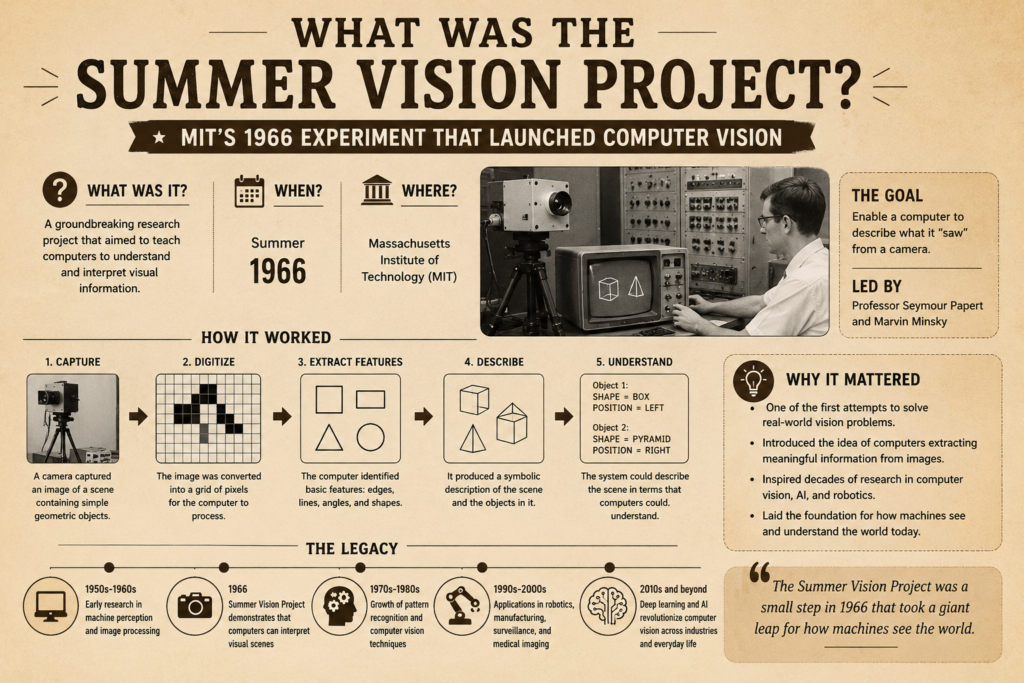
In the summer of 1966, two of the most influential minds in artificial intelligence handed an undergraduate student a task that sounds almost comical in hindsight: solve computer vision over a single summer. The summer vision project was meant to be a quick assignment, a side quest compared to the more serious AI research happening at MIT. Instead, it became one of the most famous and instructive failures in the history of computer science, a project whose lessons are still discussed more than half a century later.
This article tells the full story of the summer vision project: who proposed it, what they expected, what actually happened, and why it remains such an important reference point for anyone studying the history of artificial intelligence.
The Setting: MIT in the Mid-1960s
To understand the summer vision project, you need to understand the environment it came from. By the mid-1960s, MIT had become one of the leading centers of artificial intelligence research in the world, largely thanks to Project MAC, an ambitious research initiative funded by the Advanced Research Projects Agency that brought together computer scientists working on time-sharing systems, symbolic reasoning, and early machine intelligence.
This was the height of what is often called the symbolic AI era, a period when researchers believed that intelligence could be captured through logical rules, symbolic representations, and search algorithms. Early successes in areas like theorem proving, game playing, and natural language processing had created enormous optimism about how quickly artificial intelligence could progress. Vision seemed like it should fit naturally into this framework: identify the objects in a scene, represent them symbolically, and reason about them logically.
It was within this optimistic atmosphere that the summer vision project was born.
The Proposal: A Summer Project (1966)
In 1966, Seymour Papert, a mathematician and AI researcher who had recently joined MIT, proposed what became known as the MIT summer vision project 1966. The idea, often attributed jointly to Papert and his colleague Marvin Minsky, was straightforward on paper: assign an undergraduate student the task of building a system that could analyze a camera image and identify the objects within it.
The famous summer vision project memo, circulated within the artificial intelligence laboratory at MIT, outlined a plan that now reads as remarkably ambitious for what was framed as a summer assignment. The plan called for the system to take input from a camera, perform background and foreground segregation, identify regions corresponding to distinct objects, and ultimately produce a description of the scene.
Marvin Minsky computer vision project involvement is well documented in the historical record, and the project reflects the broader confidence that characterized AI research at the time. The assumption embedded in the proposal was that the core building blocks, separating objects from their background, identifying their boundaries, and matching them to known shapes, were essentially solved problems that simply needed to be assembled into a working system.
What the Summer Vision Project Was Supposed to Do
The technical plan for the summer vision project involved several stages that would later become recognizable as core components of computer vision pipelines.
The first stage involved capturing images using a vidisector camera, an early type of electronic camera tube capable of converting a scene into a signal that could be digitized and processed by a computer. This step alone represented a significant engineering challenge given the hardware available at the time.
The second stage involved what researchers called figure ground analysis, the process of separating an image into a foreground figure, the object of interest, and a background. The origins of figure ground analysis in computer vision trace directly back to this project, even though the underlying idea draws on much older work in visual perception psychology, particularly the Gestalt psychologists of the early twentieth century who studied how humans perceptually separate objects from their surroundings.
The third stage involved region description, analyzing the segmented regions to extract properties like shape, size, and texture that could help identify what each region represented. The final stage involved matching these descriptions against a library of known objects, similar in spirit to the shape-matching approach Lawrence Roberts had used in his first computer vision experiments a few years earlier.
The overall plan assumed that everyday objects calibration, essentially preparing the system to recognize a small set of common objects under reasonably controlled conditions, could be achieved relatively quickly once the underlying segmentation and matching algorithms were in place.
What Actually Happened
The summer vision project did not succeed in the way it was originally framed. The task of reliably segmenting a natural scene into meaningful regions, even before attempting to identify what those regions represented, turned out to be extraordinarily difficult. Real-world images contained shadows, reflections, texture variations, overlapping objects, and lighting changes that the simple algorithms available at the time could not handle reliably.
What was meant to be solved in a summer instead became a research program that occupied multiple students and researchers for years. The image segmentation origins that trace back to this project reflect not a quick solution but the beginning of a research thread that remains active to this day. Decades later, image segmentation remains an actively researched problem, with deep learning approaches achieving results that would have seemed like science fiction to the researchers of 1966, yet still falling short of perfect, general-purpose scene understanding.
The computational complexity of the problem was also far beyond what anyone had anticipated. The computers available at MIT in 1966 had extremely limited memory and processing power. Even storing a single digitized image consumed a significant portion of available memory, let alone running the multiple processing stages the project envisioned. Each stage of the pipeline, segmentation, region description, and matching, turned out to involve subproblems that were themselves the subject of ongoing research for years afterward.
Why the Summer Vision Project Failed
Why the summer vision project failed has become something of a case study in the history of artificial intelligence, often cited as an early example of researchers underestimating the difficulty of tasks that seem effortless for humans. This phenomenon would later be formalized as Moravec’s paradox, the observation that tasks easy for humans, like perception and motor control, are often extremely hard for computers, while tasks hard for humans, like complex calculation, are often easy for computers.
Several specific factors contributed to the failure. First, the researchers underestimated the variability of real-world visual scenes. The block world experiments that had succeeded a few years earlier worked precisely because they used simple geometric objects under controlled lighting. Natural scenes, even relatively simple ones, contained far more variation than anyone had accounted for.
Second, the available algorithms for figure ground analysis and image segmentation were simply not robust enough. Edge detection methods of the time, while a genuine advance, produced noisy and incomplete results on natural images, making it extremely difficult to reliably group pixels into coherent regions corresponding to real objects.
Third, the computational resources available were inadequate for the scale of processing the task actually required. This was not a problem that could be solved through better algorithms alone within the timeframe of a summer; it required computational power that simply did not exist yet.
The Lasting Legacy of the Summer Vision Project
Despite, or perhaps because of, its failure, the summer vision project became one of the most referenced moments in the history of computer vision. It is frequently cited in textbooks, lectures, and historical surveys as a cautionary tale about the gap between how easy a task seems and how hard it actually is to automate.
More importantly, the project helped define the research agenda for computer vision for decades to come. The specific subproblems it identified, image segmentation, figure ground separation, region description, and object matching, became the core research areas of the field. Researchers working on the history of pattern recognition and the history of image processing throughout the 1970s and 1980s were, in many ways, working on problems first articulated explicitly by the summer vision project.
The artificial intelligence laboratory at MIT, which grew out of Project MAC and the broader research environment that produced the summer vision project, became one of the most important institutions in the history of computer vision, training generations of researchers who went on to make foundational contributions across the field.
The summer vision project also serves as an early data point in the broader story of how machines learned to see. It shows that the path from initial ambition to working systems was not a smooth, predictable progression, but a series of overestimations, failures, course corrections, and slow accumulation of partial solutions over many decades.
Frequently Asked Questions
What was the goal of the summer vision project?
The goal of the summer vision project was to build a system that could take an image from a camera, separate the objects in the scene from the background, describe the regions corresponding to those objects, and match them against known object descriptions, all within the span of a single summer at MIT in 1966.
Who started the summer vision project?
The summer vision project is most commonly attributed to Seymour Papert, with significant involvement from Marvin Minsky, both prominent researchers at the MIT artificial intelligence laboratory. The project was assigned to an undergraduate student as part of ongoing research within the lab.
Why is the summer vision project famous?
The summer vision project is famous primarily because of how dramatically it underestimated the difficulty of computer vision. What was framed as a summer assignment touched on problems, image segmentation, figure ground analysis, and object recognition, that remained active areas of research for decades afterward. It is often cited as an example of how easy human visual perception feels compared to how hard it is to replicate computationally.
Did the summer vision project produce any useful results?
While the project did not achieve its original goal of solving computer vision in a summer, it played an important role in clearly articulating the major subproblems of the field. These subproblems, including image segmentation and region description, became central research areas that shaped decades of subsequent work, even though the immediate technical results from the summer itself were limited.
How does the summer vision project relate to modern AI?
The summer vision project is a useful historical reference point for understanding why progress in computer vision took so long compared to early expectations. The problems it identified were not solved by clever algorithms alone but required decades of advances in mathematics, hardware, and ultimately the deep learning techniques that emerged after 2012. It serves as a reminder that visual perception, while effortless for humans, involves enormous computational complexity.
Conclusion
The summer vision project stands as one of the most instructive episodes in the entire history of artificial intelligence. What began as an optimistic summer assignment in 1966 turned into a window onto just how difficult the problem of machine perception actually was. Rather than a footnote of failure, it should be remembered as a foundational moment that helped define the research agenda for an entire field.
The gap between the project’s original ambitions and what was actually achievable in 1966 illustrates just how far computer vision technology has come since then. Tasks that seemed within reach of a summer’s work in 1966 took decades of research, new mathematical frameworks, and entirely new computing hardware to make practical. Understanding the summer vision project is understanding the true scale of the challenge that generations of researchers chose to take on, and ultimately, against long odds, succeeded in solving.