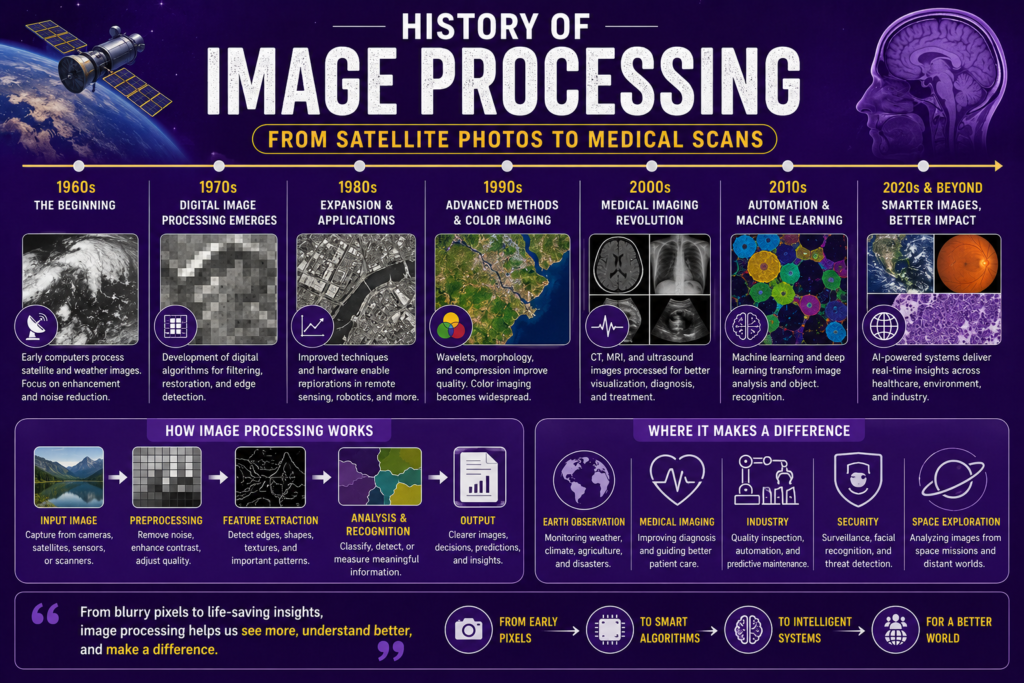
Every photo you take, every medical scan a doctor reviews, and every satellite image used to track a hurricane relies on decades of mathematical and engineering work that most people never think about. The history of image processing is the story of how raw pixels and grayscale matrices became something computers could clean up, enhance, compress, and analyze. This article traces that history from its earliest applications in space exploration to the algorithms that quietly run inside every smartphone camera today.
What Image Processing Actually Means
Image processing refers to the application of mathematical operations to digital images in order to enhance, transform, compress, or extract information from them. This is distinct from computer vision in an important way. Image processing is primarily concerned with transforming images, sharpening them, removing noise, adjusting contrast, while computer vision is concerned with understanding what is in them.
That said, the history of image processing and the history of computer vision are deeply intertwined. Nearly every computer vision technique relies on image processing operations as a first step, and many image processing techniques were originally developed to support specific computer vision and analysis tasks. Quantization and sampling, the processes of converting a continuous image into a discrete grid of pixel values with a limited range of intensities, form the mathematical foundation that everything else in this history builds on.
The Space Race Drives Early Innovation (1960 – 1970)
Some of the earliest serious work in the history of image processing came not from computer science departments but from space agencies. In the early 1960s, the Jet Propulsion Laboratory (JPL) needed a way to process images sent back from spacecraft millions of miles away, images that arrived corrupted by noise, distortion, and the limitations of the transmission technology of the era.
The Ranger spacecraft lunar photos, captured during NASA’s Ranger missions to the Moon between 1961 and 1965, presented exactly this challenge. The raw images transmitted back to Earth contained significant noise and geometric distortion introduced by the camera systems and the transmission process. Engineers at JPL developed digital techniques to correct these problems, applying mathematical filters to remove noise and geometric corrections to fix distortion, producing usable images from data that would otherwise have been nearly unreadable.
This early space probe image reconstruction work represents one of the first large-scale, practical applications of digital image processing. It demonstrated that mathematical operations applied to grids of numbers representing pixel values could meaningfully improve image quality, an idea that would expand into countless other domains over the following decades.
Foundational Techniques Take Shape (1965 – 1975)
During the mid to late 1960s, researchers at institutions including Bell Labs and various universities began developing the foundational mathematical techniques that would define the history of image processing for decades. Bell Labs image processing research during this period explored how signal processing concepts, originally developed for audio and communications, could be applied to two-dimensional image data.
Linear filtering techniques became central to this work. A linear filter operates on an image by computing a weighted combination of pixel values in a local neighborhood around each pixel, producing operations like blurring, sharpening, and edge enhancement depending on how the weights are chosen. These techniques are direct two-dimensional extensions of one-dimensional signal processing methods, and they remain fundamental building blocks of image processing software today.
Spatial domain transformations, operations performed directly on pixel values rather than on a transformed representation of the image, dominated this early period. Simple operations like adjusting brightness and contrast, applying thresholds to create binary images, and basic noise reduction were all spatial domain techniques that could be implemented relatively efficiently even on the limited computers of the era.
The Fourier Transform Changes Everything (1965 – 1980)
One of the most significant mathematical developments in the history of image processing was the popularization of the Fast Fourier Transform (FFT), an efficient algorithm for computing the frequency content of a signal, published by James Cooley and John Tukey in 1965. While the underlying mathematics of the Fourier transform dates back to the early nineteenth century, the FFT made it computationally practical to apply this transform to large datasets, including images, for the first time.
The FFT allowed researchers to analyze images not just in terms of pixel values, the spatial domain, but in terms of the frequencies of patterns within the image, the frequency domain. This frequency domain perspective enabled powerful new techniques for noise removal, since many types of noise have distinctive frequency signatures that can be filtered out, and for image enhancement, since sharpening an image essentially means boosting its high-frequency content.
The introduction of frequency domain analysis represented a major conceptual leap in the history of digital filtering algorithms. Operations that were difficult or computationally expensive to perform directly on pixel values could often be performed much more efficiently by transforming the image into the frequency domain, applying a simple operation there, and transforming it back.
Histogram Equalization and Contrast Enhancement (1970 – 1980)
Among the most widely used techniques to emerge during the 1970s was histogram equalization history, a method for improving the contrast of an image by redistributing its pixel intensity values. An image histogram shows how many pixels in an image have each possible intensity value, from completely black to completely white. In many images, especially those captured in poor lighting conditions, this histogram is concentrated in a narrow range, resulting in an image that looks washed out or too dark.
Histogram equalization works by remapping the intensity values so that the resulting histogram is spread more evenly across the full range of possible values, increasing the overall contrast of the image and often revealing details that were difficult to see in the original. This technique became particularly important for early image enhancement technology used in fields like medical imaging and satellite photography, where important details could be hidden in regions of an image with poor contrast.
These techniques were part of a broader wave of early image enhancement technology development that gave researchers and practitioners practical tools for improving the visual quality and analytical usefulness of digital images, often as a preprocessing step before more advanced analysis.
Image Processing Meets Computer Vision (1980 – 1995)
As the broader field of computer vision developed throughout the 1980s, the history of image processing became increasingly intertwined with efforts to extract meaningful information from images rather than simply enhance them. Edge detection algorithms, which rely fundamentally on linear filtering techniques applied to pixel intensity gradients, became one of the most important applications of image processing methods within computer vision.
The history of edge detection during this period, including the development of the Canny edge detector in 1986, demonstrates how image processing techniques, Gaussian smoothing, gradient computation, and thresholding, could be combined to produce information directly useful for higher-level computer vision tasks like object recognition and scene segmentation.
Pioneers of digital image analysis during this period also developed techniques for image registration, aligning multiple images of the same scene taken at different times or from different viewpoints, which became essential for applications ranging from medical imaging, where doctors needed to compare scans taken months apart, to satellite imagery, where changes in land use or vegetation needed to be tracked over time.
Compression Becomes Critical (1980 – 2000)
As digital images became larger and more common, storing and transmitting them efficiently became a major practical challenge. The history of image compression standards is a critical chapter in the history of image processing, addressing the problem of representing images using as little data as possible while preserving acceptable visual quality.
The discrete cosine transform (DCT), a mathematical technique closely related to the Fourier transform, became the foundation for the most widely used image compression standard ever developed: JPEG, finalized in 1992. JPEG works by dividing an image into small blocks, applying the DCT to each block to convert it into frequency domain information, and then discarding the frequency information that contributes least to the perceived quality of the image, since the human eye is less sensitive to certain types of detail than others.
This combination of mathematical insight, the DCT, and perceptual insight, understanding which information human vision is least sensitive to losing, allowed JPEG to achieve dramatic reductions in file size while maintaining image quality that looked acceptable to most viewers. JPEG and related standards became essential infrastructure for the growth of digital photography, the web, and eventually smartphone cameras.
Medical Imaging Becomes a Major Application (1970 – 2010)
The development of medical image processing represents one of the most consequential applications in the entire history of image processing. Computed tomography, introduced in the early 1970s, fundamentally relies on image processing techniques to reconstruct cross-sectional images of the body from a series of X-ray measurements taken at different angles, a mathematical process that depends heavily on techniques related to the Fourier transform.
Magnetic resonance imaging, developed through the 1970s and 1980s, similarly relies on sophisticated image reconstruction algorithms to convert raw signal data into viewable images. As computational power increased through the 1990s and 2000s, medical image processing expanded to include automated enhancement, noise reduction, and eventually computer-aided detection systems that could highlight regions of interest for radiologists to examine more closely.
This medical imaging work represents a direct precursor to medical imaging ai, the modern deep learning systems that can detect tumors, classify tissue types, and assist in diagnosis, all of which depend on decades of foundational image processing work to prepare and standardize medical images before any AI analysis takes place.
Image Processing in the Deep Learning Era (2012 – 2026)
When deep learning transformed computer vision after 2012, many assumed that classical image processing techniques would become obsolete, replaced entirely by learned representations. In practice, classical image processing remains essential, often working alongside deep learning rather than being replaced by it.
Modern computer vision pipelines frequently use classical image processing techniques, normalization, resizing, color space conversion, and noise reduction, as preprocessing steps before images are fed into neural networks. The history of pattern recognition shows that these preprocessing steps significantly affect how well deep learning models perform, since neural networks are sensitive to the format and quality of their input data.
At the same time, image compression standards based on the discrete cosine transform and related techniques remain ubiquitous, meaning that nearly every image processed by a modern computer vision system has, at some point, passed through compression and decompression algorithms developed decades ago. The history of image processing is not a story of older techniques being discarded, but of new techniques being layered on top of a foundation that remains as relevant as ever.
Frequently Asked Questions
What is the difference between image processing and computer vision?
Image processing focuses on transforming images, enhancing, filtering, compressing, or correcting them, without necessarily extracting meaning from their content. Computer vision focuses on understanding what is in an image, identifying objects, scenes, or patterns. In practice, the two fields overlap heavily, since most computer vision systems rely on image processing techniques as a preprocessing step.
What was the first major application of digital image processing?
One of the earliest major applications was processing images transmitted from spacecraft, particularly the Ranger spacecraft lunar photos from NASA missions in the early 1960s. Engineers at the Jet Propulsion Laboratory developed digital techniques to remove noise and correct distortion in these images, demonstrating the practical value of digital image processing for the first time at scale.
How does the Fast Fourier Transform relate to image processing?
The Fast Fourier Transform allows images to be analyzed in the frequency domain rather than just the spatial domain of pixel values. This makes certain operations, like noise removal and sharpening, much more efficient and effective. The FFT and related transforms, including the discrete cosine transform used in JPEG compression, are foundational to many image processing techniques developed since the 1960s.
Why is image compression important in the history of image processing?
As digital images became larger and more widely used, efficiently storing and transmitting them became essential. Compression standards based on the discrete cosine transform, most notably JPEG, allowed image file sizes to be dramatically reduced while maintaining acceptable visual quality, enabling the growth of digital photography, the internet, and modern smartphone cameras.
Is classical image processing still relevant in the age of deep learning?
Yes. Despite the rise of deep learning, classical image processing techniques remain essential as preprocessing steps in nearly every modern computer vision pipeline. Operations like resizing, normalization, color space conversion, and compression are applied to images before they are analyzed by neural networks, and the quality of this preprocessing significantly affects how well deep learning models perform.
Conclusion
The history of image processing spans more than sixty years, beginning with engineers at the Jet Propulsion Laboratory trying to make sense of noisy images sent back from the Moon, and continuing through the development of foundational mathematical tools like the Fast Fourier Transform, practical techniques like histogram equalization, and essential infrastructure like JPEG compression. Medical imaging, satellite photography, and eventually deep learning based computer vision all built directly on this foundation.
Every application of computer vision technology today, from a smartphone camera adjusting exposure automatically to a hospital system reconstructing a CT scan, depends on decades of image processing research that mostly happens invisibly in the background. Understanding the history of image processing reveals just how much careful mathematical work underlies even the simplest tasks we now take completely for granted.