Long before machines could recognize a face or read a street sign, researchers had to answer a much more fundamental question: how can a computer tell two things apart? The history of pattern recognition is the story of that question, and the decades of mathematical, statistical, and computational work that went into answering it. From simple geometric shapes to deep neural networks, pattern recognition has always been the hidden engine behind computer vision, speech recognition, and much of modern artificial intelligence.
This article traces that history in detail, covering the theoretical foundations, the major schools of thought, and the people whose ideas still shape the field today.
What Pattern Recognition Actually Means
At its core, pattern recognition is the task of assigning a label to an input based on its measurable characteristics. Given a set of measurements, called features, a pattern recognition system decides which category the input belongs to. This sounds simple, but it underlies an enormous range of real-world problems: identifying handwritten digits, classifying tumors as benign or malignant, detecting fraudulent transactions, and recognizing objects in images.
The history of pattern recognition is closely tied to the broader history of computer vision because images are, fundamentally, just very large collections of measurements. Turning those measurements into a meaningful classification, a face, a letter, a defect, a disease, is the central problem that pattern recognition was developed to solve.
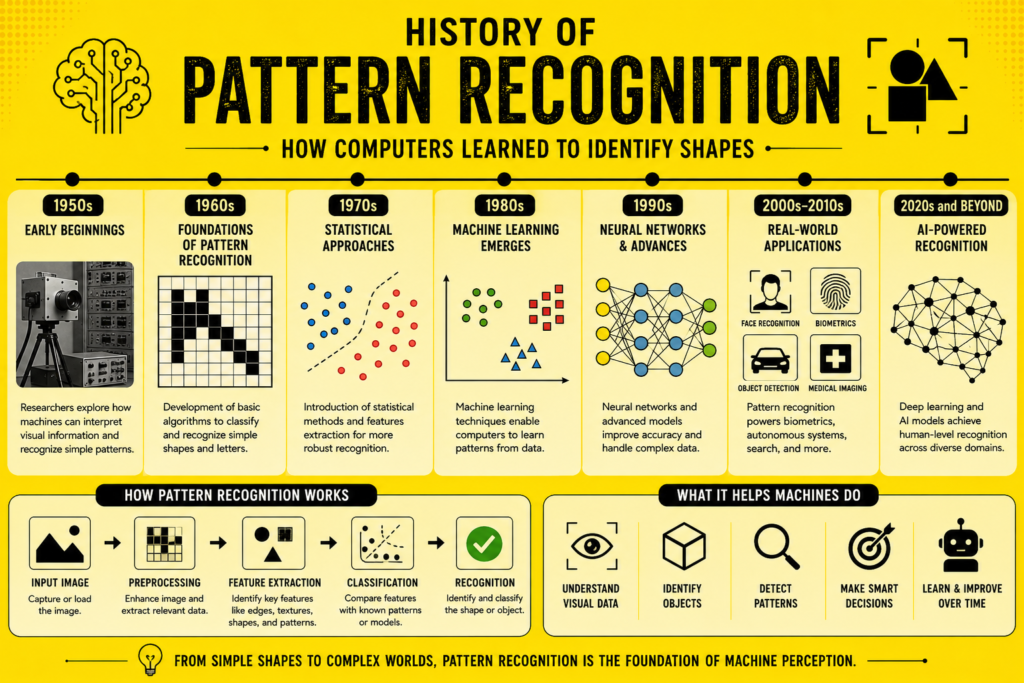
Early Foundations: Cybernetics and Statistics (1940 – 1960)
The roots of the history of pattern recognition reach back to the 1940s and the cybernetics paradigm, the study of communication and control in animals and machines, pioneered by Norbert Wiener and others. Cybernetics asked how systems, biological or mechanical, could process information from their environment and respond appropriately. Pattern recognition emerged as one of the practical questions this broader framework raised: how does a system decide what category an input belongs to?
By the 1950s, statisticians had already developed much of the mathematical machinery that pattern recognition would rely on. Bayes decision theory, based on the eighteenth century work of Thomas Bayes, provided a framework for making optimal decisions under uncertainty by combining prior probabilities with observed evidence. This decision theoretic approach became one of the two major philosophical foundations of pattern recognition, alongside more geometric approaches that thought about classification in terms of distances and boundaries in feature space representation.
Frank Rosenblatt’s Perceptron, introduced in 1957, was an early practical attempt to build a system that could learn to classify inputs. Although limited to linearly separable problems, the Perceptron demonstrated that classification rules could be learned from examples rather than specified by a programmer, an idea that would become central to the entire field.
The 1960s: Pattern Recognition Becomes a Discipline (1960 – 1970)
The 1960s saw 1960s pattern classification emergence as a recognized academic discipline in its own right, separate from but closely related to cybernetics, statistics, and the emerging field of artificial intelligence. Researchers began formalizing the mathematical tools needed to build classification systems and applying them to real problems.
Discriminant functions became a central concept during this period. A discriminant function takes the features of an input and produces a score for each possible category, with the input assigned to whichever category produces the highest score. Linear discriminant functions, which compute scores using weighted sums of features, were among the first to be studied in depth, and they remain useful today for problems where categories can be separated by straight lines or flat planes in feature space.
This was also the decade when Lawrence Roberts conducted his groundbreaking block world experiments at MIT, part of the broader first computer vision experiments of the era. While Roberts’s work focused on 3D reconstruction rather than classification per se, it relied on pattern recognition techniques to match extracted shapes against known geometric templates, an early example of structural pattern analysis applied to visual data.
Post war pattern recognition research during this period split along two major lines that would coexist for decades: the statistical approach, which represented patterns as points in a feature space and used probability and geometry to classify them, and the syntactic approach, which represented patterns as combinations of simpler primitive elements arranged according to grammatical rules.
Statistical vs Structural: Two Schools of Thought (1970 – 1980)
By the 1970s, the history of pattern recognition had crystallized into two major schools that approached the problem from fundamentally different angles.
The statistical approach treated each pattern as a vector of numerical measurements, a point in a high-dimensional feature space representation. Classification meant dividing this space into regions, one for each category, and assigning new points based on which region they fell into. K-nearest neighbors (KNN) history begins in this era, with the simple but remarkably effective idea of classifying a new point based on the categories of its closest neighbors in the training data. Despite its simplicity, KNN remains a useful baseline method to this day.
Early syntactic pattern recognition, sometimes called structural pattern recognition, took a completely different approach. Instead of representing a pattern as a point in space, it represented a pattern as a structure built from simpler parts according to rules, similar to how a sentence is built from words according to grammar. This approach was particularly well suited to patterns with clear hierarchical or compositional structure, such as chromosome classification, fingerprint analysis, and certain types of character recognition.
History of geometric pattern matching also developed during this period, focusing on techniques for comparing shapes directly, finding correspondences between points, lines, or regions in different images or templates. These techniques fed directly into early systems for the history of optical character recognition, where comparing the shape of an unknown character against a library of known templates was the dominant approach for years.
The establishment of IEEE Transactions on Pattern Analysis (PAMI) in 1979 marked the formal arrival of pattern recognition and the closely related field of machine intelligence as a major academic discipline, providing a dedicated venue for research that had previously been scattered across statistics, electrical engineering, and computer science journals.
Neural Networks Re-enter the Picture (1980 – 1995)
The 1980s brought a revival of interest in neural network approaches to pattern recognition, building on ideas that had been largely dormant since the limitations of the Perceptron were identified in the late 1960s. Kunihiko Fukushima’s Neocognitron, introduced in 1980, represented a significant advance, the history of the Neocognitron showing how a hierarchical neural architecture inspired by the visual cortex could learn to recognize visual patterns through layers of increasingly abstract feature detectors.
Yann LeCun’s work on convolutional neural networks in the late 1980s, combining Fukushima’s hierarchical architecture with backpropagation training, demonstrated that neural networks could be trained effectively on real-world pattern recognition tasks like handwritten digit recognition. This was a significant departure from the purely statistical and structural approaches that had dominated the field, introducing an approach where the system learned its own internal representations directly from data rather than relying on hand-designed features or rules.
Throughout this period, the question of supervised vs unsupervised classification became increasingly important. Supervised methods required labeled training examples, where the correct category for each example was known in advance. Unsupervised methods, by contrast, attempted to discover natural groupings or structure in data without any labels, using techniques broadly related to data clustering algorithms. Both approaches found important applications, with supervised methods dominating in tasks where labeled data was available and unsupervised methods proving valuable for exploratory analysis and cases where labels were scarce or expensive to obtain.
The Rise of Support Vector Machines (1992 – 2005)
In the early 1990s, a new approach to pattern recognition emerged that would dominate the field for nearly two decades. Support Vector Machines (SVM) roots trace back to work by Vladimir Vapnik and Alexey Chervonenkis on statistical learning theory, with the modern SVM formulation appearing in the early 1990s.
SVMs approached classification by finding the boundary between categories that maximized the margin, the distance between the boundary and the nearest examples of each category. This margin maximization principle gave SVMs strong theoretical guarantees about generalization, their ability to perform well on new, unseen data, which was a significant advance over earlier methods that lacked such guarantees.
Combined with the kernel trick, a mathematical technique that allowed SVMs to find nonlinear boundaries by implicitly mapping data into higher-dimensional spaces, SVMs became extremely effective for a wide range of pattern recognition problems, including many in the history of image processing and early object recognition systems. Throughout the 1990s and 2000s, SVMs combined with hand-engineered features like SIFT and HOG represented the state of the art for visual pattern recognition.
Deep Learning Changes Everything (2006 – 2020)
The history of pattern recognition entered its most dramatic phase when deep learning transformed computer vision starting around 2012. Deep neural networks, particularly convolutional neural networks, demonstrated that pattern recognition systems could learn their own feature representations directly from raw data, eliminating the need for hand-engineered features that had dominated the field for decades.
The success of AlexNet in the 2012 ImageNet competition was, in many ways, the culmination of the entire history of pattern recognition. It combined ideas from multiple historical threads: the hierarchical architecture pioneered by Fukushima, the backpropagation training developed by LeCun and others, the statistical learning theory that had matured through decades of work on SVMs and earlier methods, and the massive labeled datasets and computational power that had only recently become available.
Subsequent architectures, including the history of VGGNet, the history of GoogLeNet, and the history of ResNet, continued to push the boundaries of what pattern recognition systems could achieve, eventually surpassing human-level performance on specific benchmark tasks.
Pattern Recognition Today (2020 – 2026)
Modern pattern recognition has largely been absorbed into the broader field of machine learning and deep learning, but the fundamental questions remain the same: how do you represent an input in a way that makes meaningful categories separable, and how do you learn the rules that separate them?
Vision transformers, introduced in 2020, represent the latest chapter, applying attention-based architectures originally developed for language to pattern recognition problems in images. The history of multimodal AI extends pattern recognition beyond single modalities, with systems that recognize patterns across text, images, audio, and video simultaneously.
Despite all this progress, classical concepts from the history of pattern recognition remain relevant. Discriminant functions, Bayes decision theory, and feature space representation are still taught in every introductory machine learning course, because the deep learning systems of today are, in a deep sense, highly sophisticated extensions of the same underlying principles that researchers were developing in the 1950s and 1960s.
Frequently Asked Questions
What is the difference between pattern recognition and machine learning?
Pattern recognition is generally considered a subfield of machine learning focused specifically on the task of classifying or labeling inputs based on their features. Machine learning is a broader field that includes pattern recognition along with other tasks like regression, reinforcement learning, and generative modeling. Historically, pattern recognition existed as a distinct discipline before the term machine learning became widely used.
Who are the key figures in the history of pattern recognition?
Important figures include Frank Rosenblatt, whose Perceptron introduced learnable classification in 1957, Vladimir Vapnik, whose statistical learning theory underpins support vector machines, Kunihiko Fukushima, whose Neocognitron introduced hierarchical neural pattern recognition, and Yann LeCun and Geoffrey Hinton, whose work on deep learning transformed the field after 2012.
What is the difference between statistical and structural pattern recognition?
Statistical pattern recognition represents inputs as numerical feature vectors and classifies them based on their position in a feature space, using methods like discriminant functions, k-nearest neighbors, and support vector machines. Structural, or syntactic, pattern recognition represents inputs as compositions of simpler parts arranged according to rules, similar to grammar, and is particularly suited to patterns with clear hierarchical structure.
How did support vector machines change pattern recognition?
Support vector machines, which emerged in the early 1990s, introduced a principled approach to finding classification boundaries that maximized the margin between categories, providing strong theoretical guarantees about generalization. Combined with kernel methods for handling nonlinear boundaries, SVMs became the dominant approach to pattern recognition throughout the 1990s and 2000s, until deep learning largely replaced them after 2012.
Is classical pattern recognition still relevant in the deep learning era?
Yes. While deep learning has replaced many hand-engineered approaches in practice, the theoretical concepts developed throughout the history of pattern recognition, including Bayes decision theory, discriminant functions, and feature space representation, remain foundational to understanding how modern systems work. Many deep learning techniques can be understood as highly flexible, data-driven versions of these classical ideas.
Conclusion
The history of pattern recognition is, in many ways, the intellectual backbone of modern artificial intelligence. It began with statisticians and cyberneticists asking how decisions could be made under uncertainty, progressed through decades of competing statistical and structural approaches, and was eventually transformed by neural networks that could learn their own representations directly from data.
Every modern application built on computer vision technology, from facial recognition to medical diagnosis to autonomous vehicles, ultimately rests on principles first articulated in the history of pattern recognition. Understanding where these ideas came from is not just a historical curiosity. It is the key to understanding why modern systems work the way they do, and where their limitations come from.