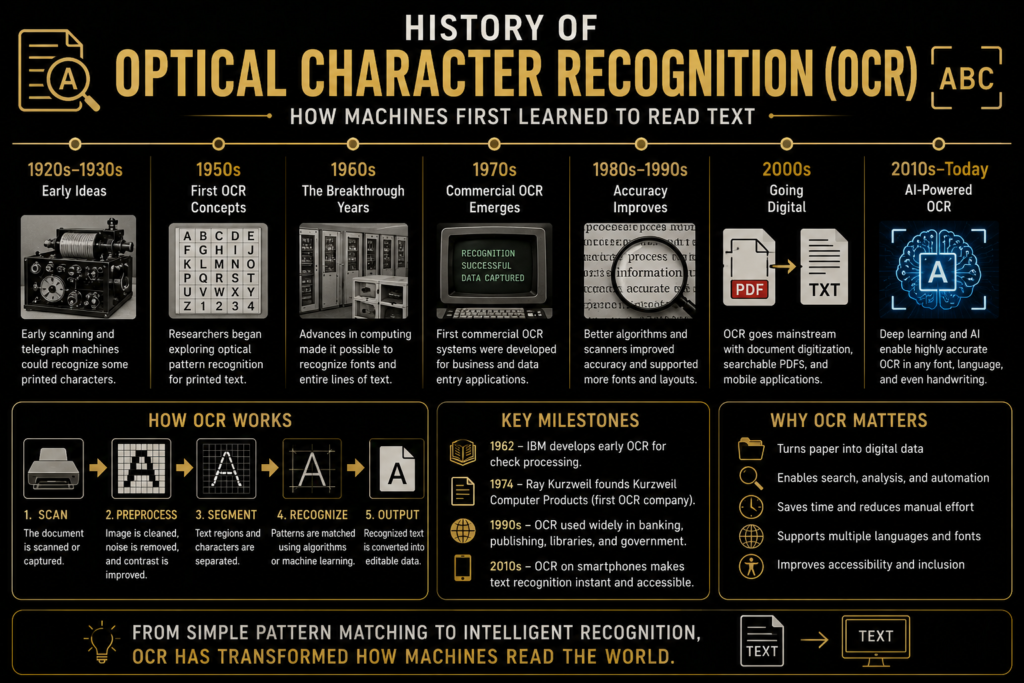
Long before computers could recognize faces or drive cars, they had a much narrower but equally important challenge to solve: reading text. The history of optical character recognition stretches back further than most people realize, beginning with mechanical reading machines built decades before the first digital computers existed. This article traces that history from its earliest mechanical roots through the statistical and pattern-matching era to the deep learning systems that power OCR today.
What Optical Character Recognition Actually Does
Optical character recognition, commonly known as OCR, is the technology that converts images of printed or handwritten text into machine-encoded text that a computer can search, edit, and process. At its core, OCR takes a picture, a scanned page, a photo of a sign, a screenshot, and turns the shapes within it back into the letters, numbers, and symbols they represent.
This task sits at an interesting crossroads. It is, in a sense, one of the narrowest problems in computer vision because the set of possible outputs, the alphabet and digits of a given language, is small and well defined compared to the vast variety of objects in the world. Yet it is also one of the oldest and most commercially important problems, because reading text automatically has obvious applications in business, government, and accessibility that predate modern computing entirely.
Mechanical Beginnings: Reading Before Computers (1914 – 1929)
The history of optical character recognition does not begin with computers at all. It begins with mechanical and electromechanical devices designed to help blind people read printed text. In 1914, Edmund Fournier d’Albe invented the optophone, a device that used photoelectric cells to scan printed text and convert the patterns of light and dark into audible optophone tones, different pitches corresponding to different shapes on the page. A trained user could, with practice, learn to interpret these tones well enough to read printed material.
The optophone was not OCR in the modern sense, since it did not convert text into digital characters. But it established the basic principle that would underlie OCR for the next century: scanning a printed page with a light-sensitive sensor and converting the visual pattern into some other form of information.
In the late 1920s, Gustav Tauschek, an Austrian inventor, developed what is often considered one of the first true OCR machines. Tauschek’s device used pattern matching templates, physical templates of letter shapes that could be mechanically compared against the scanned text to identify matches. This template matching approach, comparing an unknown shape against a library of known shapes, became the dominant strategy in OCR for decades.
Early Commercial Systems (1930 – 1960)
Through the 1930s and into the 1950s, OCR remained largely experimental, but the underlying ideas continued to develop. Emanuel Goldberg, a pioneer in the related field of document retrieval systems, developed a statistical machine in the 1920s and 1930s capable of searching microfilm archives using a form of pattern matching, an early precursor to the kind of automated document processing that OCR would later make possible at scale.
By the 1950s, the first commercially deployed OCR systems began to appear, primarily for very narrow applications like reading the printed numbers on bank checks. These systems used photoelectric cells to detect the presence or absence of ink at specific positions, comparing the resulting pattern against a small set of known digit shapes printed in a specialized font designed specifically to be easy for machines to read.
Telegraphic code conversion systems from this era, which converted printed characters into telegraph codes for transmission, shared important technical similarities with early OCR. Both involved converting visual or symbolic information into a different encoded form, and both relied on rigid, font-specific pattern matching that worked only under tightly controlled conditions.
The 1960s: OCR Enters the Computer Age (1960 – 1970)
The 1960s mark a turning point in the history of optical character recognition, as OCR began to be integrated with digital computers rather than purely mechanical or electromechanical systems. This period overlaps with the broader first computer vision experiments happening at institutions like MIT, where researchers were beginning to explore how computers could process visual information of all kinds, not just text.
IBM became a major player in commercial OCR during this decade. The IBM 1287 scanner, introduced in the late 1960s, was capable of reading both hand-printed numerals and a specialized OCR font, representing a significant step toward more flexible reading machines. These systems were deployed for tasks like processing utility bills, where customers would write payment amounts in standardized boxes that the scanner could reliably interpret.
Early postal mail sorting OCR systems also emerged during this period. Postal services around the world faced an enormous and growing volume of mail that needed to be sorted by destination, and OCR offered a way to automate part of this process by reading printed or typed addresses and zip codes. These systems were limited to specific fonts and formats, but they represented one of the first large-scale, real-world deployments of OCR technology, processing millions of pieces of mail.
Reading Machines for the Blind (1970 – 1980)
One of the most significant developments in the history of optical character recognition came from an unexpected direction: accessibility technology. In the mid-1970s, inventor Ray Kurzweil developed what became known as the Kurzweil Reading Machine, the first device capable of reading printed text in essentially any normal font and converting it into synthesized speech.
The history of reading machines for the blind before Kurzweil’s invention had relied on devices like the optophone, which required extensive training and produced results that were slow and difficult to interpret. Ray Kurzweil reading machine history represents a major leap because it combined two breakthrough technologies developed by Kurzweil and his team: font independent recognition, the ability to read text regardless of the specific typeface used, and text to speech synthesis, converting recognized text into spoken words.
Kurzweil’s company, founded as Kurzweil Computer Products and later connected to the Intelligent Machines Research Corporation, commercialized this technology, with early units sold to organizations serving blind and visually impaired users starting in 1976. This was widely regarded as the first omni font OCR scanner, capable of reading a wide variety of printed materials without being limited to a single specialized font, a dramatic improvement over the rigid, font-specific systems that had dominated OCR until that point.
Statistical Methods and Better Accuracy (1980 – 2000)
Through the 1980s and 1990s, OCR accuracy improved steadily as researchers applied increasingly sophisticated techniques drawn from the broader history of pattern recognition. Rather than relying purely on rigid template matching, OCR systems began incorporating statistical models that could account for variations in how individual letters were printed or written, differences in font, size, spacing, and even minor distortions from scanning.
Handheld OCR reader history also begins during this period, with portable scanning devices that could capture and recognize text from documents, signs, and other printed materials in real time, without requiring a connection to a larger computer system. These devices found applications in fields like logistics and inventory management, where workers needed to quickly digitize printed information in the field.
Digitizing print media history accelerated dramatically during the 1990s as libraries, newspapers, and government archives began large-scale projects to convert printed materials into searchable digital text. OCR accuracy on clean, modern printed text reached very high levels during this period, often exceeding 99 percent for well-scanned pages in common fonts, though accuracy on older documents, handwriting, and degraded materials remained much lower.
Open Source OCR and the Tesseract Era (2000 – 2010)
A major milestone in the history of optical character recognition came with the development and eventual open-sourcing of Tesseract OCR origins tracing back to research conducted at Hewlett-Packard between 1985 and 1995. Tesseract was, at the time of its initial development, considered one of the most accurate OCR engines available, but it was shelved for several years before HP released it as open source in 2005.
Google subsequently took over development of Tesseract, improving its accuracy and adding support for many additional languages. Because it was free and open source, Tesseract became one of the most widely used OCR engines in the world, powering everything from academic research projects to commercial applications, and forming a core component of the broader history of OpenCV ecosystem of open computer vision tools that researchers and developers rely on.
This period also saw OCR increasingly integrated with broader document retrieval systems, allowing scanned documents to be indexed and searched by their textual content, transforming how organizations managed large archives of paper records.
Deep Learning and Modern OCR (2012 – 2026)
When deep learning transformed computer vision after 2012, OCR was one of the areas that benefited most dramatically. Convolutional neural networks and, later, recurrent neural networks and transformer-based architectures proved extremely effective at recognizing text, including handwriting, distorted text, and text in complex real-world scenes like street signs and product packaging.
Modern OCR systems can now read text embedded in photographs taken at odd angles, under poor lighting, or partially obscured, tasks that would have been essentially impossible for the template-matching systems of earlier decades. The history of Google Lens, launched in 2017, demonstrated this capability vividly, allowing users to point a smartphone camera at text in the real world and have it instantly translated, searched, or copied.
The history of multimodal AI represents the current frontier for OCR. Modern multimodal models can not only recognize text but understand its context, reading a menu and answering questions about it, or extracting structured data from a complex form, blending OCR with broader visual and language understanding in ways that go far beyond simply converting pixels into characters.
Frequently Asked Questions
When was OCR invented?
The earliest precursors to OCR date back to 1914 with Edmund Fournier d’Albe’s optophone, though this device produced audible tones rather than digital text. The first true OCR machines using pattern matching templates emerged in the late 1920s with inventors like Gustav Tauschek. Modern font-independent OCR began with the Kurzweil Reading Machine in 1976.
What was the first commercial use of OCR?
Some of the earliest commercial uses of OCR were in banking, where specialized fonts were used to print check numbers that could be reliably read by early scanning machines in the 1950s. Postal services also adopted early OCR systems for sorting mail by reading printed addresses and zip codes during the 1960s.
How accurate is modern OCR compared to early systems?
Early OCR systems were limited to specific fonts and formats, often achieving low accuracy outside narrow conditions. Modern OCR systems using deep learning can achieve accuracy exceeding 99 percent on clean printed text and can also handle handwriting, distorted text, and text within complex photographs, a dramatic improvement over the rigid template matching of early systems.
What is the difference between OCR and computer vision?
OCR is a specialized application within the broader field of computer vision, focused specifically on recognizing and converting text within images into machine-encoded characters. The history of computer vision encompasses a much wider range of tasks, including object detection, facial recognition, and scene understanding, many of which use techniques that originated in or alongside OCR research.
Is Tesseract still used today?
Yes. Tesseract OCR origins trace back to the 1980s, and after being open-sourced and maintained by Google, it remains one of the most widely used OCR engines in the world, particularly for projects that need a free, customizable, and well-documented OCR solution. However, many modern commercial applications now use deep learning based OCR systems that can outperform Tesseract on challenging real-world images.
Conclusion
The history of optical character recognition is a story that began long before the first digital computer, with mechanical devices designed to help blind people read printed text. It progressed through decades of font-specific template matching, breakthrough innovations in font-independent recognition, the rise of open source tools like Tesseract, and finally the transformation brought about by deep learning, which made OCR robust enough to read text anywhere in the real world.
Today, OCR is so deeply embedded in computer vision technology that it often goes unnoticed, quietly converting receipts, signs, documents, and screenshots into searchable, editable text every single day. Understanding the history of optical character recognition reveals just how much patient engineering went into making something that now feels almost instantaneous and effortless.