Decades before convolutional neural networks became the engine behind self-driving cars, facial recognition, and medical imaging AI, a Japanese researcher built a neural network modeled directly on the human visual cortex. The history of the Neocognitron begins in 1980, when Kunihiko Fukushima introduced an architecture so far ahead of its time that it would take another two decades for the rest of the field to fully catch up to its core ideas. This article explores that history in detail, covering the biological inspiration, the technical design, and the lasting influence the Neocognitron still has on artificial intelligence today.
Why the Neocognitron Matters
Most discussions of deep learning history jump straight from the Perceptron in the late 1950s to convolutional neural networks in the late 1980s and early 1990s, often skipping over a crucial intermediate step. The history of the Neocognitron fills that gap. It represents the first serious attempt to build a multi-layered neural network specifically designed to recognize visual patterns the way biological vision systems do, using a hierarchical structure of increasingly complex feature detectors.
Understanding this history matters because so much of what makes modern computer vision work, hierarchical feature extraction, local receptive fields, and tolerance to small shifts in position, was first articulated in the Neocognitron, years before the computational power existed to fully exploit these ideas.
The Biological Inspiration: Hubel and Wiesel (1959 – 1962)
To understand the history of the Neocognitron, you first need to understand the neuroscience that inspired it. In the late 1950s and early 1960s, David Hubel and Torsten Wiesel conducted groundbreaking experiments on the primary visual cortex of cats, work that would later earn them the Nobel Prize.
Their research revealed that the visual cortex contains neurons organized into a hierarchy. At the lowest level, neurons respond to simple visual features like edges at specific orientations within small receptive fields, the specific region of the visual field that a given neuron responds to. At higher levels, neurons combine signals from many lower-level neurons, becoming responsive to more complex patterns while also becoming somewhat tolerant to the exact position of those patterns within the visual field.
This Hubel and Wiesel model of the visual cortex provided exactly the kind of biological blueprint that Kunihiko Fukushima would later translate into a computational architecture. If the brain processes vision through layers of increasingly complex, position-tolerant feature detectors, Fukushima reasoned, perhaps an artificial neural network could be built the same way.
Fukushima’s Earlier Work: The Cognitron (1975)
Before the Neocognitron, Fukushima had already been working on related ideas. The history of cognitron neural network research begins in 1975, when Fukushima introduced the cognitron, an earlier self-organizing neural network capable of learning to distinguish between different input patterns through a process the field later described as learning without a teacher, what would now be called unsupervised learning.
The cognitron used layers of neuron-like units connected through synaptic weight adjustment, where the strength of connections between units changed based on the patterns of activity during training. While the cognitron demonstrated that a multi-layered network could organize itself to distinguish patterns, it had a significant limitation: it was sensitive to the exact position of a pattern within its input. A shape recognized in one location would not necessarily be recognized if it appeared shifted to a different location in the input field.
This limitation set the stage for Fukushima’s next major contribution, which would directly address the position problem.
The Neocognitron Arrives (1980)
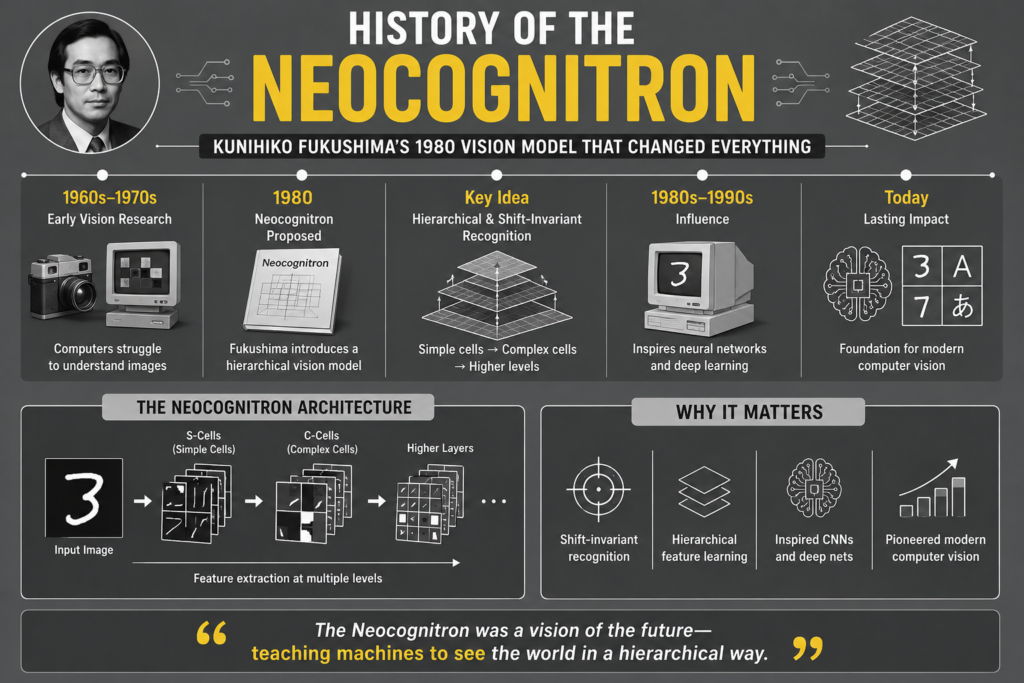
In 1980, Fukushima published his paper introducing the Neocognitron, explicitly building on both the cognitron and the Hubel and Wiesel model of the visual cortex. The Neocognitron neural network architecture 1980 introduced a structure built from alternating layers of two types of units, directly inspired by the simple and complex cells found in biological vision.
S-cells and C-cells, named after the simple and complex cells of the visual cortex, formed the basic building blocks of the Neocognitron. S-cells, or simple cells, performed local feature integration, detecting specific patterns within a small receptive field, similar to how early layers of a modern convolutional network detect edges and simple textures. C-cells, or complex cells, took inputs from multiple S-cells responding to the same feature at slightly different positions and combined them, providing position shift tolerance, the ability to recognize a feature even if it appeared in a slightly different location than during training.
This alternating structure of S-layers and C-layers was repeated multiple times, with each successive layer responding to increasingly complex and abstract combinations of features from the layer below, while also becoming progressively more tolerant to shifts in position. By the time information reached the final layers of the network, units could respond to entire characters or shapes regardless of small variations in exactly where those shapes appeared within the input.
How the Neocognitron Learned
One of the most distinctive aspects of the history of the Neocognitron is how it was trained. Unlike the supervised backpropagation methods that would later dominate deep learning, the Neocognitron relied primarily on a self-organizing neural network approach, learning without a teacher in the sense that it did not require labeled examples paired with explicit error signals in the way modern supervised learning does.
The training process involved presenting the network with a series of input patterns and allowing the connections between S-cells and the inputs they responded to strengthen based on which inputs were most active when a given S-cell fired. This process, similar in spirit to Hebbian learning, the idea that neurons that fire together wire together, allowed the network to gradually develop S-cells that responded to useful, recurring features in the training data without being explicitly told what those features should be.
The units in the Neocognitron used analog threshold elements, producing graded outputs based on how strongly their inputs matched their preferred pattern, rather than simple binary on or off responses. This allowed for more nuanced representations of how well a given input matched a given feature detector.
Neocognitron Handwritten Character Recognition
The most famous demonstration of the Neocognitron’s capabilities came in the domain of Neocognitron handwritten character recognition. Fukushima trained the network to recognize handwritten digits, a task that requires exactly the kind of position shift tolerance and hierarchical feature combination that the architecture was designed to provide.
Handwritten digits present a genuinely difficult challenge: the same digit written by different people, or even by the same person at different times, can vary significantly in size, position, slant, and stroke thickness. A system that could only recognize a digit in exactly the position and form it was trained on would be useless for any real application.
The Neocognitron’s hierarchical structure allowed it to recognize digits despite these variations, because the position shift tolerance built into the C-cells meant that small differences in exactly where strokes appeared did not prevent the network from recognizing the overall digit shape. This was a significant achievement and represented one of the clearest demonstrations to date that a neural network architecture could solve a genuinely useful pattern recognition task.
The Neocognitron’s Influence on Convolutional Neural Networks (1989 – 1998)
The most important chapter in the history of the Neocognitron is not the original 1980 paper itself, but the influence it had on later researchers. Yann LeCun, working at Bell Labs in the late 1980s, drew directly on the architectural principles Fukushima had introduced when developing what would become the modern convolutional neural network.
Neocognitron vs convolutional neural networks comparisons reveal both the deep similarities and the key differences between the two architectures. Both use layers of local feature detectors with shared characteristics across spatial positions, a property now called weight sharing in convolutional networks, corresponding to the origins of shift invariant pattern recognition that Fukushima had pioneered with S-cells and C-cells. Both use a hierarchical structure where early layers detect simple features and later layers detect increasingly complex combinations.
The key difference was training. LeCun’s networks, including the architecture that became known as LeNet, were trained using backpropagation, a supervised learning algorithm that could adjust all the weights in the network simultaneously based on the error between the network’s output and the correct label. This was a significant departure from the largely unsupervised, self-organizing learning approach of the original Neocognitron, and it proved to be the key that unlocked practical performance on real-world datasets.
In this sense, the history of the Neocognitron can be understood as providing the architectural blueprint, the early hierarchical multi layered networks structure with local receptive fields and position tolerance, while later work provided the training algorithm that made that blueprint practically useful.
The Neocognitron as a Precursor to Modern Deep Learning
Today, the Neocognitron is widely recognized as the precursor to modern deep learning, particularly the convolutional neural networks that power the vast majority of modern computer vision systems. When researchers look at the first layers of a trained modern network like AlexNet or ResNet, they find filters that behave remarkably similarly to the S-cells Fukushima described in 1980, detecting edges and simple textures at specific orientations.
The evolution of the Neocognitron model through subsequent decades illustrates a recurring pattern in the history of artificial intelligence: an idea can be conceptually correct and even partially demonstrated, but require additional pieces, in this case, supervised training via backpropagation, larger datasets, and far greater computational power, before it can achieve its full potential. The deep learning transformed computer vision revolution of the 2010s was, in a meaningful sense, the Neocognitron’s ideas finally meeting the resources they needed to flourish.
The history of pattern recognition more broadly owes a significant debt to Fukushima’s work, as the Neocognitron demonstrated that biologically inspired hierarchical architectures could be a viable and powerful approach to solving genuinely hard recognition problems, a principle that remains at the heart of computer vision research today.
Frequently Asked Questions
Who invented the Neocognitron?
The Neocognitron was invented by Kunihiko Fukushima, a Japanese researcher, who published the original architecture in 1980. It built on his earlier work on the cognitron from 1975 and was directly inspired by the Hubel and Wiesel model of the primary visual cortex.
How is the Neocognitron different from a convolutional neural network?
The Neocognitron and convolutional neural networks share a similar hierarchical structure with local feature detectors and position tolerance, concepts now known as weight sharing and pooling. The key difference is training: the original Neocognitron used a largely unsupervised, self-organizing learning approach, while convolutional neural networks developed by Yann LeCun and others used supervised training via backpropagation, which proved far more effective at learning useful features from large labeled datasets.
What problem did the Neocognitron solve?
The Neocognitron addressed the problem of position shift tolerance in pattern recognition, the ability to recognize a visual pattern even when it appears in a slightly different location within the input. Earlier networks like the cognitron were sensitive to exact position, limiting their usefulness. The Neocognitron’s alternating layers of S-cells and C-cells allowed it to recognize patterns like handwritten digits regardless of small positional variations.
Why did it take so long for the Neocognitron’s ideas to become widely used?
The Neocognitron’s self-organizing training approach, while conceptually elegant, did not scale as effectively as the supervised backpropagation methods developed later. Additionally, the computational power available in 1980 was nowhere near sufficient to train large versions of such networks on large datasets. It took the combination of backpropagation, much larger labeled datasets, and modern GPU computing power, developments that came together by 2012, for architectures based on these principles to achieve their full potential.
Is the Neocognitron still relevant today?
Yes, primarily as a historical and conceptual foundation. While no modern systems use the original Neocognitron architecture directly, the core ideas it introduced, hierarchical processing, local receptive fields, and position tolerance through pooling-like operations, remain fundamental to virtually every convolutional neural network used in computer vision today.
Conclusion
The history of the Neocognitron is a story about an idea that arrived before its time. Kunihiko Fukushima looked at the structure of the biological visual cortex, as revealed by Hubel and Wiesel, and translated it into a computational architecture that could recognize handwritten characters despite variations in position and form. The S-cells and C-cells he introduced in 1980 anticipated the convolutional layers and pooling operations that would not become widely practical for another three decades.
Every modern system built on computer vision technology, from smartphone cameras that recognize faces to medical imaging tools that detect disease, ultimately traces part of its architectural lineage back to the Neocognitron. Understanding this history is a reminder that breakthroughs in artificial intelligence often depend not just on having the right idea, but on having the right idea at a moment when the supporting tools, training methods, data, and computing power, are finally ready to make it work.