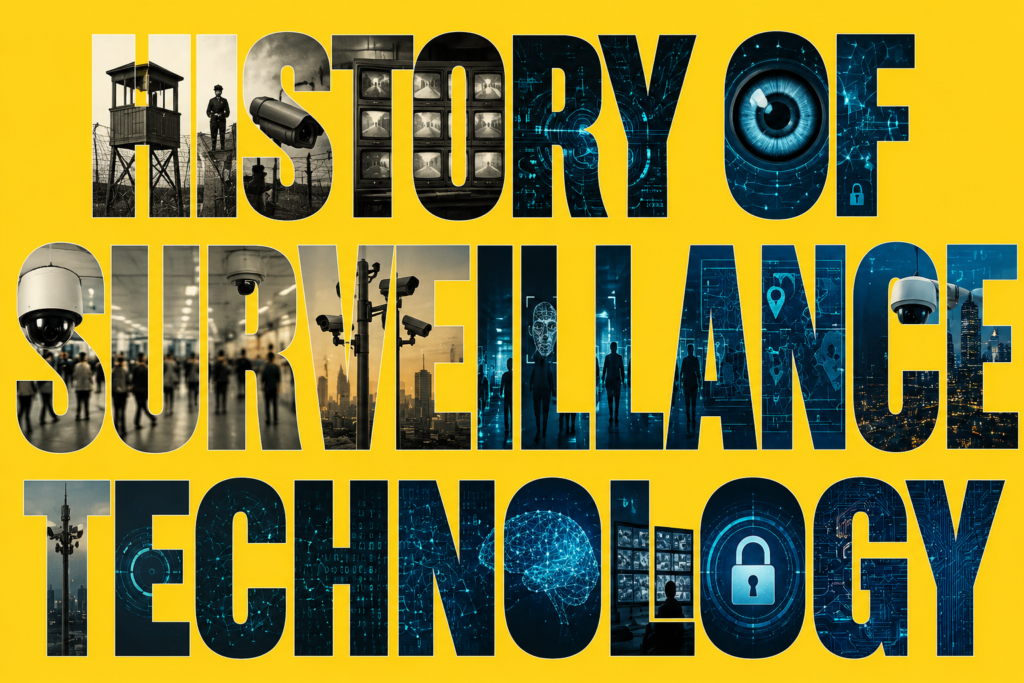
The history of surveillance technology is a fascinating tale of human innovation and the relentless pursuit of security. What began as simple mechanical observation has blossomed into an era defined by artificial intelligence and automated systems. Over the decades, the sheer Evolution of video surveillance systems has drastically altered how governments, businesses, and everyday citizens protect their most valuable assets. By exploring the history of surveillance technology, we can better understand how machines were taught not just to record, but to truly comprehend the visual world around them. This comprehensive journey through time will reveal how From analog tapes to digital video recorders history was replaced by smart, interconnected digital networks capable of astonishing feats. Through the powerful lens of the history of computer vision, we witness a transformation that has fundamentally reshaped our modern existence. Today, an entire global infrastructure relies upon these sophisticated systems, ensuring safety and optimizing operations in ways our ancestors could never have imagined. Understanding the history of surveillance technology is critical as we navigate a future where intelligent cameras are everywhere.
Early Analog Systems (1960 – 1980)
During the mid twentieth century, the history of surveillance technology officially commenced with the introduction of early camera systems. The Closed circuit television CCTV technology history is rooted in this era, heavily relying on bulky cameras and complex physical wiring. Early security personnel spent countless hours sitting inside dark CCTV monitoring centers, staring endlessly at grainy black and white screens. Because of the extreme hardware limitations, Coaxial cable video feeds were incredibly fragile and difficult to maintain over long distances. Cameras of this generation could only passively record; they possessed absolutely zero analytical capabilities. The entire burden of identifying a threat or anomaly fell squarely on human operators, who often suffered from extreme visual fatigue during their long shifts.
Despite these significant technical drawbacks, the foundational concepts of the history of surveillance technology were firmly established during these early decades. The Commercial vs military surveillance tech history diverged slightly here, with the military eagerly adopting these systems for high stakes perimeter defense long before commercial retail stores realized their potential value. Simple, fixed cameras eventually gave way to early motorized systems, paving the way for future developments. However, without any form of artificial intelligence, these analog setups were strictly reactive. They merely documented events as they unfolded, requiring human investigators to manually rewind and review endless hours of tape after a crime had already occurred.
The Digital Transition (1980 – 2000)
The final decades of the twentieth century brought a monumental shift as analog signals were gradually converted into binary code. This crucial period marked a massive turning point for the history of surveillance technology. Digital storage allowed for vastly superior image retention, easier retrieval, and the complete elimination of degrading magnetic tapes. For the very first time, security professionals could instantly skip to a specific date and time without waiting for a physical tape to mechanically rewind. The widespread introduction of Digital IP network cameras revolutionized the industry, allowing video feeds to be securely transmitted over computer networks rather than dedicated physical cables.
As the underlying digital infrastructure significantly improved, the history of object detection slowly began to take its very first rudimentary steps. Programmers started developing basic Motion detection algorithms that could alert a human operator if pixels dramatically changed within a specific frame. While these early software tools were notoriously prone to frustrating false alarms caused by moving shadows or passing animals, they represented the magnificent dawn of automated video analysis. Furthermore, early forms of Automatic number plate recognition ANPR history emerged, allowing law enforcement to automatically scan and log vehicle license plates at border crossings and toll booths. The incredible history of surveillance technology was rapidly moving away from passive observation toward a more active, analytical approach.
Era of Automated Analysis (2000 – 2015)
As the new millennium dawned, the true power of software began to thoroughly dominate the hardware. The History of AI powered security cameras properly began during this dynamic period, driven by massive increases in computer processing speed and the availability of sophisticated algorithms. The integration of advanced Video Content Analytics (VCA) allowed cameras to identify specific parameters, such as a person crossing a virtual tripwire or an object intentionally left behind in a crowded public airport. This period heavily highlighted the fascinating history of facial recognition, as governments and massive corporations invested heavily in algorithms designed to identify individuals in real time.
Simultaneously, the History of facial recognition surveillance networks expanded globally, raising significant operational and ethical questions. As systems grew more intelligent, the debate around facial recognition and privacy became a central, unavoidable topic of public discourse. Citizens rightfully worried about the vast Data retention legal standards required to manage millions of captured faces daily. Yet, the relentless march of the history of surveillance technology continued unabated. Engineers perfected Pan-Tilt-Zoom (PTZ) automated cameras that could mechanically lock onto a suspicious target and seamlessly track their movement across a busy courtyard. The Evolution of public mass surveillance systems accelerated rapidly, transforming major urban centers into heavily monitored digital fortresses. The history of surveillance technology during these fifteen years proved that machines could reliably assist human guards in identifying active threats long before a situation escalated.
Deep Learning and Smart Cities (2015 – 2026)
The last decade has witnessed an absolute explosion in technological capabilities, fundamentally driven by the marvels of deep neural networks. The history of surveillance technology has entered an astonishing new paradigm characterized by proactive intelligence rather than simple reactive observation. Modern intelligent systems utilize powerful Edge AI security processors built directly into the camera chassis, allowing for instantaneous, real time data analysis without ever sending heavy video feeds back to a central server. This incredible leap in localized processing power has birthed the modern Smart city surveillance infrastructure timeline, where traffic lights, security cameras, and environmental sensors all seamlessly communicate via robust Cloud architecture storage.
Today, advanced video understanding in ai enables systems to comprehend complex human interactions. The incredible History of behavioral anomaly detection in surveillance allows modern security grids to instantly flag a person loitering suspiciously near an ATM or a sudden, panicked crowd dispersal in a public square. Furthermore, sophisticated Object tracking re-identification (ReID) algorithms can accurately track a single individual across dozens of entirely different camera feeds, even if the person temporarily disappears from view or changes their jacket. We are currently witnessing the absolute zenith of the history of surveillance technology, where artificial intelligence agents act as autonomous, tireless sentinels. They flawlessly identify potential risks, continuously monitor massive digital environments, and instantly alert human commanders only when absolutely necessary.
FAQs:
What is the core definition of the history of surveillance technology?
It refers to the long, historical progression of tools and systems used to closely monitor people, environments, or specific activities. It officially encompasses everything from the earliest analog closed circuit television cameras to today’s highly advanced, artificial intelligence driven video networks.
How does deep learning actually improve security cameras?
Deep learning algorithms enable modern cameras to intelligently see and understand the environment. Instead of just recording dumb pixels, these neural networks can accurately distinguish between a swaying tree branch, a passing dog, and a human intruder, drastically reducing annoying false alarms.
Are there major privacy concerns with these new systems?
Yes, there are significant and highly valid concerns. As cameras become smarter and more ubiquitous, questions about strict data ownership, facial tracking without active consent, and the potential for severe government overreach are constantly debated by legal scholars worldwide.
Can these intelligent systems prevent crimes before they happen?
While no system is completely psychic, modern AI can actively flag suspicious behavioral patterns, such as someone aggressively pacing outside a restricted door, allowing human guards to immediately intervene before a crime officially occurs.
Conclusion
The vast and remarkable history of surveillance technology beautifully illustrates humanity’s endless desire to create safer, more secure environments. From the incredibly humble beginnings of grainy, black and white analog monitors to the astonishing brilliance of deep learning neural networks, the overarching journey has been truly magnificent. By actively utilizing advanced computer vision technology, modern security systems have completely transcended their original, passive limitations. They no longer simply watch the world; they actively interpret it, analyze it, and continuously protect it with unwavering, flawless precision. As we look boldly toward the future, the ongoing history of surveillance technology promises even more profound integrations of artificial intelligence. While we must continuously balance these incredible advancements with the fundamental human right to privacy, there is absolutely no denying that these intelligent visual systems have permanently and remarkably changed global security forever.