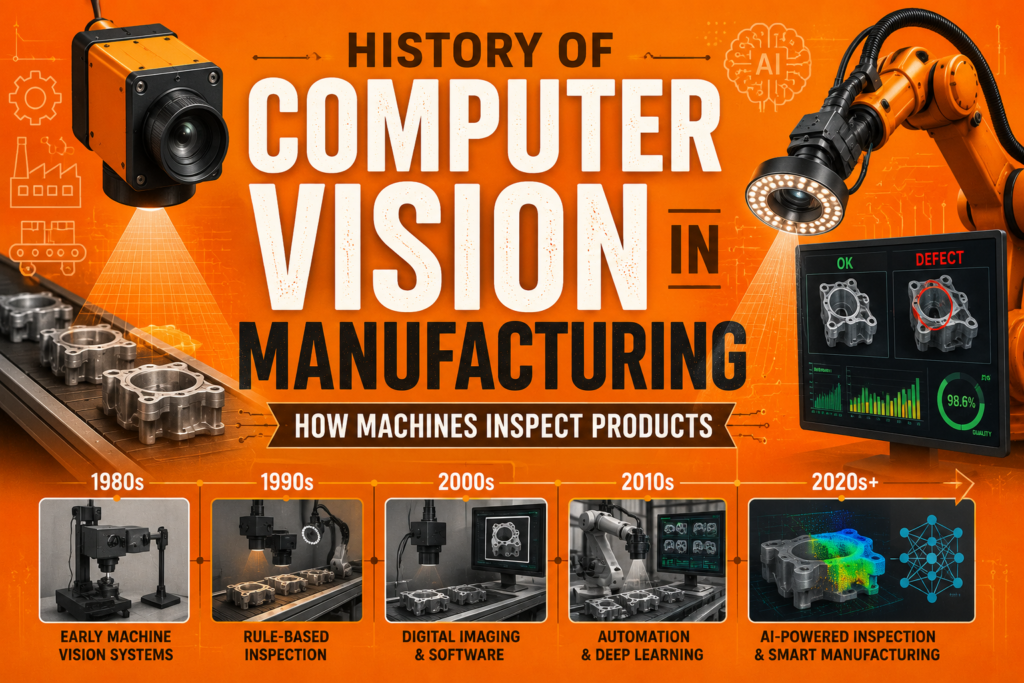
The global industrial sector has witnessed a massive transformation over the past century. One of the most incredible shifts occurred when factories moved away from manual checking and started adopting fully automated systems. At the core of this monumental revolution is computer vision in manufacturing. This amazing capability allows modern factories to automate complex visual tasks that previously required human eyes, saving both time and money. The Industrial applications of computer vision are vast and deeply impactful. From checking microscopic electronic parts to managing heavy automotive assembly operations, the ability of machines to clearly see and analyze has changed everything about production. This deep dive into the past and present reveals how facilities successfully adopted Computer vision for quality control systems. Over many decades, dedicated engineers worked tirelessly to ensure machines could identify flaws instantly. Today, computer vision in manufacturing stands proudly as a pillar of modern production, ensuring supreme safety, rapid speed, and absolute visual precision across the globe.
Early Dawn of Automated Inspection (1960 – 1970)
The long journey began with modest experiments inside specialized academic laboratories. The early years of computer vision in manufacturing were strictly defined by significant hardware limitations and slow processors. Before advanced software existed, eager engineers relied on rudimentary light sensors just to detect the basic presence or absence of a part moving on a conveyor belt. The history of image processing shows that converting a visual scene into usable digital data was incredibly difficult during this era. Computers of the time were massive, hugely expensive, and severely lacked the processing power needed for complex visual analysis.
However, early innovators clearly saw the massive potential for Automated visual inspection in manufacturing. They boldly theorized that if a camera could capture a physical image, a computer could eventually be programmed to analyze it accurately. The initial experimental systems could only process simple binary images, meaning pure black and white without any subtle gray shades or colors. These early technological setups required highly controlled environments to function properly. Even a slight change in the ambient light of the room would cause the entire system to fail completely. Despite these immense and frustrating challenges, the fundamental groundwork was firmly laid for a future where factories would operate with perfect visual accuracy.
Rise of Machine Vision in Assembly (1970 – 1990)
As raw computing power gradually increased through the invention of microprocessors, so did the practical capabilities of factory automation. During this exciting period, the history of edge detection became a critical turning point for programmers. Mathematical algorithms were developed specifically to identify the sharp boundaries of objects within a digital image. This breakthrough allowed early computer systems to calculate basic geometric measurements of physical objects. Machine vision technology on assembly lines began to appear frequently in advanced automotive and electronics factories. These competitive industries demanded extremely high precision, and human workers naturally struggled to maintain visual focus during long, exhausting shifts.
To properly support these new software capabilities, the physical hardware had to evolve rapidly. The brilliant introduction of Telecentric lens setups successfully eliminated annoying perspective distortion, ensuring that parts appeared the exact same size regardless of their physical distance from the camera lens. Additionally, engineers seamlessly integrated Programmable Logic Controllers (PLC) to translate visual digital data into immediate mechanical action. If a smart camera detected a physical flaw, the programmable controller would instantly trigger a mechanical robotic arm to reject the broken part from the line. The History of pick and place robots computer vision highlights how these early visual robotic systems revolutionized factory logistics. This successful integration of cameras and moving robotics marked a definitive and powerful leap forward for computer vision in manufacturing.
Shift to Robust computer vision in manufacturing (1990 – 2010)
The late twentieth century brought a stunning wave of technological standardization and digital growth. The physical hardware matured significantly during this time, making computer vision in manufacturing far more reliable for everyday commercial use. The invention and widespread global adoption of Industrial CMOS image sensors completely replaced older, bulkier, and hotter camera technologies. These modern sensors were exceptionally faster, much cheaper to produce, and captured incredibly clear digital images even in demanding, dusty factory environments. Lighting technology also experienced its own manufacturing revolution. Factories quickly began using Strobe led lighting illumination to effectively freeze the motion of extremely fast moving parts on factory conveyor belts. This clever technique ensured that industrial cameras captured perfectly crisp, clear images without any disruptive motion blur.
Software capabilities simultaneously expanded well beyond simple edge boundary detection into highly complex Pattern matching matching templates. Engineers could now easily teach a computer system what a perfect, flawless part looked like, and the software would meticulously compare every new manufactured part against that ideal digital template. This specific era truly defined how machines learned to see in highly structured industrial environments. The impressive development of Computer vision surface defect detection software allowed manufacturers to reliably spot microscopic scratches on fragile glass or shiny metal surfaces. Furthermore, High speed manufacturing part counting with AI early models also aggressively emerged, drastically improving warehouse inventory management. Factories utilizing Real-time production line inspection could finally achieve unprecedented product throughput rates without ever sacrificing their strict quality standards.
The Deep Learning Revolution (2010 – 2020)
Everything in the industrial sector changed dramatically when deep learning transformed computer vision. Traditional machine vision previously relied heavily on human programmers who had to meticulously and manually define every single rule, threshold, and parameter. If a factory decided to produce a slightly new part, a programmer had to spend several weeks tweaking the heavy software code. Deep learning beautifully eliminated this massive operational bottleneck. Instead of writing rigid mathematical rules, modern engineers fed thousands of digital images directly into a massive neural network. The intelligent system quickly learned to identify subtle defects entirely on its own.
This amazing paradigm shift supercharged computer vision in manufacturing globally. For the very first time, inspection systems could handle immense physical variability with ease. Deep learning anomaly detection in factories quickly became a powerful, necessary tool for identifying unpredictable defects like bizarre unpredictable cracks, strange surface discolorations, or unusual material warping. Even more impressive to the industry was the rapid introduction of Unsupervised anomaly detection, where the artificial intelligence could easily flag strange anomalies without ever seeing that specific defect beforehand. The smart software simply learned what a normal product looked like and instantly flagged anything that deviated from that established norm. Consequently, the ROI of machine vision systems in smart factories skyrocketed seemingly overnight because these incredibly robust AI systems required far less manual maintenance, coding, and daily calibration.
Modern computer vision in manufacturing (2020 – 2030)
Today, the visual inspection technology has reached truly breathtaking levels of speed and sophistication. The modern technological landscape of computer vision in manufacturing is distinctly characterized by extreme operational speed and distributed digital intelligence. Smart cameras for manufacturing logistics now contain their own powerful internal computer processors, totally eliminating the need for bulky, expensive external computer cabinets on the factory floor. This massive shift toward Edge AI deployment devices means that complex image processing happens directly on the physical camera itself. This brilliantly reduces data latency to mere milliseconds.
The extensive history of object detection has brilliantly culminated in dynamic algorithms that can instantly identify, flawlessly classify, and accurately track dozens of overlapping physical parts simultaneously on a chaotic, fast paced production line. Manufacturers now heavily rely on these automated systems to rigorously verify strict Dimensional accuracy tolerances, confidently ensuring that critical aerospace components and delicate medical devices are manufactured to the exact required micrometer. The ultimate financial and operational goal for many modern global facilities is achieving a highly coveted Zero defect manufacturing strategy, and advanced automated visual inspection is currently the only realistic way to reach that incredibly ambitious target. By successfully combining incredible digital hardware with brilliant artificial intelligence, computer vision in manufacturing practically guarantees that only flawless, safe products ever reach the hands of the consumer market.
FAQs
What exactly does computer vision in manufacturing involve on a daily basis?
It involves actively utilizing advanced digital cameras, specialized industrial lighting, and powerful artificial intelligence software to fully automate necessary visual checks on a busy production line. Instead of human workers staring blankly at moving parts for hours, the automated system captures high resolution digital images and analyzes them instantly for any potential defects, scratches, or sizing anomalies.
Why is computer vision in manufacturing considered so universally important today?
It is critically important because it virtually eliminates normal human error and natural physical fatigue. A well maintained machine can carefully inspect thousands of parts at incredibly high speeds twenty four hours a day without ever losing focus or getting tired. This directly leads to significantly higher product quality, vastly less material waste, and ultimately much safer final products for everyday consumers.
How expensive is it for a company to implement computer vision in manufacturing?
While the required initial financial investment in specialized hardware and custom software can be quite significant for a small business, the long term financial returns are genuinely massive. By automatically catching expensive defects early, completely preventing disastrous product recalls, and dramatically increasing daily production speed, modern factories very quickly recover their initial setup costs. The ongoing financial benefits of these brilliant automated systems are widely recognized and celebrated across all major global industries.
Can computer vision in manufacturing completely replace all human factory workers?
No, these specific automated systems are intentionally designed to strongly augment and assist human labor, not effectively replace it entirely. They are built to flawlessly handle the highly repetitive, visually strenuous, and often dangerous tasks of high speed part inspection. This clever implementation actually allows valuable human workers to safely transition into much more strategic, comfortable roles, such as directly managing the AI technology, maintaining the robotic hardware, and intelligently overseeing complex operational factory logistics.
Conclusion
The incredibly fascinating evolution of automated visual systems clearly proves that technological innovation never truly stops. From very early, basic experiments with rudimentary light sensors to modern, brilliant neural networks instantly identifying microscopic flaws, the historical journey has been nothing short of deeply spectacular. The massive global impact of computer vision in manufacturing is heavily felt across absolutely every major commercial industry, from heavy automotive assembly lines to delicate pharmaceutical pill packaging facilities. It has fundamentally and permanently altered how physical goods are produced, consistently ensuring unprecedented and amazing levels of product quality and consumer safety. As we eagerly look toward the next exciting technological decade, the continuous, aggressive refinement of computer vision technology will undoubtedly drive smart factories even closer to perfect operational efficiency. The long held dream of a fully automated, flawlessly accurate production line is officially no longer just hopeful science fiction. It is the highly brilliant, highly profitable reality of modern industrial engineering, heavily promising a bright future where manufactured goods are always consistently exceptional.