For centuries, scientists assumed that energy behaved like water flowing from a tap, smooth, continuous, and infinitely divisible. You could always take half of it, then half again, forever, without ever hitting a bottom. Then, in 1900, German physicist Max Planck shattered that assumption with a single, startling idea. He proved that energy quanta, not smooth continuous flow, are the true building blocks of energy in nature.
This discovery did not just tweak an existing theory. It rewrote the rulebook of physics entirely. Understanding energy quanta means understanding one of the most important turning points in scientific history, a moment when physicists realized that reality, at its smallest scales, is not smooth at all. It is broken into tiny, indivisible pieces.
What Are Energy Quanta? A Clear Definition
In the simplest terms, energy quanta are the smallest possible discrete units in which energy can be emitted, absorbed, or transferred. The word “quantum” comes from the Latin word for “how much,” and it refers to a fixed, indivisible amount.
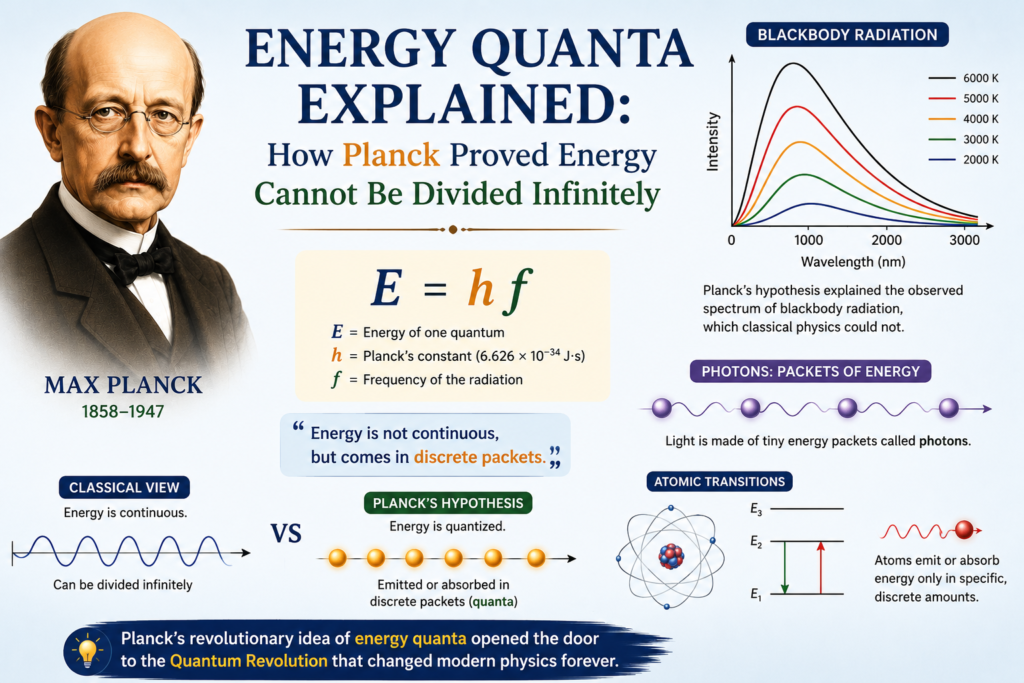
Before this concept existed, physicists believed energy could take on any value along a continuous scale, similar to a dial that could be turned to any position. Energy quanta challenged this directly, proposing instead that energy behaves more like coins in a jar than water in a stream. You cannot have half a coin. Similarly, at the quantum level, you cannot have half a quantum of energy.
This idea of energy quanta became the seed from which all of quantum mechanics eventually grew.
The Problem That Forced Scientists to Rethink Energy (1859 – 1900)
To understand why energy quanta were even proposed, you need to understand the scientific crisis that came before them. In the late nineteenth century, physicists were struggling with the blackbody radiation problem, a puzzle involving how idealized objects emit radiation based purely on temperature.
Classical physics predicted that as wavelength decreased toward the ultraviolet range, a blackbody should emit infinite energy, an obviously impossible result known as the ultraviolet catastrophe. Real world experiments showed nothing of the sort. Something in the classical model was fundamentally broken, and no amount of mathematical adjustment could fix it using continuous energy models alone.
Physicists needed an entirely new way of thinking about energy, one that could explain why nature refused to produce infinite results.
Planck’s Breakthrough: Introducing Energy Quanta (1900)
Max Planck, working through this problem using tools borrowed from statistical mechanics, proposed something radical in December 1900. He suggested that energy is not exchanged in a smooth, continuous stream, but only in fixed, discrete packets, which he called energy quanta.
Each quantum carries a specific amount of energy determined by its frequency, expressed through the now legendary equation:
E = hν
In this formula, E represents the energy of a single quantum, ν (the Greek letter nu) represents frequency, and h is planck’s constant, a fundamental number with an approximate value of 6.626 × 10⁻³⁴ joule seconds.
This equation was revolutionary because it directly linked energy to frequency in fixed, indivisible steps. It meant that energy quanta could not be split into smaller and smaller pieces indefinitely. There was a fundamental limit, a smallest possible unit, and that limit was defined by planck’s constant itself.
Why Energy Cannot Be Divided Infinitely
Classical physics assumed that if you kept dividing energy into smaller and smaller portions, you could continue forever, approaching zero but never quite reaching a true minimum unit. Energy quanta proved otherwise.
Because energy is quantized according to E = hν, the smallest possible unit of energy at a given frequency is fixed. You cannot have three quarters of a quantum or one third of a quantum at that frequency. Energy exists only in whole number multiples of hν, expressed as:
E = nhν
Where n is a positive integer (1, 2, 3, and so on). This equation shows that energy jumps between discrete values rather than sliding smoothly between them. This was the mathematical proof that energy quanta represent a genuine physical limit, not simply a convenient approximation.
Planck’s Law of Radiation and the Quantization of Energy
To formally resolve the blackbody radiation crisis, Planck developed what is now known as planck’s law of radiation, a formula describing the spectral energy density of a blackbody at any given temperature:
B(ν, T) = (2hν³ / c²) × 1 / (e^(hν / kT) − 1)
Where:
- B(ν, T) is the spectral radiance at frequency ν and temperature T
- h is planck’s constant
- c is the speed of light
- k is the Boltzmann constant
- T is the absolute temperature
This formula matched experimental blackbody data with remarkable accuracy, something classical continuous energy models had completely failed to achieve. Its success depended entirely on accepting that energy quanta, not continuous energy flow, govern how radiation behaves.
From Hypothesis to Reality: The Quantum Hypothesis Confirmed
Planck himself was initially cautious about the implications of energy quanta, treating the idea as a mathematical convenience rather than a literal feature of nature. This cautious proposal became known as the quantum hypothesis, and it took several more years before physicists fully accepted it as physical reality.
In 1905, Albert Einstein extended the concept of energy quanta to explain the photoelectric effect, proposing that light itself travels as discrete packets called photons, each carrying energy according to the same equation, E = hν. This explanation confirmed that energy quanta were not just a mathematical trick for blackbody radiation, but a genuine property of light and matter across many physical phenomena.
Einstein’s work also helped establish the concept of wave-particle duality, showing that light can behave as both a continuous wave and as discrete energy quanta, depending on how it is observed and measured.
Energy Quanta in Atomic Structure
Niels Bohr later applied the concept of energy quanta to atomic structure, proposing that electrons within atoms can only occupy specific, discrete energy levels rather than any arbitrary value. When electrons move between these levels, they emit or absorb energy quanta in the form of photons, with energy differences precisely matching the gap between allowed levels.
This discovery explained atomic transitions and spectral lines that classical physics could never account for, further reinforcing the reality of energy quanta at the atomic scale.
Macro World vs Micro World: Why We Don’t Notice Energy Quanta
Because planck’s constant is so extraordinarily small, the effects of energy quanta are completely invisible in everyday macroscopic life. A thrown ball or a burning candle appears to release energy smoothly, not in visible discrete jumps. This is because the individual quanta involved are so numerous and so small that they blend together into what appears to be continuous behavior.
At the atomic and subatomic scale, however, energy quanta become the dominant and unavoidable reality. This distinction between macro and micro physics is one of the most important legacies of Planck’s original discovery, and it defines the boundary between classical and quantum physics.
The Legacy: Max Planck Quantum Universe
The discovery of energy quanta gave birth to what is often called the Max Planck Quantum Universe, a reality built not on smooth continuity, but on discrete, indivisible steps at its most fundamental level. This shift transformed physics permanently, paving the way for quantum mechanics, semiconductor technology, laser systems, and modern quantum computing research that continues to this day.
Frequently Asked Questions
What are energy quanta in simple terms?
Energy quanta are the smallest possible discrete units of energy that can be emitted or absorbed, rather than energy flowing continuously as classical physics once assumed.
Who discovered energy quanta?
Max Planck introduced the concept of energy quanta in 1900 while solving the blackbody radiation problem, marking the beginning of quantum mechanics.
Why can’t energy be divided infinitely?
According to quantum theory, energy exists only in fixed multiples of hν, meaning there is a smallest possible unit at any given frequency. This prevents energy from being divided into arbitrarily small amounts.
How are energy quanta related to photons?
Photons are packets of light energy that exist as individual energy quanta, each carrying energy calculated using the formula E equals h times frequency.
Why don’t we notice energy quanta in daily life?
Because planck’s constant is extremely small, quantum effects are only noticeable at atomic and subatomic scales. In everyday macroscopic objects, countless quanta blend together, appearing smooth and continuous.
Conclusion
The discovery of energy quanta stands as one of the most transformative moments in the history of science. What began as a mathematical solution to a stubborn radiation problem revealed a truth about the universe that no one had previously imagined: energy is not infinitely divisible. It exists in discrete, indivisible steps, governed by a fundamental constant that connects frequency directly to energy. This single insight didn’t just solve a nineteenth century puzzle, it opened the door to an entirely new understanding of reality, one where the smallest details of the universe operate on rules unlike anything classical physics had ever predicted.