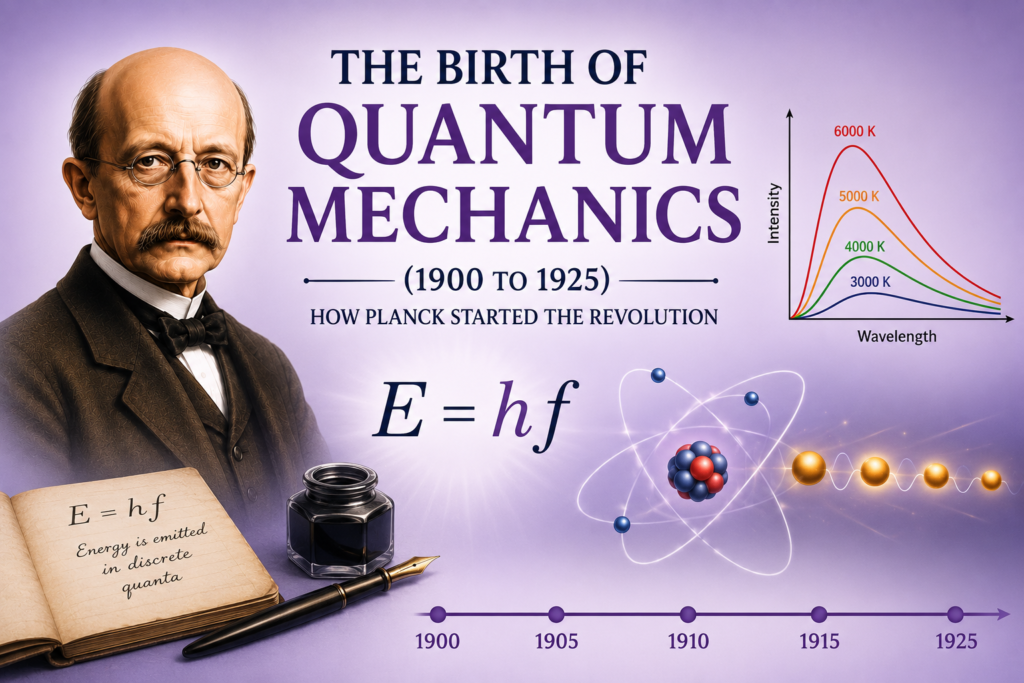
Every great scientific revolution has a starting point, a single moment where the old rules stop working and something entirely new begins. For physics, that moment arrived in December 1900. The birth of quantum mechanics did not happen overnight, nor was it the work of a single genius acting alone. It unfolded over twenty five transformative years, beginning with a reluctant German physicist and ending with a complete reimagining of how the universe works at its smallest scales.
Understanding the birth of quantum mechanics means tracing a remarkable chain of discoveries, from Max Planck’s original breakthrough through Einstein, Bohr, Heisenberg, de Broglie, and Schrödinger, each building on the last until an entirely new branch of physics emerged.
Setting the Stage: Classical Physics Before 1900
Before we can explore the birth of quantum mechanics, it helps to understand the world it replaced. By the late nineteenth century, physicists believed classical physics, built on Newtonian mechanics and Maxwell’s equations for electromagnetic waves, could explain virtually everything in the universe. Energy was assumed to be smooth and continuous. Motion was deterministic and predictable.
This confidence was shattered by a stubborn puzzle known as the blackbody radiation problem, which involved predicting how much energy an idealized object emits at different wavelengths based purely on temperature. Classical equations predicted nonsensical results at short wavelengths, forecasting infinite energy output, a failure so glaring it became known as the ultraviolet catastrophe. Something in classical physics was fundamentally broken.
1900: Planck’s Breakthrough and the True Birth of Quantum Mechanics
The actual birth of quantum mechanics traces back to December 14, 1900, when Max Planck presented a radical solution to the German Physical Society. Instead of assuming energy could be emitted continuously, Planck proposed that energy is exchanged only in fixed, discrete packets, which he called quanta.
This became known as the quantum hypothesis, and it introduced a groundbreaking equation:
E = hν
Here, E represents the energy of a quantum, ν (nu) is frequency, and h is a newly introduced fundamental constant, later named planck’s constant, with an approximate value of 6.626 × 10⁻³⁴ joule seconds. Using this assumption, Planck derived his now famous law of radiation:
B(ν, T) = (2hν³ / c²) × 1 / (e^(hν / kT) − 1)
This formula finally matched experimental blackbody data with precision, resolving the ultraviolet catastrophe and marking the true starting point in the birth of quantum mechanics, even though Planck himself was initially hesitant to accept the full physical implications of his own idea.
1905: Einstein Expands the Quantum Idea
Five years after Planck’s original proposal, Albert Einstein took the concept significantly further. In 1905, Einstein applied energy quantization to light itself, explaining the photoelectric effect by proposing that light travels as discrete packets called photons.
The relationship between planck and einstein became central to legitimizing quantum theory during this early period. While Planck remained cautious, Einstein treated energy quanta as a genuine physical reality, using the same E = hν relationship to show that photons striking a metal surface could eject electrons only if their frequency exceeded a certain threshold, regardless of light intensity. This discovery, which classical wave theory could not explain, helped confirm that the birth of quantum mechanics was rooted in real, observable physics.
1913: Bohr’s Atomic Model and Quantized Orbits
In 1913, Danish physicist Niels Bohr extended quantum ideas to atomic structure, proposing that electrons orbit the nucleus only at specific, discrete energy levels rather than at arbitrary distances. When electrons jump between these levels, they emit or absorb energy quanta as photons, with energy differences precisely matching the gap between allowed orbits.
The niels bohr atom model successfully explained the previously mysterious spectral lines of hydrogen, providing further powerful evidence that nature operates according to quantized rules rather than smooth classical behavior. This period is often referred to by historians as the era of old quantum theory, a transitional phase in the birth of quantum mechanics.
1911 to 1927: The Solvay Conferences and Growing Consensus
Throughout the early twentieth century, the world’s leading physicists gathered at the famous solvay conference meetings in Brussels to debate and refine emerging quantum ideas. These gatherings, attended by Planck, Einstein, Bohr, and later Heisenberg and Schrödinger, became legendary venues where the foundations of quantum theory were fiercely argued and gradually solidified.
These conferences played a crucial role in transforming isolated discoveries into a unified, accepted framework, pushing the quantum revolution from a collection of strange observations into a coherent scientific discipline.
1923 to 1924: De Broglie and Wave-Particle Duality
In 1923, French physicist Louis de Broglie proposed a startling idea, that not only does light behave as both a wave and a particle, but matter itself, including electrons, exhibits this same dual nature. This concept, known as wave-particle duality, suggested that every particle has an associated wavelength determined by its momentum.
De Broglie’s hypothesis was later confirmed experimentally and became a cornerstone of modern quantum theory, further deepening the strange and counterintuitive picture emerging from the birth of quantum mechanics.
1925 to 1926: Heisenberg, Schrödinger, and the Formal Theory
The birth of quantum mechanics reached its mathematical maturity between 1925 and 1926. German physicist Werner Heisenberg developed what became known as matrix mechanics, a formal mathematical framework describing quantum systems using arrays of numbers rather than classical trajectories.
Shortly afterward, Austrian physicist Erwin Schrödinger introduced an alternative approach using wave functions, now known as the schrödinger wave equation. Remarkably, these two seemingly different formulations were later proven mathematically equivalent, giving physicists two complementary ways of describing the same underlying quantum reality.
Together with Bohr’s later contributions to interpretation, known as the copenhagen interpretation, these developments completed the transition from Planck’s original quantum hypothesis into a fully formed scientific theory.
Why This 25 Year Period Changed Physics Forever
The birth of quantum mechanics between 1900 and 1925 fundamentally altered how scientists understand reality. Classical determinism gave way to probability. Continuous energy gave way to discrete quanta. Solid, predictable trajectories gave way to wave-particle duality and inherent uncertainty.
This transformation did not happen through a single discovery, but through a quarter century of collaborative struggle among some of history’s greatest scientific minds, each contributing a critical piece to an increasingly complex and astonishing puzzle.
The Legacy: Max Planck Quantum Universe
The world that emerged from this twenty five year journey is often described as the Max Planck Quantum Universe, a reality governed by discrete energy levels, probabilistic behavior, and principles that seemed almost unimaginable before 1900. This universe now forms the foundation of modern electronics, computing, chemistry, and ongoing quantum computing research that continues to expand upon these original early twentieth century discoveries.
Frequently Asked Questions
When did the birth of quantum mechanics actually begin?
The birth of quantum mechanics is generally traced to December 1900, when Max Planck introduced the concept of energy quanta to solve the blackbody radiation problem.
Who were the key contributors to the birth of quantum mechanics?
Major contributors include Max Planck, Albert Einstein, Niels Bohr, Louis de Broglie, Werner Heisenberg, and Erwin Schrödinger, each building on previous discoveries between 1900 and 1926.
What is the difference between old quantum theory and modern quantum mechanics?
Old quantum theory refers to early ideas from Planck and Bohr that quantized energy without a complete mathematical framework. Modern quantum mechanics, developed by Heisenberg and Schrödinger, provided a fully consistent mathematical theory.
Why is 1925 considered a turning point in quantum physics?
By 1925, Heisenberg’s matrix mechanics and Schrödinger’s wave equation provided the first complete, mathematically rigorous formulations of quantum theory, completing the transition from early quantum hypotheses to a mature science.
What role did the Solvay Conferences play in quantum theory?
The Solvay Conferences brought together leading physicists to debate and refine quantum ideas, helping transform isolated discoveries into a widely accepted, unified scientific framework.
Conclusion
The birth of quantum mechanics stands as one of the most remarkable achievements in the history of science, unfolding gradually over twenty five extraordinary years. What began as Max Planck’s reluctant solution to a stubborn radiation problem grew, through the contributions of Einstein, Bohr, de Broglie, Heisenberg, and Schrödinger, into a complete scientific revolution. This journey from 1900 to 1925 did not just solve old problems, it revealed an entirely new layer of reality, one built on discrete quanta, probability, and duality that continues to shape science and technology to this day.